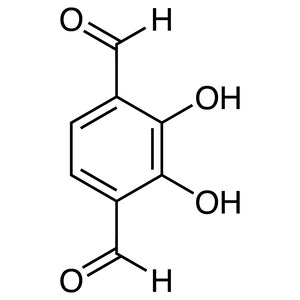
2,4-Dihydroxybenzene-1,3,5-tricarbaldehyde is a versatile chemical compound widely used in laboratory settings for the synthesis of complex molecules. As a key building block in organic chemistry, it serves as a foundational element in the development of various chemical structures. Its unique aromatic structure and functional groups make it an essential reagent for chemists engaged in synthetic processes. This compound is commonly utilized in research aimed at creating new compounds with specific properties, such as pharmaceuticals and industrial chemicals. Its role in laboratory work is critical due to its ability to participate in multiple reaction types, including substitution and condensation reactions.
The compound’s reactivity and structural stability make it a preferred choice for synthetic chemists. Its aromatic ring and multiple carboxaldehyde groups provide multiple sites for functional group modifications, enabling the creation of diverse molecular architectures. The presence of hydroxyl groups further enhances its reactivity, allowing it to interact with a wide range of reagents. These properties make it suitable for use in both academic and industrial research environments. Its ability to form stable intermediates during chemical reactions also contributes to its popularity in laboratory applications.
In Indonesian laboratories, 2,4-Dihydroxybenzene-1,3,5-tricarbaldehyde is widely used in organic chemistry research and the synthesis of complex compounds. It is commonly found in university laboratories and research institutions where scientists work on developing new chemical compounds. Its availability and reliability make it a go-to reagent for researchers seeking to create compounds with specific functional properties. Its application in the synthesis of pharmaceuticals and industrial chemicals further underscores its importance in the Indonesian scientific community.
Advantages (TCI brochure)
- Allows the synthesis of β-ketoenamine-linked COFs.
- The properties of COFs can be modified by the quantity of hydroxyl groups.
TCI brochures (PDF)
- Aldehyde Linkers for β-Ketoenamine Linked Covalent Organic Frameworks (COFs) 2024-01-16 · p. 1
- Diurea Linkers for the Synthesis of Reconstructed COFs 2024-08-19 · p. 1
- Covalent Organic Framework (COF) Linkers 2026-05-18 · p. 5
Related TCI products
- TCI H1651 81502-74-1 2-Hydroxy-1,3,5-benzenetricarbaldehyde
- TCI B6003 3163-76-6 Benzene-1,3,5-tricarbaldehyde
- TCI T4301 680575-17-1 2,4,6-Trimethoxybenzene-1,3,5-tricarbaldehyde
- TCI T3688 34374-88-4 2,4,6-Triformylphloroglucinol
- TCI D6102 179693-85-7 2,3-Dimethoxyterephthalaldehyde
- TCI F0310 3328-70-9 4-Hydroxyisophthalaldehyde
- Organic synthesis projects benefit from this compound due to its ability to form stable intermediates and participate in various reaction mechanisms.
- Pharmaceutical research utilizes it for the development of new drug compounds through functional group modifications and structural diversification.
- Industrial chemical production relies on its reactivity to create complex molecules with specific chemical properties and applications.
- Academic research institutions use it as a fundamental building block for teaching and experimental purposes in synthetic chemistry courses.
- Polymer science applications take advantage of its aromatic structure to create materials with enhanced chemical and thermal stability.
| Brand | TCI |
|---|---|
| CAS number | 58343-11-6 |
| Molecular formula | — |
| Purity | — |
| Category | Chemistry > Building Blocks > Non-Heterocyclic Building Blocks |
| Pack sizes | Available in various quantities as per supplier specifications |
| Physical form | Solid, crystalline appearance |
| Storage | Store in a cool, dry place away from direct sunlight and moisture |
Data from the TCI brochure
| Kemasan | 1g / 5g |
|---|
Source: TCI brochure FF162 (2024-01-16)
This compound should be stored in a cool, dry environment to maintain its chemical integrity and prevent degradation. It is recommended to use airtight containers to protect it from moisture and air exposure. Due to its reactivity, it should be handled in a well-ventilated laboratory setting to minimize inhalation risks. Proper personal protective equipment, such as gloves and safety goggles, should be worn when handling the compound. It should be kept away from incompatible substances, such as strong oxidizers, to ensure safe storage. Regular monitoring of storage conditions is essential to maintain the compound's stability and effectiveness in laboratory applications.
—
Product Categories
- Material Building BlocksCovalent Organic Frameworks (COFs) LinkersAldehyde Linkers [Covalent Organic Frameworks (COFs) Linkers]
- Polymer/Macromolecule ReagentsCovalent Organic Frameworks (COFs) LinkersAldehyde Linkers [Covalent Organic Frameworks (COFs) Linkers]
- Polymer/Macromolecule ReagentsDendrimer Building Blocks
Produk Terkait
-
2-Hydroxy-1,3,5-benzenetricarbaldehyde TCI H1651
Regular price Rp 4.695.000,00Regular priceRp 3.195.000,00Sale price Rp 4.695.000,00 -
Benzene-1,3,5-tricarbaldehyde TCI B6003
Regular price From Rp 1.921.000,00Regular priceRp 1.306.000,00Sale price From Rp 1.921.000,00 -
2,4,6-Trimethoxybenzene-1,3,5-tricarbaldehyde TCI T4301
Regular price From Rp 3.088.000,00Regular priceRp 2.101.000,00Sale price From Rp 3.088.000,00 -
2,4,6-Triformylphloroglucinol TCI T3688
Regular price From Rp 2.154.000,00Regular priceRp 1.465.000,00Sale price From Rp 2.154.000,00 -
2,3-Dimethoxyterephthalaldehyde TCI D6102
Regular price From Rp 3.165.000,00Regular priceRp 2.153.000,00Sale price From Rp 3.165.000,00 -
4-Hydroxyisophthalaldehyde TCI F0310
Regular price From Rp 3.062.000,00Regular priceRp 2.083.000,00Sale price From Rp 3.062.000,00 -
2,3-Dihydroxyterephthalaldehyde TCI D6103
Regular price From Rp 2.128.000,00Regular priceRp 1.448.000,00Sale price From Rp 2.128.000,00 -
2,5-Dihydroxyterephthalaldehyde TCI D5510
Regular price From Rp 3.554.000,00Regular priceRp 2.418.000,00Sale price From Rp 3.554.000,00