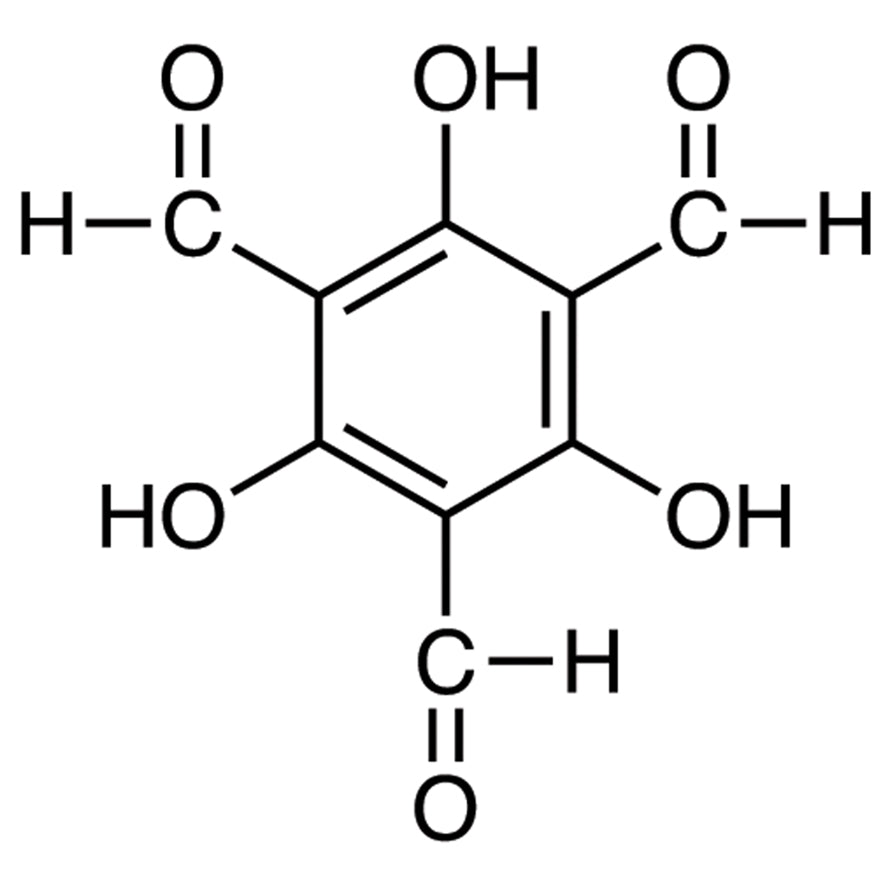
2,4,6-Triformylphloroglucinol, often abbreviated as Tp in the literature, is a phloroglucinol derivative with three aldehyde groups and three hydroxyl groups arranged alternately around a benzene ring. This three-fold symmetry has made it one of the most widely used node monomers in the synthesis of Covalent Organic Frameworks (COFs). In the laboratory, it serves as a building unit for porous, crystalline and stable two-dimensional networks. It is also used as a precursor for imine-based ligands and functional materials.
Researchers choose this compound mainly because it forms β-ketoenamine-linked COFs. When the aldehyde groups react with amines to form imines, the neighbouring hydroxyl groups drive an irreversible enol-to-keto tautomerization. The resulting framework is much more stable in water, acid and base than a conventional imine-linked COF. Because of this chemical stability, Tp-based COFs are widely used in aqueous settings such as separation, pollutant adsorption and photocatalysis. Its classic partner is 1,4-Phenylenediamine, which together with Tp forms the widely cited TpPa material.
In Indonesia, interest in porous materials such as COFs continues to grow in university chemistry and materials science departments and in research institutes. Laboratories working on porous framework synthesis, adsorbents for water treatment and photocatalytic materials use this TCI building block as a dependable starting material. It suits student thesis projects as well as funded research programmes that need reproducible monomers from an established reagent brand.
Advantages (TCI brochure)
- Allows the synthesis of β-ketoenamine-linked COFs.
- The properties of COFs can be modified by the quantity of hydroxyl groups.
TCI brochures (PDF)
- Aldehyde Linkers for β-Ketoenamine Linked Covalent Organic Frameworks (COFs) 2024-01-16 · p. 1
- Diurea Linkers for the Synthesis of Reconstructed COFs 2024-08-19 · p. 1
- 2,2'-Bipyridine Linkers for the Synthesis of COFs 2026-08-25 · p. 1
- Covalent Organic Framework (COF) Linkers 2026-05-18 · p. 2
Related TCI products
- TCI D6102 179693-85-7 2,3-Dimethoxyterephthalaldehyde
- TCI D6046 58343-11-6 2,4-Dihydroxybenzene-1,3,5-tricarbaldehyde
- TCI H1651 81502-74-1 2-Hydroxy-1,3,5-benzenetricarbaldehyde
- TCI F0310 3328-70-9 4-Hydroxyisophthalaldehyde
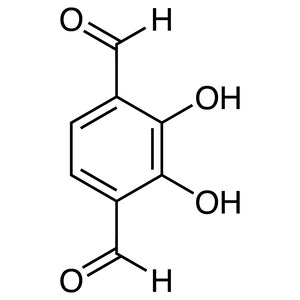
- TCI D6103 148063-59-6 2,3-Dihydroxyterephthalaldehyde
- TCI D5510 1951-36-6 2,5-Dihydroxyterephthalaldehyde
- COF synthesis: the three aldehyde groups arranged symmetrically on the ring make it a natural three-way node for building ordered, crystalline two-dimensional porous networks with diamine linkers.
- β-ketoenamine framework preparation: the hydroxyl groups next to each aldehyde trigger irreversible enol-keto tautomerization, which gives frameworks that hold up in water, acid and base.
- Separation and pollutant adsorption research: Tp-based COFs stay stable in aqueous environments, so they can be tested as adsorbents and separation media for water-related studies.
- Photocatalysis studies: the chemically robust β-ketoenamine frameworks made from this monomer suit photocatalytic experiments carried out in water or other demanding reaction media.
- Ligand and functional material precursor: the reactive aldehyde groups readily condense with amines, so the compound works as a starting point for imine-based ligands and other functional organic materials.
From the TCI brochure
- Synthesis of COFs
| Brand | TCI (product code T3688) |
|---|---|
| CAS number | 34374-88-4 |
| Molecular formula | — |
| Purity | — |
| Category | Chemistry > Building Blocks > Non-Heterocyclic Building Blocks |
| Pack sizes | as listed in the variant options on this page |
| Physical form | refer to the TCI product specification and Certificate of Analysis |
| Storage | follow the storage conditions stated on the product label and the Safety Data Sheet (SDS) |
Data from the TCI brochure
| Kemasan | 200mg / 1g |
|---|
Source: TCI brochure FF162 (2024-01-16)
Keep 2,4,6-Triformylphloroglucinol in its original, tightly closed container in a cool, dry and well-ventilated area, away from heat sources, direct sunlight and incompatible substances such as strong oxidizing agents. Follow the specific temperature and atmosphere recommendations on the TCI label and SDS. Because the compound carries reactive aldehyde groups, limit its exposure to moisture and air, and reseal the container promptly after each use. Handle the material in a fume hood or well-ventilated workspace, and wear standard protective equipment, including a lab coat, safety glasses and chemical-resistant gloves. Avoid creating or inhaling dust, and wash your hands thoroughly after handling. Dispose of residues and contaminated materials according to your institution's chemical waste procedures and local regulations.
—
Product Categories
- Material Building BlocksCovalent Organic Frameworks (COFs) LinkersAldehyde Linkers [Covalent Organic Frameworks (COFs) Linkers]
- Polymer/Macromolecule ReagentsCovalent Organic Frameworks (COFs) LinkersAldehyde Linkers [Covalent Organic Frameworks (COFs) Linkers]
- Polymer/Macromolecule ReagentsDendrimer Building Blocks
Produk Terkait
-
2,3-Dimethoxyterephthalaldehyde TCI D6102
Regular price From Rp 3.232.950,00Regular priceRp 2.260.650,00Sale price From Rp 3.232.950,00 -
2,4-Dihydroxybenzene-1,3,5-tricarbaldehyde TCI D6046
Regular price From Rp 2.625.000,00Regular priceRp 1.835.400,00Sale price From Rp 2.625.000,00 -
2-Hydroxy-1,3,5-benzenetricarbaldehyde TCI H1651
Regular price Rp 4.797.450,00Regular priceRp 3.354.750,00Sale price Rp 4.797.450,00 -
4-Hydroxyisophthalaldehyde TCI F0310
Regular price From Rp 3.127.950,00Regular priceRp 2.187.150,00Sale price From Rp 3.127.950,00 -
2,3-Dihydroxyterephthalaldehyde TCI D6103
Regular price From Rp 2.174.550,00Regular priceRp 1.520.400,00Sale price From Rp 2.174.550,00 -
2,5-Dihydroxyterephthalaldehyde TCI D5510
Regular price From Rp 3.630.900,00Regular priceRp 2.538.900,00Sale price From Rp 3.630.900,00 -
1,3,5-Tris(4-formylphenyl)benzene TCI F1252
Regular price From Rp 2.625.000,00Regular priceRp 1.835.400,00Sale price From Rp 2.625.000,00 -
2,5-Dimethoxyterephthalaldehyde TCI D6056
Regular price From Rp 1.644.300,00Regular priceRp 1.149.750,00Sale price From Rp 1.644.300,00