

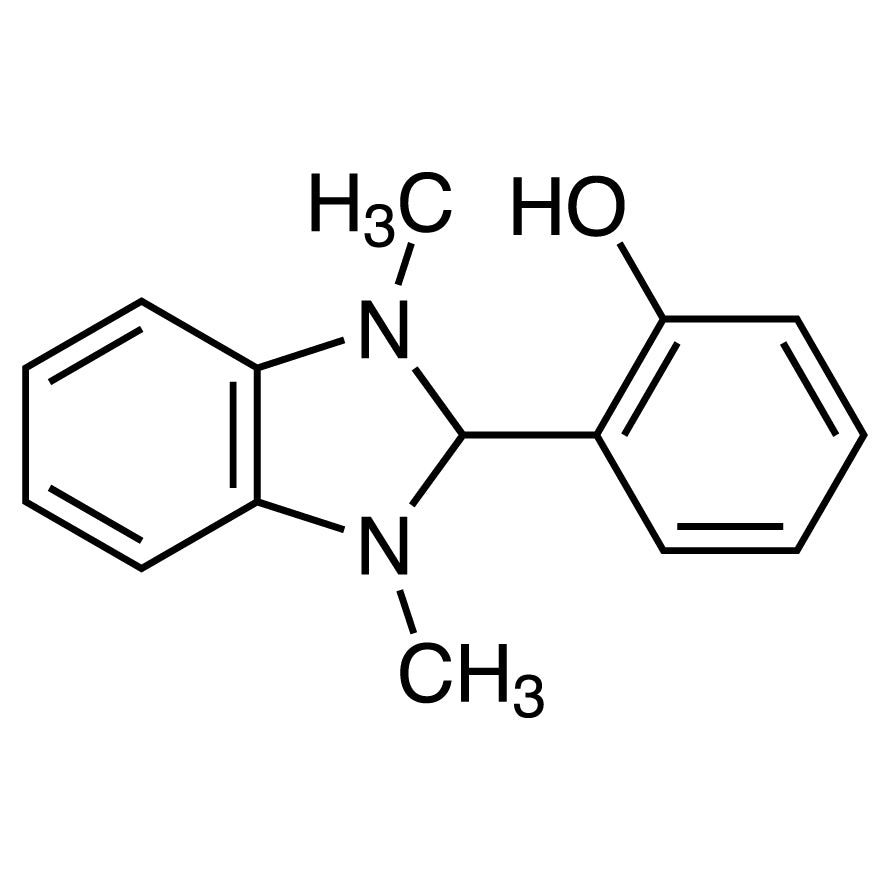
TCI D6193, 2-(1,3-Dimethyl-2,3-dihydro-1H-benzimidazol-2-yl)phenol, is a member of the dihydrobenzimidazole family carrying a phenol group at the two position. The structure combines two functions within a single molecule: a dihydrobenzimidazole core that is recognised as an organic hydride donor, and a phenolic hydroxyl group capable of donating a hydrogen atom. In the laboratory, compounds built on this design are used as mild organic reducing agents, serving as an alternative to metal hydride reagents that are harsh and difficult to control in reactions demanding high selectivity.
The property that makes this compound attractive is the ease with which hydride is released from the two position, a process driven thermodynamically by the formation of a stable aromatic benzimidazolium cation. The neighbouring phenol group adds a second reactivity pathway through hydrogen atom transfer, and that hydroxyl group also allows the formation of an intramolecular hydrogen bond which influences the conformation of the molecule and the ease with which it releases its hydrogen. Because the reagent is molecular and neutral in character, reagents of this type generally operate under milder reaction conditions.
In Indonesian laboratories, materials of this class are typically handled in academic synthetic chemistry groups, university research centres, and industrial research units working on selective organic transformations. Their neutral molecular nature means they are more tolerant of a wide range of functional groups and more easily separated from reaction mixtures than conventional hydride reagents, which suits work carried out on a research scale where selectivity and straightforward work-up matter more than raw reducing power.
Related TCI products
- TCI D6194 2376423-07-1 N,N-Dimethyl-4-(1,3,5,6-tetramethyl-2,3-dihydro-1H-benzimidazol-2-yl)aniline
- TCI D6182 1400191-57-2 4-(1,3-Dimethyl-2,3-dihydro-1H-benzimidazol-2-yl)-N,N-diphenylaniline
- TCI D5944 302818-73-1 4-(1,3-Dimethyl-2,3-dihydro-1H-benzimidazol-2-yl)-N,N-dimethylaniline
- TCI D6596 3418-46-0 1,3-Dimethyl-1,3-dihydro-2H-benzo[d]imidazole-2-thione
- TCI D5423 255901-50-9 3,3-Dimethyl-3,4-dihydro-2H-thieno[3,4-b][1,4]dioxepine
- TCI D4470 3652-92-4 2,3-Dihydro-1,3-dimethyl-2-phenylbenzimidazole
- Mild organic reduction chemistry, where the compound serves as an alternative to harsh metal hydride reagents in transformations that demand a high degree of chemical selectivity.
- Hydride transfer studies, taking advantage of the favourable release of hydride from the two position that is driven by formation of a stable aromatic benzimidazolium cation product.
- Hydrogen atom transfer investigations, since the phenolic hydroxyl group adjacent to the heterocyclic core provides a distinct second reactivity pathway alongside hydride donation.
- Intramolecular hydrogen bonding research, because the phenol hydroxyl can engage the heterocycle and thereby influence molecular conformation and hydrogen releasing behaviour.
- Functional group tolerant synthesis, where the neutral molecular character of the reagent permits milder reaction conditions and simpler separation from the resulting product mixture.
| Brand | TCI |
|---|---|
| CAS number | 3652-93-5 |
| Molecular formula | — |
| Purity | — |
| Category | TCI |
| Pack sizes | available in standard TCI research quantities; please confirm the packing option when ordering |
| Physical form | — |
| Storage | keep in the closed original container under the conditions stated on the manufacturer label |
- Chemical name: 2-(1,3-Dimethyl-2,3-dihydro-1H-benzimidazol-2-yl)phenol
Store the container tightly closed in a cool, dry, and well ventilated place, away from direct sunlight, heat sources, and strong oxidising agents. Keep the material in its original supplier packaging wherever possible, or in a compatible tightly sealed glass container with an inert closure, clearly labelled with the chemical name and CAS number. Handle only in a functioning fume hood using safety glasses, chemically resistant gloves, and a laboratory coat. Avoid generating dust, avoid contact with skin and eyes, and close the container promptly after weighing. Always consult the manufacturer safety data sheet before use and dispose of residues through an approved chemical waste route.
—
Produk Terkait
-
N,N-Dimethyl-4-(1,3,5,6-tetramethyl-2,3-dihydro-1H-benzimidazol-2-yl)aniline TCI D6194
Regular price From Rp 4.743.900,00Regular price -
4-(1,3-Dimethyl-2,3-dihydro-1H-benzimidazol-2-yl)-N,N-diphenylaniline TCI D6182
Regular price From Rp 5.009.550,00Regular price -
4-(1,3-Dimethyl-2,3-dihydro-1H-benzimidazol-2-yl)-N,N-dimethylaniline TCI D5944
Regular price From Rp 5.432.700,00Regular price -
1,3-Dimethyl-1,3-dihydro-2H-benzo[d]imidazole-2-thione TCI D6596
Regular price From Rp 4.108.650,00Regular price -
3,3-Dimethyl-3,4-dihydro-2H-thieno[3,4-b][1,4]dioxepine TCI D5423
Regular price From Rp 2.041.200,00Regular price -
2,3-Dihydro-1,3-dimethyl-2-phenylbenzimidazole TCI D4470
Regular price From Rp 4.056.150,00Regular price -
2,3-Dihydro-2,2-dimethyl-7-hydroxybenzofuran TCI D2154
Regular price From Rp 584.850,00Regular price -
1,3,5-Tris(1-phenyl-1H-benzimidazol-2-yl)benzene TCI T3537
Regular price From Rp 2.068.500,00Regular price


![1,3-Dimethyl-1,3-dihydro-2H-benzo[d]imidazole-2-thione (CAS 3418-46-0) - TCI D6596 - AMI Scientific](http://amiscientific.com/cdn/shop/files/TCI2510D6596.jpg?v=1768818611&width=533)
![3,3-Dimethyl-3,4-dihydro-2H-thieno[3,4-b][1,4]dioxepine (CAS 255901-50-9) - TCI D5423 - AMI Scientific](http://amiscientific.com/cdn/shop/files/TCI2510D5423.jpg?v=1768818413&width=533)


