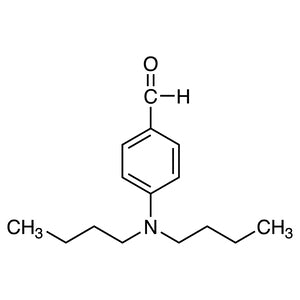
4-(Dibutylamino)benzaldehyde is a chemical compound widely used in organic synthesis reactions within laboratory settings. It serves as a key building block for the development of complex molecules, including pharmaceuticals, pharmacologically active compounds, and industrial chemicals. This compound is particularly valuable due to its ability to participate in various synthetic pathways, making it a versatile tool for chemists. Its role extends beyond simple synthesis, as it can be modified through multiple reaction types to yield a wide range of derivatives.
The compound’s molecular structure is both stable and reactive, allowing it to engage in substitution and condensation reactions efficiently. These properties make it a preferred choice for researchers aiming to construct intricate molecular frameworks. Its chemical stability ensures that it remains effective under a variety of experimental conditions, whether in catalytic or direct reaction environments. Additionally, its resistance to degradation means it can be stored for extended periods when handled properly.
In Indonesian laboratories, 4-(Dibutylamino)benzaldehyde is frequently utilized in organic chemistry research, especially in pharmaceutical and industrial chemistry fields. Researchers and students rely on this compound to develop complex molecular structures, both in small-scale experiments and larger production processes. Its availability and reliability make it a staple in academic and industrial chemical laboratories across Indonesia.
Related TCI products
- Organic synthesis for the creation of complex pharmaceutical compounds due to its reactivity and structural versatility.
- Development of pharmacologically active substances as a precursor in multi-step synthetic routes.
- Industrial chemical production where stable and reactive building blocks are essential for process efficiency.
- Research in medicinal chemistry for the design of novel drug molecules through functional group modification.
- Educational use in academic settings to teach fundamental concepts of organic reaction mechanisms and molecular construction.
| Brand | TCI |
|---|---|
| CAS number | 90134-10-4 |
| Molecular formula | — |
| Purity | — |
| Category | Chemistry > Building Blocks > Non-Heterocyclic Building Blocks |
| Pack sizes | Available in various quantities as per standard laboratory supply sizes |
| Physical form | Solid or liquid, depending on the specific formulation |
| Storage | Store in a cool, dry place away from direct sunlight and incompatible materials |
This compound should be stored in a cool, dry environment to maintain its stability and reactivity. It is recommended to use airtight containers to prevent exposure to moisture and air, which may affect its chemical integrity. Proper labeling of storage containers is essential for safety and traceability. Laboratory personnel should wear appropriate personal protective equipment, such as gloves and safety goggles, when handling this material. It should be kept away from incompatible substances like strong oxidizers or acids. Regular inspection of storage conditions ensures that the compound remains suitable for use in chemical synthesis processes.
—
Produk Terkait
-
4-(Dibutylamino)salicylaldehyde TCI D3260
Regular price Rp 5.380.200,00Regular price -
4-(1,2,2-Triphenylvinyl)benzaldehyde TCI T4136
Regular price Rp 3.790.500,00Regular price -
Benzaldehyde TCI B2379
Regular price Rp 743.400,00Regular price -
4-(Phenylethynyl)benzaldehyde TCI P2975
Regular price From Rp 1.829.100,00Regular price -
2-(Phenylethynyl)benzaldehyde TCI P2914
Regular price Rp 6.228.600,00Regular price -
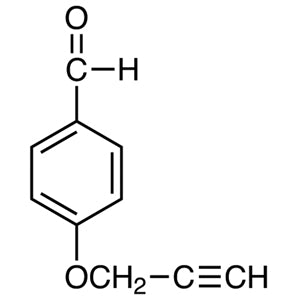
4-(Propargyloxy)benzaldehyde TCI P2339
Regular price From Rp 1.458.450,00Regular price -
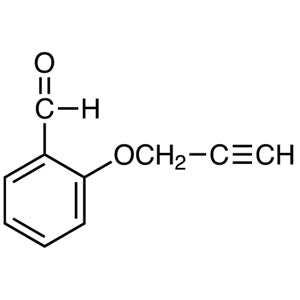
2-(Propargyloxy)benzaldehyde TCI P2338
Regular price From Rp 717.150,00Regular price -
4-Methoxy-3-(methoxymethoxy)benzaldehyde TCI M3066
Regular price Rp 3.976.350,00Regular price