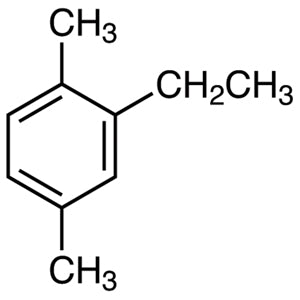
2-Ethyl-p-xylene is a chemical compound widely used as a foundational material in various laboratory reactions. It belongs to the category of non-heterocyclic building blocks, making it a versatile component in the synthesis of complex chemical structures. This compound is commonly employed as a solvent or auxiliary material in chemical processes due to its chemical stability and inert nature. Its role in laboratory settings is critical for maintaining the integrity of chemical reactions and ensuring reproducibility in experimental outcomes.
The properties of 2-Ethyl-p-xylene make it a preferred choice for laboratory use. It exhibits chemical stability and does not readily react with other substances, which enhances its reliability in diverse experimental conditions. Its non-heterocyclic structure ensures it does not participate in reactions involving heterocyclic compounds, making it ideal for applications requiring chemical neutrality. Additionally, its boiling and melting points allow it to be used across a range of reaction conditions, providing flexibility in experimental design.
In Indonesian laboratories, 2-Ethyl-p-xylene is extensively used in chemical research, particularly in the synthesis of organic compounds and the separation of chemical materials. It is a common reagent in both academic and industrial settings, supporting a wide array of chemical processes. Its stability and inertness make it a reliable choice for researchers working on complex chemical reactions and analytical procedures.
- Organic synthesis reactions benefit from 2-Ethyl-p-xylene due to its chemical stability and inert nature, allowing it to act as a non-reactive solvent.
- It is suitable for solvent-based extraction processes because of its ability to dissolve a variety of organic compounds without participating in the reaction.
- In chromatographic techniques, 2-Ethyl-p-xylene serves as a mobile phase due to its low reactivity and compatibility with different stationary phases.
- It is commonly used in distillation and purification steps where a stable and non-reactive solvent is required.
- For analytical purposes, 2-Ethyl-p-xylene is used in spectroscopic and chromatographic analyses as a reference standard due to its consistent properties.
| Brand | TCI |
|---|---|
| CAS number | 1758-88-9 |
| Molecular formula | — |
| Purity | — |
| Category | Chemistry > Building Blocks > Non-Heterocyclic Building Blocks |
| Pack sizes | Available in various quantities as per supplier specifications |
| Physical form | Liquid |
| Storage | Store in a cool, dry place away from direct sunlight and incompatible materials |
2-Ethyl-p-xylene should be stored in a cool, dry environment, away from direct sunlight and sources of heat. It is recommended to use sealed, airtight containers made of materials compatible with organic solvents, such as glass or high-density polyethylene. Due to its low reactivity, it does not require special handling under normal laboratory conditions, but it should be kept away from strong oxidizing agents and incompatible substances. In laboratory settings, proper ventilation is advised when handling this compound to ensure safe working conditions. Always follow standard safety protocols when working with organic solvents to minimize exposure and maintain a safe environment.
—
Produk Terkait
-
4-tert-Butyl-o-xylene TCI B1338
Regular price Rp 1.724.100,00Regular price -
5-tert-Butyl-m-xylene TCI B0965
Regular price From Rp 769.650,00Regular price -
5-Isopropyl-m-xylene TCI I0156
Regular price From Rp 2.597.700,00Regular price -
5-Ethyl-m-xylene TCI E0282
Regular price Rp 5.034.750,00Regular price -
4-Ethyl-o-xylene TCI E0281
Regular price Rp 1.724.100,00Regular price -
3-Ethyl-o-xylene TCI E0280
Regular price Rp 5.539.800,00Regular price -
4-Ethyl-m-xylene TCI E0241
Regular price From Rp 3.605.700,00Regular price -
alpha,alpha'-Bis(4-methylbenzyloxy)-p-xylene TCI B1482
Regular price From Rp 2.254.350,00Regular price