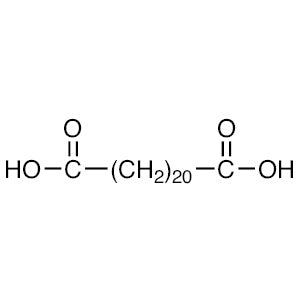
Eicosanedioic Acid (E0320), with CAS number 2424-92-2, is a chemical compound widely used in laboratory settings for its versatility in organic synthesis. As a dicarboxylic acid, it possesses two carboxyl groups at the ends of its molecular structure, making it highly reactive and suitable for a variety of chemical reactions. This compound is commonly found in the chemical supply catalog of AMI Scientific, serving as a fundamental building block for researchers and chemists. Its role in the laboratory is crucial for the development of complex molecules, including polymers, pharmaceuticals, and industrial chemicals.
The unique molecular structure of Eicosanedioic Acid contributes to its popularity among chemists. Its stability allows it to react efficiently with various reagents, making it a preferred choice for both heterocyclic and non-heterocyclic synthesis. The absence of heteroatoms such as nitrogen or oxygen simplifies the synthesis process, ensuring clarity in molecular structure. This characteristic is particularly beneficial in research where precise chemical control is essential. Additionally, its non-toxic nature under normal conditions enhances its safety profile, making it a reliable material for use in controlled laboratory environments.
In Indonesian laboratories, Eicosanedioic Acid is a key component in scientific research, especially in academic and industrial settings. It is frequently used in studies related to organic chemistry, polymer science, and pharmaceutical development. Its availability through AMI Scientific ensures that researchers have access to this essential compound for their experiments and innovations. The compound's reliability and consistent performance make it an indispensable tool in the laboratory.
- Organic synthesis is a primary application where Eicosanedioic Acid serves as a building block for creating complex molecules due to its reactive carboxyl groups.
- Polymer development benefits from this compound as it can be used to create biodegradable or functional polymers through esterification or amidation reactions.
- Pharmaceutical research utilizes Eicosanedioic Acid in the synthesis of drug molecules, particularly those requiring specific molecular structures and functional groups.
- Industrial chemical production relies on this compound for the creation of specialty chemicals, including coatings, adhesives, and lubricants.
- Material science applications involve the use of Eicosanedioic Acid in the development of new materials with tailored properties for various technological applications.
| Brand | TCI |
|---|---|
| CAS number | 2424-92-2 |
| Molecular formula | — |
| Purity | — |
| Category | Chemistry > Building Blocks > Non-Heterocyclic Building Blocks |
| Pack sizes | Available in various quantities as per supplier specifications |
| Physical form | Solid, crystalline appearance |
| Storage | Store in a cool, dry place away from moisture and direct sunlight |
Eicosanedioic Acid should be stored in a cool, dry environment to maintain its chemical stability. It is recommended to use airtight containers to prevent exposure to moisture and contaminants. Since it is non-toxic under normal conditions, it is generally safe to handle, but standard laboratory safety practices should still be followed. Avoid direct contact with skin and inhalation of dust during handling. Ensure proper ventilation in the workspace to minimize any potential risks. Regularly check storage conditions to ensure the compound remains in optimal condition for use in experiments and research.
—
Produk Terkait
-
DocosanedioicAcid TCI D3137
Regular price Rp 7.075.950,00Regular price -
DimethylIcosanedioate TCI E0330
Regular price From Rp 2.969.400,00Regular price -
TetradecanedioicAcid TCI T0704
Regular price From Rp 2.121.000,00Regular price -
TridecanedioicAcid TCI T0021
Regular price From Rp 928.200,00Regular price -
PentadecanedioicAcid TCI P0909
Regular price From Rp 477.750,00Regular price -
HexadecanedioicAcid TCI H0293
Regular price From Rp 1.246.350,00Regular price -
DodecanedioicDihydrazide TCI D2342
Regular price From Rp 769.650,00Regular price -
DodecanedioicAcid TCI D0013
Regular price From Rp 584.850,00Regular price