

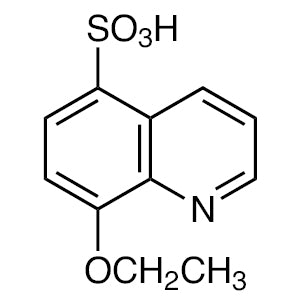
8-Ethoxyquinoline-5-sulfonic Acid is a versatile chemical compound widely used in organic synthesis reactions, particularly in the development of heterocyclic compounds. Its unique molecular structure enables it to participate in various substitution reactions, making it an essential building block for creating complex chemical structures. This compound is commonly found in chemical laboratories as a raw material for constructing molecules with applications in pharmaceuticals, industrial chemicals, and material research. Its role in synthetic pathways is critical for the production of compounds with specific functional groups and structural features.
The compound is valued for its chemical stability under controlled conditions, although it is sensitive to moisture and air exposure. Its polar nature allows it to dissolve in organic solvents such as ethyl acetate and dimethyl sulfoxide, which enhances its utility in laboratory settings. Additionally, its ability to act as an electron donor in specific reactions makes it a preferred choice for heterocyclic synthesis. These properties contribute to its effectiveness in a range of chemical processes and make it a reliable reagent for researchers.
In Indonesian laboratories, 8-Ethoxyquinoline-5-sulfonic Acid is frequently used in applied chemical research, especially in pharmaceutical and material science fields. Research institutions and universities rely on this compound as a key reagent for experiments requiring heterocyclic structures. Its availability supports ongoing studies aimed at developing new drugs and advanced materials, reinforcing its importance in the scientific community.
- Organic synthesis of heterocyclic compounds due to its reactive functional groups and structural versatility.
- Pharmaceutical research for the development of new drugs with complex molecular frameworks.
- Material science applications in the creation of advanced polymers and functional materials.
- Chemical analysis as a reference standard for identifying and quantifying similar compounds.
- Industrial chemical production for the synthesis of specialty chemicals and intermediates.
| Brand | TCI |
|---|---|
| CAS number | 15301-40-3 |
| Molecular formula | — |
| Purity | — |
| Category | Chemistry > Building Blocks > Heterocyclic Building Blocks |
| Pack sizes | Available in various quantities as per standard laboratory requirements |
| Physical form | Solid powder |
| Storage | Store in a cool, dry place away from moisture and air exposure |
This compound should be stored in a cool, dry environment to prevent degradation due to moisture and air exposure. It is recommended to use airtight containers made of glass or high-density polyethylene to maintain its chemical integrity. Laboratory personnel should handle the compound with care, using appropriate personal protective equipment such as gloves and safety goggles. It should be kept away from incompatible materials, including strong oxidizers and reactive metals. Regular monitoring of storage conditions is essential to ensure the compound remains stable and suitable for use in chemical experiments. Proper labeling of containers is also important for safe handling and identification.
—
Produk Terkait
-
Sodium8-Ethoxyquinoline-5-sulfonate TCI E0338
Regular price From Rp 1.060.500,00Regular price -
6-Methoxyquinolin-8-amine TCI M3456
Regular price From Rp 1.458.450,00Regular price -
6-MethoxyquinolineN-Oxide TCI M2999
Regular price From Rp 1.565.550,00Regular price -
6-Methoxyquinoline-4-carboxylicAcid TCI M2751
Regular price Rp 5.883.150,00Regular price -
8-Methoxyquinoline TCI M2718
Regular price Rp 1.749.300,00Regular price -
6-Methoxyquinoline TCI M0891
Regular price From Rp 980.700,00Regular price -
4-[(6,7-Dimethoxyquinolin-4-yl)oxy]aniline TCI D5070
Regular price From Rp 769.650,00Regular price -
AcidMonohydrate TCI T4293
Regular price From Rp 1.696.800,00Regular price


![4-[(6,7-Dimethoxyquinolin-4-yl)oxy]aniline (CAS 190728-25-7) - TCI D5070 - AMI Scientific](http://amiscientific.com/cdn/shop/files/TCI2510D5070.jpg?v=1767108359&width=533)
![1,1,2-Trimethyl-1H-benzo[e]indole-7-sulfonic Acid Monohydrate - AMI Scientific](http://amiscientific.com/cdn/shop/files/TCI2510T4293.jpg?v=1767145027&width=533)