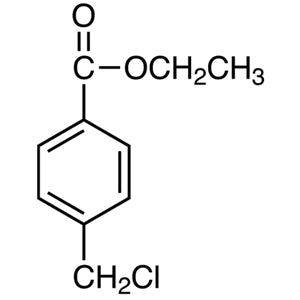
Ethyl 4-(Chloromethyl)benzoate from TCI is the para isomer of chloromethyl-substituted ethyl benzoate, with the chloromethyl group and the ester group positioned directly opposite one another on the benzene ring. This linear arrangement makes it a straight, symmetrical aromatic linker, particularly useful when researchers want to assemble two molecular fragments at a well-defined distance and orientation. Its role in the laboratory is that of an alkylating reagent and, at the same time, a precursor to substituted benzoic acids, so that a single material can serve several stages within one synthetic route.
The advantage that makes it a frequent choice is its high benzylic reactivity combined with a rigid and readily predictable para framework. Nucleophilic substitution at the chloromethyl group proceeds smoothly with a wide range of nucleophiles under mild temperature conditions, while the ester group acts as a masked functional group ready to be unveiled at a later stage. The para geometry is also favoured in the design of elongated molecules such as liquid crystals, polymer monomers, and drug conjugates, because it preserves the linearity of the molecular axis.
In Indonesian laboratories, this building block is typically used in university and institutional research groups working on organic synthesis, medicinal chemistry, and materials chemistry. The availability of two pack sizes offers flexibility between reaction-condition screening work and larger synthetic campaigns, so that a group running exploratory trials and a group scaling up an established route can both order an appropriate quantity without holding excess material on the shelf.
Related TCI products
- TCI M2203 34040-62-5 Methyl 2-(Chloromethyl)benzoate
- TCI E0661 54589-54-7 Ethyl 3-(Chloromethyl)benzoate
- TCI C1763 34040-64-7 Methyl 4-(Chloromethyl)benzoate
- TCI B6408 5335-05-7 Chloromethyl Benzoate
- TCI P1012 18997-19-8 Chloromethyl Pivalate [Amino-Protecting Agent]
- TCI C3982 23731-06-8 5-(Chloromethyl)-2-hydroxybenzaldehyde
- Benzylic alkylation of nucleophiles: the chloromethyl group undergoes clean nucleophilic substitution with amines, thiols, alcohols and other nucleophiles under mild temperature conditions, making it a dependable alkylating reagent.
- Precursor to substituted benzoic acids: the ethyl ester serves as a masked carboxylic acid that can be unveiled at a late stage, allowing one reagent to cover several steps of a route.
- Rigid aromatic linker construction: the para arrangement places the two functional handles directly opposite each other, joining two molecular fragments at a defined distance and orientation.
- Liquid crystal and materials synthesis: the linear para geometry preserves the molecular long axis, which is exactly the structural feature required when building elongated mesogenic frameworks.
- Polymer monomer and drug conjugate preparation: the combination of a reactive benzylic handle and a latent acid group supports controlled attachment chemistry in monomer design and conjugate assembly work.
| Brand | TCI |
|---|---|
| CAS number | 1201-90-7 |
| Molecular formula | — |
| Purity | — |
| Category | Chemistry > Building Blocks > Non-Heterocyclic Building Blocks |
| Pack sizes | available in two pack sizes |
| Physical form | — |
| Storage | keep in a cool, dry place in a tightly closed container |
- Product code: E0662
Store the container tightly closed in a cool, dry and well-ventilated area, away from moisture, heat and direct sunlight, and separated from strong bases and strong nucleophiles. Keep the material in its original supplier container or in a compatible tightly sealed glass container, clearly labelled. Handle in a fume hood using standard laboratory personal protective equipment, including safety glasses, chemical-resistant gloves and a laboratory coat, since benzylic halides are reactive alkylating agents and can irritate skin, eyes and the respiratory tract. Avoid contact and inhalation of vapours, close the container promptly after use, and dispose of residues through the laboratory's chemical waste procedures.
—
Produk Terkait
-
Methyl2-(Chloromethyl)benzoate TCI M2203
Regular price From Rp 4.213.650,00Regular price -
Ethyl3-(Chloromethyl)benzoate TCI E0661
Regular price Rp 875.700,00Regular price -
Methyl4-(Chloromethyl)benzoate TCI C1763
Regular price From Rp 980.700,00Regular price -
ChloromethylBenzoate TCI B6408
Regular price From Rp 1.670.550,00Regular price -
ChloromethylPivalate[Amino-ProtectingAgent] TCI P1012
Regular price From Rp 717.150,00Regular price -
5-(Chloromethyl)-2-hydroxybenzaldehyde TCI C3982
Regular price From Rp 1.565.550,00Regular price -
2-(Chloromethyl)benzoylChloride TCI C3152
Regular price Rp 2.094.750,00Regular price -
ChloromethylButyrate TCI C2841
Regular price Rp 2.439.150,00Regular price



![18997-19-8 Chloromethyl Pivalate [Amino-Protecting Agent] - AMI Scientific](http://amiscientific.com/cdn/shop/files/TCI2510P1012.jpg?v=1767134108&width=533)