

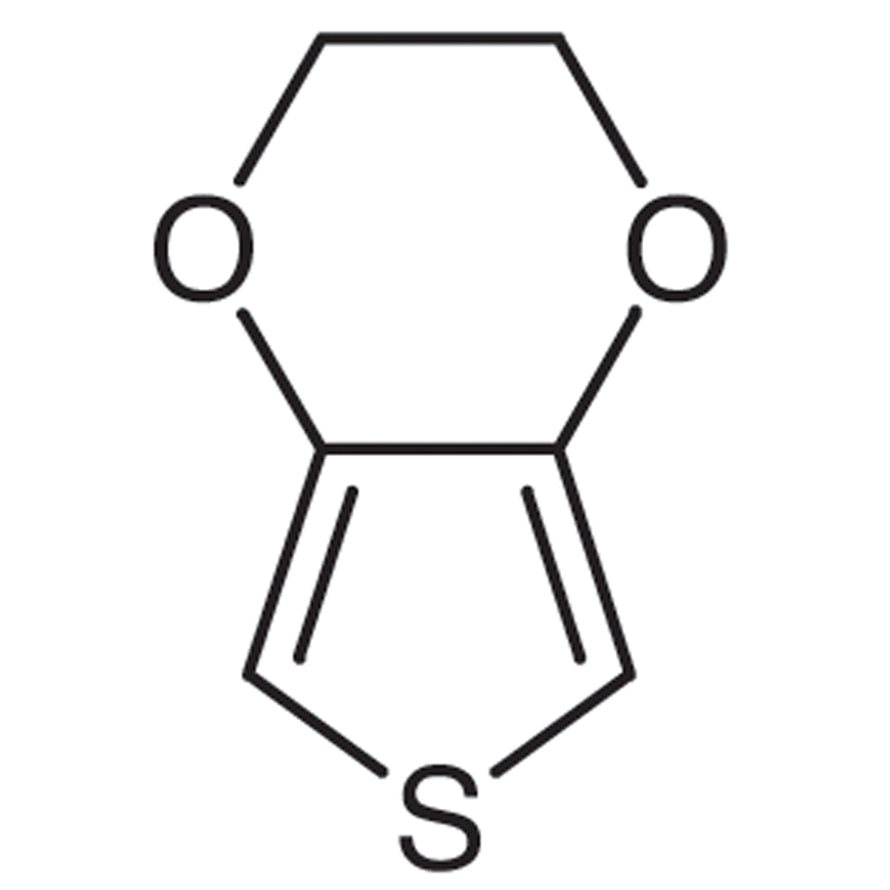
TCI E0741 3,4-Ethylenedioxythiophene (CAS 126213-50-1), commonly abbreviated as EDOT, is a thiophene monomer bearing an ethylenedioxy bridge across the 3 and 4 positions of the ring. The compound is the principal starting material for the preparation of PEDOT, one of the most important and most widely studied conductive polymers in materials science. Tokyo Chemical Industry supplies it within its material building block category for polymer semiconductors, making it a standard entry point for laboratories that construct conjugated polymer systems from well-defined monomer precursors rather than from pre-formed dispersions.
The advantage that makes EDOT the monomer of choice lies in its molecular design. The dioxy bridge blocks the 3 and 4 positions of the thiophene ring, so that when polymerisation proceeds, coupling between monomer units can only occur at the alpha positions. The result is a regular polymer chain, almost free of defects, with long and uninterrupted conjugation along the backbone. The electron-rich oxygen atoms additionally lower the band gap of the polymer, so that PEDOT is highly conductive, transparent in thin-film form, and well suited to applications where both electrical and optical performance are required simultaneously.
In the laboratory, EDOT is used for both electrochemical and chemical polymerisation to produce conductive thin layers on electrodes, conductive glass substrates, textiles, and other surfaces studied in organic electronic device research. In Indonesian laboratories this places the monomer squarely in the workflows of university materials chemistry groups, government research institutes, and device-oriented laboratories working on organic electronics, sensors, and electrode modification, where a reliable monomer source is needed for reproducible film deposition.
TCI brochures (PDF)
- Thiophenes 2026-06-29 · p. 13
- Building Blocks for Organic Semiconductor 2026-03-24 · p. 38
Related TCI products
- TCI E0743 18361-03-0 3,4-Ethylenedioxythiophene-2,5-dicarboxylic Acid
- TCI D4746 225518-49-0 2,5-Dichloro-3,4-ethylenedioxythiophene
- TCI E1150 204905-77-1 3,4-Ethylenedioxythiophene-2-carboxaldehyde
- TCI A1356 28657-75-2 6'-Amino-3',4'-(methylenedioxy)acetophenone
- TCI M1378 7797-83-3 2,3-(Methylenedioxy)benzaldehyde
- TCI M0874 3162-29-6 3',4'-(Methylenedioxy)acetophenone
- Electrochemical polymerisation of PEDOT films — EDOT oxidises and couples cleanly at the alpha positions under applied potential, allowing controlled deposition of adherent conductive layers directly onto working electrodes.
- Chemical (oxidative) polymerisation of PEDOT — the same alpha-selective coupling operates in solution-phase chemical polymerisation, giving regular, low-defect chains suitable for bulk conductive polymer preparation in flask-scale work.
- Conductive coatings on transparent substrates — because PEDOT thin films combine high conductivity with optical transparency, EDOT is the preferred monomer for coating conductive glass substrates used in device studies.
- Modification of textile and flexible surfaces — EDOT can be polymerised in situ on textiles and other non-rigid surfaces, letting researchers convert ordinary substrates into electrically conductive materials.
- Organic electronic device research — as a defined material building block for polymer semiconductors, EDOT supports device-oriented studies where the low band gap and long conjugation of PEDOT are essential.
| Brand | TCI (Tokyo Chemical Industry) |
|---|---|
| CAS number | 126213-50-1 |
| Molecular formula | — |
| Purity | — |
| Category | Materials Science > Material Building Blocks > Polymer/Macromolecule Semiconductor Building Blocks |
| Pack sizes | available in the standard TCI catalogue pack sizes; please refer to the product listing for currently offered options |
| Physical form | — |
| Storage | — |
- Catalogue number: E0741
- Chemical name: 3,4-Ethylenedioxythiophene (EDOT)
Store the container tightly closed in a cool, dark place, following the storage conditions stated by the manufacturer on the product label and safety data sheet. As a polymerisable monomer, EDOT should be protected from heat, light, and oxidising agents, and kept in its original tightly sealed container or in an equivalent chemically compatible, well-closed vessel. Handle in a fume hood using gloves, safety glasses, and a laboratory coat, and avoid contact with skin, eyes, and inhalation of vapour. Allow refrigerated material to reach room temperature before opening to prevent moisture condensation, and always consult the current safety data sheet before use.
—
Produk Terkait
-
3,4-Ethylenedioxythiophene-2,5-dicarboxylicAcid TCI E0743
Regular price From Rp 2.306.850,00Regular price -
2,5-Dichloro-3,4-ethylenedioxythiophene TCI D4746
Regular price Rp 1.405.950,00Regular price -
3,4-Ethylenedioxythiophene-2-carboxaldehyde TCI E1150
Regular price From Rp 980.700,00Regular price -
6'-Amino-3',4'-(methylenedioxy)acetophenone TCI A1356
Regular price Rp 2.782.500,00Regular price -
2,3-(Methylenedioxy)benzaldehyde TCI M1378
Regular price From Rp 2.439.150,00Regular price -
3',4'-(Methylenedioxy)acetophenone TCI M0874
Regular price Rp 3.312.750,00Regular price -
4,8-Bis[(2-ethylhexyl)oxy]-2,6-bis(trimethylstannyl)benzo[1,2-b:4,5-b']dithiophene TCI B5490
Regular price From Rp 3.367.350,00Regular price -
4,8-Bis[5-(2-ethylhexyl)thiophen-2-yl]benzo[1,2-b:4,5-b']dithiophene TCI B5485
Regular price Rp 3.551.100,00Regular price


![1160823-78-8 4,8-Bis[(2-ethylhexyl)oxy]-2,6-bis(trimethylstannyl)benzo[1,2-b:4,5-b']dithiophene - AMI Scientific](http://amiscientific.com/cdn/shop/files/TCI2510B5490.jpg?v=1769055924&width=533)
![1352642-35-3 4,8-Bis[5-(2-ethylhexyl)thiophen-2-yl]benzo[1,2-b:4,5-b']dithiophene - AMI Scientific](http://amiscientific.com/cdn/shop/files/TCI2510B5485.jpg?v=1769141889&width=533)