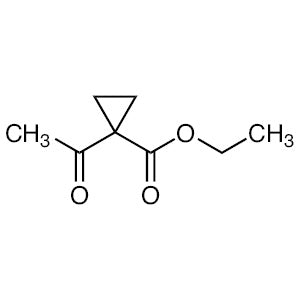
TCI E1442 with CAS number 32933-03-2 is Ethyl 1-Acetylcyclopropane-1-carboxylate, a non-heterocyclic building block that carries a cyclopropane ring doubly substituted at one and the same carbon atom. Attached to that quaternary carbon are an acetyl group and an ethyl ester group, which makes the molecule simultaneously a 1,3-dicarbonyl compound locked inside a three-membered ring. Its role in the laboratory is to provide rapid access to the cyclopropane motif that is currently in high demand in medicinal chemistry, because this small ring is frequently used to lock molecular conformation and improve metabolic properties.
The property that leads chemists to select this compound is the combination of cyclopropane ring strain with two reactive carbonyl groups. The ketone group can undergo nucleophilic addition, condensation, or reductive amination, while the ester group can be hydrolysed, amidated, or reduced to an alcohol. The 1,3-dicarbonyl arrangement on the quaternary carbon also opens a route towards the formation of a variety of heterocycles through reaction with hydrazine, hydroxylamine, or amidines, with the cyclopropane ring remaining intact as a structural marker. Because both functional groups differ in reactivity, they can be addressed selectively in sequence.
In Indonesian laboratories this building block is typically used in organic synthesis research groups at universities and in research and development units working on active pharmaceutical ingredient candidates or agrochemicals. It is normally handled on a small to moderate scale, in synthesis routes where the cyclopropane fragment has to be introduced early and carried through subsequent steps. Analytical laboratories also use it as a starting material for preparing reference compounds and intermediates required for method development work.
Related TCI products
- TCI M1111 6206-25-3 Methyl 1-Methylcyclopropane-1-carboxylate
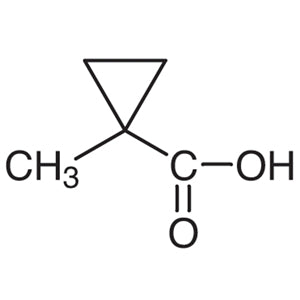
- TCI M0885 6914-76-7 1-Methylcyclopropane-1-carboxylic Acid
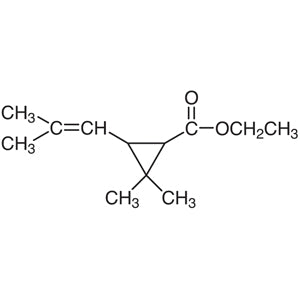
- TCI D2112 97-41-6 Ethyl 2,2-Dimethyl-3-(2-methyl-1-propenyl)cyclopropane-1-carboxylate
- TCI A0881 874-23-7 2-Acetylcyclohexanone
- TCI A0869 1670-46-8 2-Acetylcyclopentanone
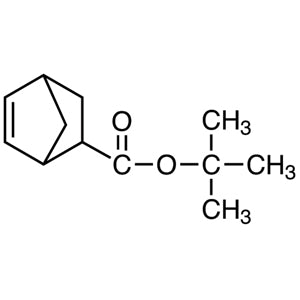
- TCI B4267 154970-45-3 tert-Butyl 5-Norbornene-2-carboxylate (endo- and exo- mixture)
- Medicinal chemistry building block synthesis: the ready-made cyclopropane ring lets chemists install a conformationally restricted fragment into candidate molecules without having to construct the strained ring themselves.
- Heterocycle construction: the 1,3-dicarbonyl arrangement reacts with hydrazine, hydroxylamine, or amidines to build pyrazole, isoxazole, and pyrimidine cores that retain the cyclopropane substituent.
- Selective ester transformations: the ethyl ester can be hydrolysed to the acid, converted to amides, or reduced to an alcohol, giving several downstream intermediates from one starting material.
- Ketone-directed derivatisation: the acetyl group supports nucleophilic addition, condensation, and reductive amination, so new carbon and nitrogen substituents can be introduced at a defined position.
- Agrochemical and specialty intermediate research: the compact strained ring paired with two handles suits exploratory route scouting where structural diversity must be generated from a single scaffold.
| Brand | TCI (Tokyo Chemical Industry) |
|---|---|
| CAS number | 32933-03-2 |
| Molecular formula | — |
| Purity | — |
| Category | Chemistry > Building Blocks > Non-Heterocyclic Building Blocks |
| Pack sizes | available in standard TCI research-scale catalogue packs |
| Physical form | — |
| Storage | keep in the tightly closed original container as indicated on the product label |
- Chemical name: Ethyl 1-Acetylcyclopropane-1-carboxylate
Store the container tightly closed in a cool, dry, well-ventilated area away from heat sources, ignition sources, and strong oxidising agents, following the storage conditions stated on the product label and safety data sheet. Keep the material in its original manufacturer container or in a compatible tightly sealed glass vessel, and protect it from moisture to preserve the integrity of the ester group. Handle inside a fume hood while wearing safety goggles, chemically resistant gloves, and a laboratory coat. Avoid inhalation of vapours and direct skin or eye contact, transfer the material with clean dry equipment, and label all secondary containers clearly. Dispose of residues and contaminated materials as chemical waste in accordance with institutional procedures.
—
Produk Terkait
-
Methyl1-Methylcyclopropane-1-carboxylate TCI M1111
Regular price Rp 6.070.050,00Regular price -
1-Methylcyclopropane-1-carboxylicAcid TCI M0885
Regular price From Rp 3.048.150,00Regular price -
Ethyl2,2-Dimethyl-3-(2-methyl-1-propenyl)cyclopropane-1-carboxylate TCI D2112
Regular price From Rp 1.298.850,00Regular price -
2-Acetylcyclohexanone TCI A0881
Regular price From Rp 1.776.600,00Regular price -
2-Acetylcyclopentanone TCI A0869
Regular price From Rp 980.700,00Regular price -
tert-Butyl5-Norbornene-2-carboxylate(endo-andexo-mixture) TCI B4267
Regular price From Rp 1.485.750,00Regular price -
Methyl1-Oxo-2,3-dihydro-1H-indene-2-carboxylate TCI M3689
Regular price Rp 3.843.000,00Regular price -
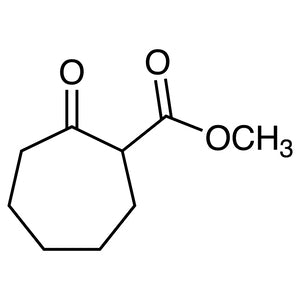
Methyl2-Oxocycloheptane-1-carboxylate TCI M3625
Regular price Rp 2.359.350,00Regular price