

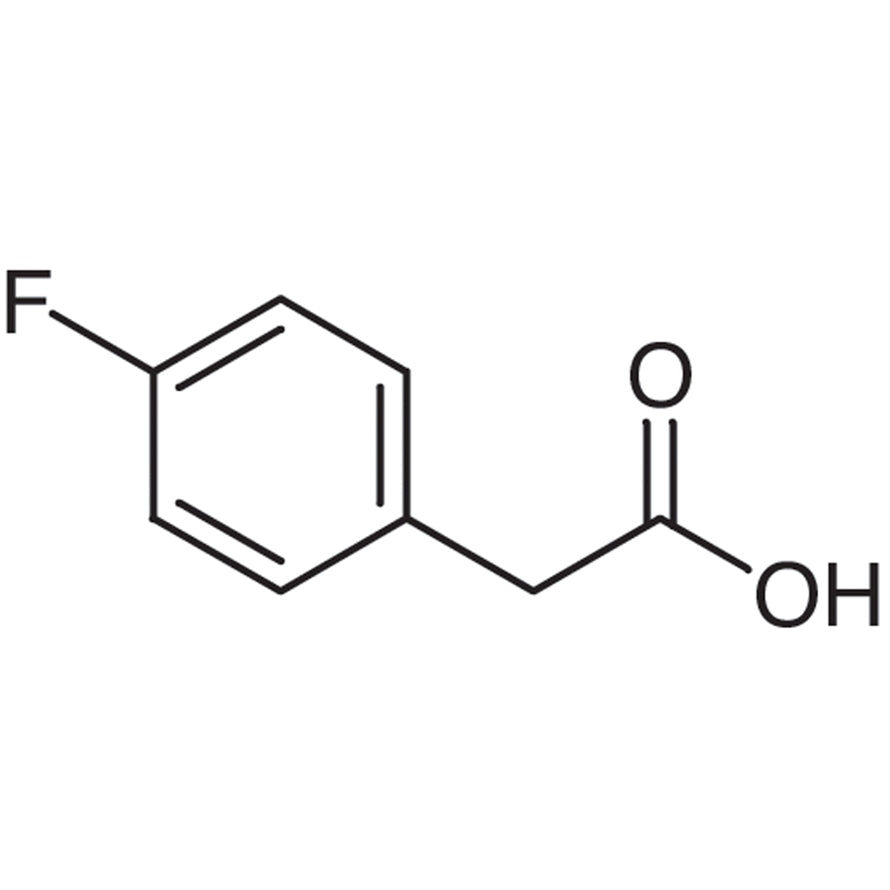
4-Fluorophenylacetic Acid (4-FPAA) is a chemical compound widely used in organic synthesis reactions. It serves as a key building block in the creation of complex molecules, particularly those incorporating fluorine atoms. In laboratory settings, 4-FPAA plays a crucial role in forming carbon-fluorine bonds, which are essential for achieving specific molecular structures and functionalities. Its versatility makes it an important reagent in various chemical processes, supporting both research and development activities.
The compound is valued for its stable molecular structure and high reactivity, allowing it to participate in a wide range of chemical reactions. Its non-colored appearance and solid form make it easy to handle and measure accurately in laboratory environments. Additionally, its ability to interact effectively with different reagents and catalysts enhances its utility in synthetic pathways. These properties make 4-FPAA a preferred choice for researchers seeking precision and control in their experiments.
In Indonesian laboratories, 4-FPAA is commonly used in scientific research across multiple disciplines, including organic chemistry, pharmaceuticals, and materials science. Its relevance extends to high-tech research areas such as drug development, where precise chemical control is essential. The compound's role in advancing scientific innovation underscores its importance in modern laboratory practices.
- Organic synthesis reactions benefit from 4-FPAA’s ability to form stable carbon-fluorine bonds, enabling the creation of complex fluorinated compounds.
- Pharmaceutical research utilizes 4-FPAA to develop new drug molecules, leveraging its reactivity and compatibility with various reagents.
- Materials science applications rely on 4-FPAA for synthesizing advanced materials with unique chemical properties and structural integrity.
- Fluorinated compound development requires 4-FPAA due to its role in introducing fluorine atoms into molecular frameworks with high precision.
- Analytical chemistry experiments use 4-FPAA as a reference standard for testing reactivity and purity in synthetic processes.
| Brand | TCI |
|---|---|
| CAS number | 405-50-5 |
| Molecular formula | — |
| Purity | — |
| Category | Chemistry > Building Blocks > Fluorinated Building Blocks |
| Pack sizes | — |
| Physical form | Solid |
| Storage | Store in a cool, dry place away from light and moisture |
4-FPAA should be stored in a cool, dry environment, away from direct light and moisture to maintain its stability and reactivity. It is recommended to use airtight containers to prevent exposure to air and contaminants. Due to its chemical nature, it should be handled with care, using appropriate personal protective equipment such as gloves and safety goggles. In laboratory settings, it is important to ensure good ventilation to minimize any potential inhalation risks. Proper labeling and storage practices help maintain safety and prevent accidental contamination. Regular monitoring of storage conditions ensures the compound remains in optimal condition for use in research applications.
—
Produk Terkait
-
3-Bromo-4-fluorophenylaceticAcid TCI B2976
Regular price Rp 1.167.600,00Regular price -
3-FluorophenylaceticAcid TCI F0216
Regular price From Rp 769.650,00Regular price -
2-FluorophenylaceticAcid TCI F0205
Regular price From Rp 530.250,00Regular price -
2-Chloro-6-fluorophenylaceticAcid TCI C1126
Regular price From Rp 795.900,00Regular price


