

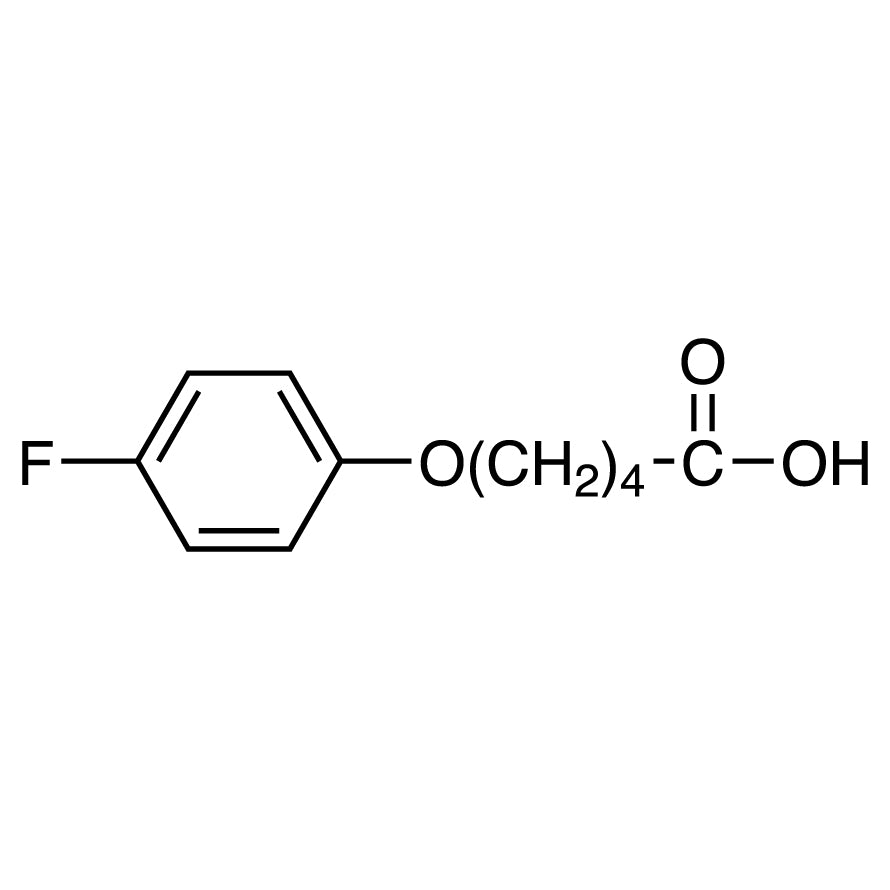
5-(4-Fluorophenoxy)valeric Acid is a chemical compound widely used as a building block in the synthesis of complex organic molecules. It plays a crucial role in organic chemistry laboratories, where it serves as a versatile intermediate for various chemical reactions. This compound is particularly valuable for its ability to participate in substitution reactions, esterification, and amidation, making it a key component in the development of new compounds with specific properties. Its presence in fluorinated building blocks highlights its importance in modern synthetic strategies.
The compound's unique structure, featuring a valeric acid chain attached to a fluorinated phenyl group, contributes to its reactivity and selectivity in chemical transformations. The incorporation of fluorine into the aromatic ring enhances its stability and reactivity, making it a preferred choice for researchers aiming to create compounds with tailored biological or physical properties. Its chemical versatility allows it to be used in a wide range of applications, from pharmaceutical research to materials science.
In Indonesian laboratories, 5-(4-Fluorophenoxy)valeric Acid is commonly utilized by chemists and scientists working in organic synthesis. It is an essential reagent for developing new drugs, functional materials, and specialty chemicals. Its availability and reliability make it a standard component in the research toolkit of academic and industrial laboratories in Indonesia.
TCI brochures (PDF)
- Fluorination Reagents, Fluorinated Building Blocks 2026-03-18 · p. 14
Related TCI products
- Organic synthesis is a primary application where this compound is used to create complex molecules with specific functional groups.
- Pharmaceutical research benefits from its ability to introduce fluorine into aromatic structures, enhancing drug efficacy and bioavailability.
- Material science applications leverage its chemical stability and reactivity for the development of advanced polymers and coatings.
- Analytical chemistry uses it as a standard reference for identifying and quantifying fluorinated compounds in various samples.
- Environmental studies incorporate it to investigate the behavior and degradation of fluorinated compounds in natural systems.
| Brand | TCI |
|---|---|
| CAS number | 347867-75-8 |
| Molecular formula | — |
| Purity | — |
| Category | Chemistry > Building Blocks > Fluorinated Building Blocks |
| Pack sizes | Available in standard laboratory quantities |
| Physical form | Solid or crystalline, depending on purity and storage conditions |
| Storage | Store in a cool, dry place away from light and moisture |
This compound should be stored in a cool, dry environment, away from direct light and moisture to maintain its chemical integrity. It is recommended to use airtight containers made of glass or high-density polyethylene to prevent contamination and degradation. Due to its chemical reactivity, it should be handled with appropriate personal protective equipment, including gloves and safety goggles. In laboratory settings, it should be stored separately from strong oxidizing agents and incompatible substances to ensure safety. Regular monitoring of storage conditions is advised to maintain optimal performance and safety standards.
—
Produk Terkait
-
2-(Pentafluorophenoxy)ethanol TCI P1225
Regular price Rp 2.730.000,00Regular price -
2-(4-Fluorophenoxy)aceticAcid TCI F1351
Regular price From Rp 2.359.350,00Regular price -
4-(4-Fluorophenoxy)benzaldehyde TCI F0537
Regular price From Rp 795.900,00Regular price -
4-(4-Fluorophenoxy)benzonitrile TCI F0532
Regular price From Rp 477.750,00Regular price -
m-(2-Fluorophenoxy)toluene TCI F0375
Regular price Rp 4.479.300,00Regular price -
m-(4-Fluorophenoxy)toluene TCI F0374
Regular price Rp 4.213.650,00Regular price -
3-(4-Fluorophenoxy)benzylBromide TCI F0243
Regular price From Rp 2.757.300,00Regular price -
3-(2-Fluorophenoxy)benzylBromide TCI F0236
Regular price From Rp 1.060.500,00Regular price


