

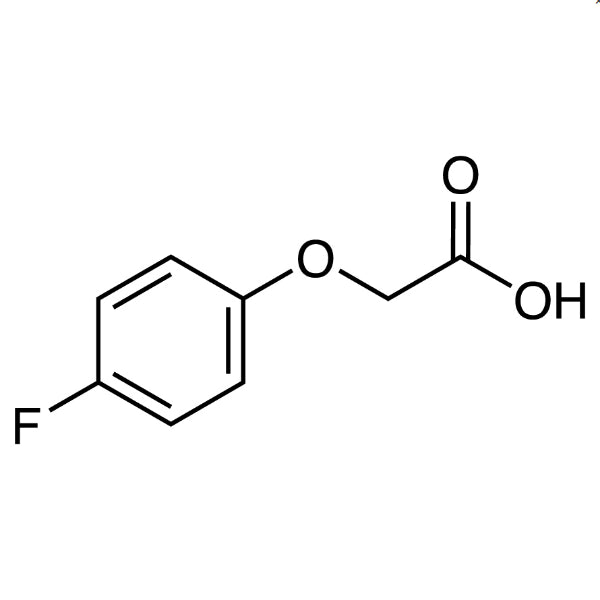
2-(4-Fluorophenoxy)acetic Acid is a chemical compound widely used in organic synthesis reactions, particularly in the development of fluorinated compounds. This reagent plays a crucial role in laboratories by serving as a building block for constructing complex molecular structures. Its ability to react with various functional groups makes it a versatile tool in synthetic chemistry. Due to its stability and controlled reactivity, it is a preferred choice for researchers aiming to introduce fluorine atoms into organic molecules.
The compound’s unique properties, including its polarity and solubility characteristics, influence its reactivity under different reaction conditions. These properties make it suitable for a wide range of chemical applications, from pharmaceutical research to materials science. The presence of fluorine atoms enhances the compound’s functionality, allowing it to participate in diverse chemical transformations. Its chemical stability ensures that it remains effective across multiple experimental setups.
In Indonesian laboratories, 2-(4-Fluorophenoxy)acetic Acid is commonly used in chemical and pharmaceutical research. It is a key component in the synthesis of new compounds and is frequently employed in academic and industrial settings. Many research institutions and universities rely on this compound for experiments requiring fluorinated building blocks. Its availability in the local market supports ongoing scientific investigations and innovation in the field.
Related TCI products
- TCI P1225 2192-55-4 2-(Pentafluorophenoxy)ethanol
- TCI F0537 137736-06-2 4-(4-Fluorophenoxy)benzaldehyde
- TCI F0532 215589-24-5 4-(4-Fluorophenoxy)benzonitrile
- TCI F0410 347867-75-8 5-(4-Fluorophenoxy)valeric Acid
- TCI F0375 78850-78-9 m-(2-Fluorophenoxy)toluene
- TCI F0374 1514-26-7 m-(4-Fluorophenoxy)toluene
- Organic synthesis applications benefit from this compound's ability to introduce fluorine atoms into complex molecular frameworks, enhancing the reactivity and stability of target compounds.
- Pharmaceutical research utilizes this reagent for the development of new drugs, as fluorinated compounds often exhibit improved pharmacological properties and metabolic stability.
- Materials science experiments leverage its unique chemical properties to create novel materials with tailored functional characteristics.
- Analytical chemistry processes use it as a standard reference for identifying and quantifying fluorinated compounds in various samples.
- Environmental studies incorporate this compound to investigate the behavior and fate of fluorinated substances in different ecosystems.
| Brand | TCI |
|---|---|
| CAS number | 405-79-8 |
| Molecular formula | — |
| Purity | — |
| Category | Chemistry > Building Blocks > Fluorinated Building Blocks |
| Pack sizes | Available in various quantities as per supplier specifications |
| Physical form | Solid or liquid, depending on the specific product variant |
| Storage | Store in a cool, dry place away from direct sunlight and moisture |
This compound should be stored in a cool, dry environment to maintain its chemical stability. It is recommended to keep it in a sealed container to prevent exposure to moisture and air. Suitable storage containers include glass or high-density polyethylene vessels that are resistant to chemical degradation. Due to its fluorinated nature, it is important to handle it with care, using appropriate personal protective equipment such as gloves and safety goggles. Avoid contact with incompatible substances and ensure proper ventilation in the laboratory. Regular monitoring of storage conditions will help preserve the compound’s integrity and ensure safe handling throughout its use.
—
Produk Terkait
-
2-(Pentafluorophenoxy)ethanol TCI P1225
Regular price Rp 2.730.000,00Regular price -
4-(4-Fluorophenoxy)benzaldehyde TCI F0537
Regular price From Rp 795.900,00Regular price -
4-(4-Fluorophenoxy)benzonitrile TCI F0532
Regular price From Rp 477.750,00Regular price -
5-(4-Fluorophenoxy)valericAcid TCI F0410
Regular price Rp 3.048.150,00Regular price -
m-(2-Fluorophenoxy)toluene TCI F0375
Regular price Rp 4.479.300,00Regular price -
m-(4-Fluorophenoxy)toluene TCI F0374
Regular price Rp 4.213.650,00Regular price -
3-(4-Fluorophenoxy)benzylBromide TCI F0243
Regular price From Rp 2.757.300,00Regular price -
3-(2-Fluorophenoxy)benzylBromide TCI F0236
Regular price From Rp 1.060.500,00Regular price


