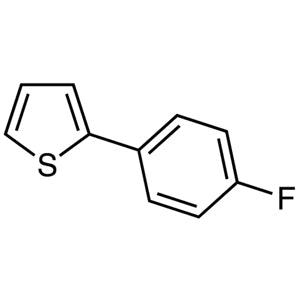
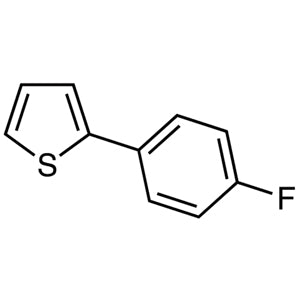
TCI F0724 is 2-(4-Fluorophenyl)thiophene, a biaryl compound that joins an electron-rich thiophene ring to a fluorine-substituted benzene ring. The molecule belongs to the class of heteroaromatic building blocks that are widely sought after in both organic materials research and medicinal chemistry. In the laboratory, compounds of this type typically serve as a structural core that is subsequently functionalized further — for example through halogenation, lithiation, or cross-coupling reactions — so that they can be assembled into conjugated oligomers or into more complex drug scaffolds.
The property that makes this compound attractive is the conjugated pi system extending across both rings, which produces a molecule with distinctive electronic and optical characteristics together with good thermal stability. The thiophene ring is electron-donating while the fluorophenyl ring is electron-withdrawing, so an internal polarization is established that is useful for tuning orbital energy levels in organic semiconductor materials. The vacant alpha position of the thiophene is a highly reactive site for electrophilic substitution as well as for directed deprotonation, giving researchers a clear route for chain extension. The fluorine atom likewise contributes to the electronic profile of the ring system.
In Indonesian laboratories, a building block of this kind is normally held as part of a synthetic chemistry inventory in university research groups, government research institutes, and industrial R&D units working on organic electronics or on pharmaceutical intermediates. It is generally ordered in the quantity needed for a defined synthetic campaign rather than in bulk, and is handled alongside other heteroaromatic intermediates on the same project, with the TCI brand chosen for the consistency expected of research-grade synthetic reagents.
TCI brochures (PDF)
- Thiophenes 2026-06-29 · p. 6
- Fluorination Reagents, Fluorinated Building Blocks 2026-03-18 · p. 15
Related TCI products
- TCI B5335 1030825-20-7 2-(5-Bromo-2-methylbenzyl)-5-(4-fluorophenyl)thiophene
- TCI F1073 115933-30-7 5-(4-Fluorophenyl)thiophene-2-carboxylic Acid
- TCI B2764 27469-60-9 1-[Bis(4-fluorophenyl)methyl]piperazine
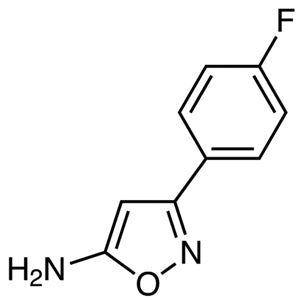
- TCI A2929 81465-82-9 5-Amino-3-(4-fluorophenyl)isoxazole
- TCI F1428 33282-24-5 5-(4-Fluorophenyl)isoxazole-3-carboxylic Acid
- TCI F1356 347-12-6 2-(4-Fluorophenyl)imidazo[1,2-a]pyridine
- Cross-coupling substrate preparation: the open alpha position of the thiophene ring can be halogenated or metalated, producing partners suitable for Suzuki, Stille, or related carbon–carbon bond-forming reactions.
- Conjugated oligomer and polymer synthesis: the pi system spanning both rings allows this unit to be chain-extended into longer conjugated frameworks intended for organic semiconductor and optoelectronic materials investigations.
- Organic semiconductor energy-level tuning: the donor thiophene combined with the electron-withdrawing fluorophenyl ring creates an internal polarization that researchers exploit to adjust frontier orbital energies in device materials.
- Medicinal chemistry scaffold elaboration: the fluorinated biaryl core acts as a starting framework that can be decorated through further functionalization toward more complex drug-candidate structures under investigation.
- Directed deprotonation and electrophilic substitution studies: the reactive alpha position offers a well-defined, predictable site for methodology work on regioselective functionalization of heteroaromatic substrates.
| Brand | TCI (Tokyo Chemical Industry) |
|---|---|
| CAS number | 58861-48-6 |
| Molecular formula | — |
| Purity | — |
| Category | Chemistry > Building Blocks > Fluorinated Building Blocks |
| Pack sizes | available in standard research-scale catalogue pack sizes; please confirm the size required when ordering |
| Physical form | — |
| Storage | — |
- Chemical name: 2-(4-Fluorophenyl)thiophene
- Catalogue reference: F0724
Store the container in a cool, dry, well-ventilated area away from direct sunlight, heat sources, and strong oxidizing agents. Keep the material in its original tightly closed supplier container, or transfer it to a clean, chemically compatible, clearly labelled vessel if subdivision is necessary. Handle the compound in a fume hood using appropriate personal protective equipment, including safety glasses, chemical-resistant gloves, and a laboratory coat. Avoid generating dust or vapour, keep containers closed when not in use, and always consult the manufacturer's safety data sheet before opening the container, weighing out material, or disposing of residues.
—
Produk Terkait
-
2-(5-Bromo-2-methylbenzyl)-5-(4-fluorophenyl)thiophene TCI B5335
Regular price Rp 1.087.800,00Regular priceRp 775.950,00Sale price Rp 1.087.800,00 -
5-(4-Fluorophenyl)thiophene-2-carboxylicAcid TCI F1073
Regular price Rp 1.431.150,00Regular priceRp 1.016.400,00Sale price Rp 1.431.150,00 -
1-[Bis(4-fluorophenyl)methyl]piperazine TCI B2764
Regular price Rp 822.150,00Regular priceRp 590.100,00Sale price Rp 822.150,00 -
5-Amino-3-(4-fluorophenyl)isoxazole TCI A2929
Regular price Rp 1.563.450,00Regular priceRp 1.108.800,00Sale price Rp 1.563.450,00 -
5-(4-Fluorophenyl)isoxazole-3-carboxylicAcid TCI F1428
Regular price Rp 2.439.150,00Regular priceRp 1.720.950,00Sale price Rp 2.439.150,00 -
2-(4-Fluorophenyl)imidazo[1,2-a]pyridine TCI F1356
Regular price Rp 3.021.900,00Regular priceRp 2.128.350,00Sale price Rp 3.021.900,00 -
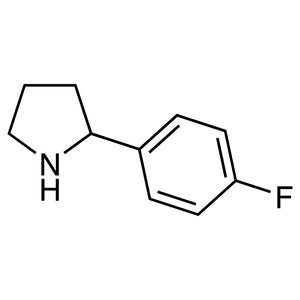
2-(4-Fluorophenyl)pyrrolidine TCI F1329
Regular price Rp 7.182.000,00Regular priceRp 5.037.900,00Sale price Rp 7.182.000,00 -
1-Benzyl-3-(4-fluorophenyl)piperazine TCI F1303
Regular price Rp 2.147.250,00Regular priceRp 1.517.250,00Sale price Rp 2.147.250,00


![27469-60-9 1-[Bis(4-fluorophenyl)methyl]piperazine - AMI Scientific](http://amiscientific.com/cdn/shop/files/TCI2510B2764.jpg?v=1768815392&width=533)

![2-(4-Fluorophenyl)imidazo[1,2-a]pyridine (CAS 347-12-6) - TCI F1356 - AMI Scientific](http://amiscientific.com/cdn/shop/files/TCI2510F1356.jpg?v=1768819019&width=533)