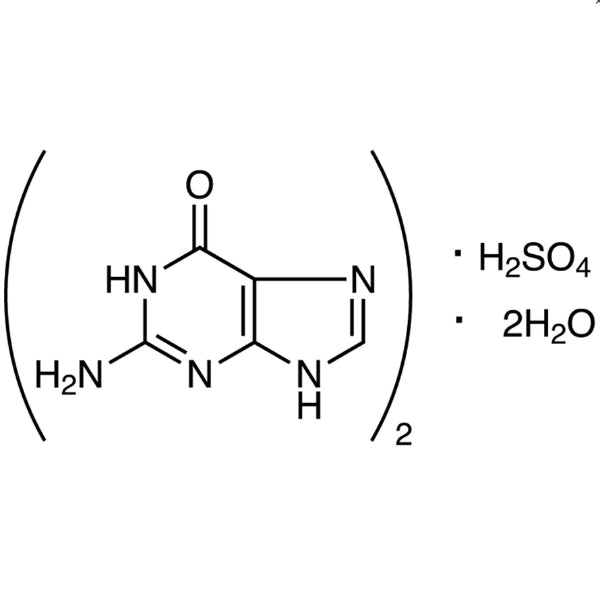
Guanine Sulfate Dihydrate is a chemical compound classified under nucleotides and plays a crucial role in laboratory research, particularly in biochemical and molecular studies. It is a fundamental component of DNA and RNA structures, making it essential for understanding genetic material and its associated functions. This compound is widely used in experiments related to nucleotide metabolism, DNA synthesis, and enzyme activity testing. Its presence in various biological processes makes it a valuable tool for researchers aiming to explore molecular mechanisms and biochemical pathways.
One of the key properties that make Guanine Sulfate Dihydrate a preferred choice is its chemical stability under controlled conditions. This stability ensures consistent performance during experiments and simplifies storage and handling over extended periods. Additionally, its high solubility in water allows for easy dissolution in aqueous solutions, facilitating its use in a wide range of chemical reactions and analytical procedures. These characteristics contribute to its reliability and versatility in laboratory settings.
In Indonesian laboratories, Guanine Sulfate Dihydrate is extensively utilized in biochemistry, pharmacology, and genetics research. Its role in studying metabolic processes and genetic material makes it a critical reagent for both academic and industrial research. Its availability and consistent quality make it a go-to choice for scientists and researchers in the region.
TCI brochures (PDF)
- Nucleosides, Nucleotides, Nucleic Acids and Related Reagents 2026-03-23 · p. 10
- Biochemical research for studying nucleotide metabolism and DNA synthesis due to its structural similarity to nucleic acids.
- Enzyme activity assays where it serves as a substrate or cofactor in biochemical reactions.
- Molecular biology experiments involving DNA and RNA analysis, including sequencing and hybridization techniques.
- Pharmacological studies to investigate the effects of nucleotide-based compounds on cellular functions.
- Genetic research for understanding the role of nucleotides in gene expression and mutation analysis.
| Brand | TCI |
|---|---|
| CAS number | 10333-92-3 |
| Molecular formula | — |
| Purity | — |
| Category | Life Science > Biochemicals and Reagents > Nucleosides, Nucleotides, Oligonucleotides |
| Pack sizes | Available in various quantities as per standard laboratory supply formats |
| Physical form | Solid powder |
| Storage | Store in a cool, dry place away from moisture and direct sunlight |
Guanine Sulfate Dihydrate should be stored in a cool, dry environment to maintain its chemical stability and prevent degradation. It is recommended to keep the compound in airtight containers to avoid moisture absorption, which could affect its solubility and purity. Since it is highly soluble in water, it should be handled in a well-ventilated area to prevent airborne exposure. Laboratory personnel should wear appropriate personal protective equipment, such as gloves and safety goggles, when handling the compound. Proper labeling of containers is essential to ensure safe handling and prevent accidental contamination. Regular inspection of storage conditions is advised to maintain optimal quality and usability of the material.
—
Produk Terkait
-
GuanineHydrochloride TCI G0170
Regular price Rp 1.353.450,00Regular price -
Guanine TCI G0169
Regular price From Rp 557.550,00Regular price -
AdenineSulfateDihydrate TCI A0151
Regular price From Rp 3.021.900,00Regular price -
CytidineSulfate TCI C0525
Regular price From Rp 477.750,00Regular price -
AminoguanidineSulfate TCI A0309
Regular price From Rp 743.400,00Regular price -
AgmatineSulfate TCI A0310
Regular price From Rp 584.850,00Regular price -
AtropineSulfateMonohydrate TCI A0550
Regular price From Rp 1.856.400,00Regular price -
Vanadium(IV)OxideSulfateHydrate TCI V0171
Regular price From Rp 743.400,00Regular price