

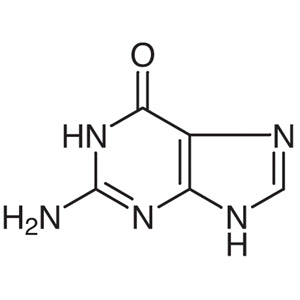
Guanine (73-40-5) is a chemical compound classified under the heterocyclic category and is one of the four nitrogenous bases found in DNA and RNA. As a fundamental building block, Guanine plays a crucial role in various chemical reactions aimed at synthesizing complex compounds, including pharmaceuticals, pesticides, and industrial chemicals. In the laboratory, it is widely used as a key reagent in organic synthesis reactions, particularly in the production of heterocyclic compounds with intricate molecular structures. Its presence in nucleic acids makes it essential for biochemical research and molecular studies.
Guanine is known for its stable molecular structure and aromatic properties, which contribute to its reactivity under diverse chemical conditions. It exhibits good solubility in organic solvents such as ethylamine and acetone, making it a preferred choice for precise and stable chemical reactions. These characteristics ensure its reliability in laboratory settings where accuracy and consistency are paramount. Its chemical stability and solubility properties make it a versatile reagent for a wide range of applications in both organic and biochemical research.
In Indonesian laboratories, Guanine is commonly used in organic chemistry research, especially in the synthesis of heterocyclic compounds and the development of pharmaceutical materials. It is also utilized in biochemical studies to investigate the structure and function of biological molecules. Its presence in DNA and RNA makes it a valuable tool for molecular biology research, contributing to advancements in both academic and industrial scientific fields.
TCI brochures (PDF)
- Nucleosides, Nucleotides, Nucleic Acids and Related Reagents 2026-03-23 · p. 9
- Reagents for Biological Research 2025-03-11 · p. 60
- Organic synthesis of heterocyclic compounds due to its stable molecular structure and aromatic nature.
- Pharmaceutical development for the synthesis of nucleoside derivatives and other bioactive molecules.
- Biochemical research to study the structural and functional properties of nucleic acids.
- Industrial chemical production for the creation of pesticides and specialty chemicals.
- Molecular biology experiments involving DNA and RNA analysis and modification.
| Brand | TCI |
|---|---|
| CAS number | 73-40-5 |
| Molecular formula | — |
| Purity | — |
| Category | Chemistry > Building Blocks > Heterocyclic Building Blocks |
| Pack sizes | Available in various quantities as per standard laboratory requirements |
| Physical form | Crystalline solid |
| Storage | Store in a cool, dry place away from light and moisture |
Guanine should be stored in a cool, dry environment, away from direct light and moisture to maintain its chemical stability. It is recommended to use airtight containers to prevent exposure to humidity and air, which could affect its solubility and reactivity. In laboratory settings, proper ventilation is essential to avoid inhalation of any vapors, although Guanine is generally considered to have low volatility. Handling should be done with appropriate personal protective equipment, such as gloves and safety goggles, to ensure safety during preparation and use. The compound is non-toxic in small quantities but should be treated with care to prevent any unnecessary exposure. Its stable nature makes it safe for routine laboratory use when stored and handled correctly.
—
Produk Terkait
-
GuanineHydrochloride TCI G0170
Regular price Rp 1.353.450,00Regular price -
GuanineSulfateDihydrate TCI G0168
Regular price Rp 1.326.150,00Regular price -
AdenineHydrochlorideHemihydrate TCI A0150
Regular price From Rp 664.650,00Regular price -
Uracil TCI U0013
Regular price From Rp 689.850,00Regular price -
4-Thiouracil TCI T2757
Regular price Rp 2.782.500,00Regular price -
8-Bromo-7-(2-butyn-1-yl)-3-methylxanthine TCI B4454
Regular price Rp 1.405.950,00Regular price -
O~6~-Benzylguanine TCI B4208
Regular price From Rp 1.167.600,00Regular price


