

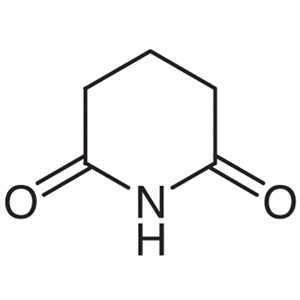
Glutarimide, also known as piperidine-2,6-dione, is a simple cyclic building block featuring two carbonyl groups flanking a single nitrogen atom. This compact structure has made it one of the most frequently encountered cores in modern medicinal chemistry, particularly as the foundational scaffold for the imide-class compounds widely recognised in targeted protein degradation research. In synthetic laboratories, glutarimide serves as a starting point for constructing more complex molecules through nitrogen alkylation, substitution on the ring, or coupling with aromatic fragments.
The reason this material is so widely chosen lies in its stability as a solid that is easy to weigh out and store, combined with the reactivity of an imide nitrogen acidic enough to be deprotonated and functionalised in a controlled manner. The two symmetrical carbonyl groups provide a scaffold whose behaviour can be predicted with confidence, while the small molecular size makes it efficient from an atom-economy standpoint when installed onto a target molecule. Its solubility in polar organic solvents such as dimethylformamide and dimethyl sulfoxide facilitates reactions at room temperature or under moderate heating without demanding extreme conditions.
In Indonesian laboratories, glutarimide is typically found in university organic synthesis groups, pharmaceutical research units, and contract research facilities working on small-molecule development. Its role is usually that of an early-stage intermediate: researchers open a pack, weigh out the required portion, and carry it directly into a functionalisation step. Because it is a stable solid rather than a sensitive reagent, it fits comfortably into the workflow of laboratories that handle building blocks across multiple ongoing projects.
- Targeted protein degradation research — the glutarimide core is the recognised imide scaffold underpinning this field, making it the logical starting material for building degrader candidates.
- Medicinal chemistry scaffold construction — its compact, predictable ring provides a reliable foundation onto which researchers append aromatic fragments and side chains during lead development.
- Nitrogen alkylation chemistry — the imide nitrogen is sufficiently acidic to be deprotonated cleanly, allowing controlled introduction of alkyl groups without competing side reactions dominating.
- Ring substitution studies — the symmetrical arrangement of two carbonyl groups gives chemists a well-understood electronic environment for exploring substitution patterns on the cyclic framework.
- General small-molecule synthesis — as a low-molecular-weight building block, it contributes favourable atom economy when incorporated into larger target molecules during multi-step synthetic routes.
| Brand | TCI |
|---|---|
| CAS number | 1121-89-7 |
| Molecular formula | — |
| Purity | — |
| Category | Chemistry > Building Blocks > Non-Heterocyclic Building Blocks |
| Pack sizes | available in standard TCI research-scale packaging; please confirm the size required when ordering |
| Physical form | solid, readily weighed and handled |
| Storage | keep in the closed original container in a cool, dry place |
- Catalogue Code: G0269
Store glutarimide in its original tightly closed container, kept in a cool, dry location away from moisture and direct sunlight. Amber glass or the supplier's original packaging is suitable; transfer any working portions into clean, clearly labelled containers and reseal promptly after weighing. Handle the solid in a fume hood or well-ventilated area to avoid inhaling dust, and wear standard laboratory protective equipment including safety glasses, gloves, and a laboratory coat. Use clean, dry spatulas to prevent contamination of the bulk material. Avoid contact with skin and eyes, wash hands thoroughly after handling, and consult the manufacturer's safety data sheet before first use for complete hazard information and disposal guidance.
—
Produk Terkait
-
3,3-Tetramethyleneglutarimide TCI T1412
Regular price Rp 1.565.550,00Regular price -
3-Ethyl-3-methylglutarimide TCI E0284
Regular price Rp 6.228.600,00Regular price -
3,3-Dimethylglutarimide TCI D1324
Regular price Rp 1.298.850,00Regular price


