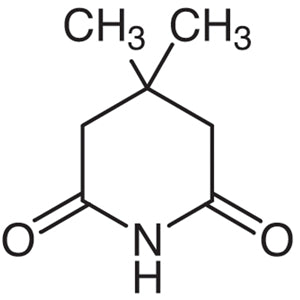
TCI D1324 3,3-Dimethylglutarimide is a cyclic imide compound built on the 3,3-dimethylglutaric acid skeleton, in which a nitrogen atom bridges the two carbonyl groups. Although nitrogen is present within the ring, this product is classified in the catalogue as a non-heterocyclic building block because its practical function is that of a branched aliphatic starting material. In the laboratory it serves as a core framework for constructing substituted glutarimide derivatives, as a source of an imide group that can be alkylated at the nitrogen atom, and as a molecular model for studying hydrogen bonding behaviour and the acidity of the N–H proton in cyclic imide systems.
The characteristic that makes this compound attractive to synthetic chemists is the combination of a stable imide ring with two geminal methyl groups that impose conformational rigidity on the structure. The N–H proton of an imide is relatively acidic compared with that of an ordinary amide, so it is readily deprotonated and subsequently reacted with alkyl halides to install new substituents at nitrogen. The glutarimide framework itself is widely recognised in medicinal chemistry as a structural motif appearing in a range of active compounds, which is why this doubly methylated version is frequently used to investigate the influence of branching on the behaviour of the parent scaffold.
In Indonesian laboratories, this building block is typically found in university and institutional research groups working on organic synthesis, medicinal chemistry, and structure–activity studies, as well as in industrial R&D units that prepare intermediates on a small scale. It is generally handled at the bench scale, weighed out for individual reaction steps, and stored alongside other TCI building blocks in the general organic chemicals inventory of a synthesis laboratory.
- Synthesis of substituted glutarimide derivatives: the intact imide ring provides a ready-made core so chemists build outward from it rather than assembling the ring themselves.
- N-alkylation reactions: the relatively acidic N–H proton is easily deprotonated and then coupled with alkyl halides to install new nitrogen substituents cleanly.
- Medicinal chemistry scaffold studies: the glutarimide motif appears in numerous active compounds, making this a useful starting point for analogue preparation and screening.
- Investigation of steric branching effects: the two geminal methyl groups add conformational rigidity, letting researchers compare branched versus unbranched glutarimide behaviour directly.
- Physical organic model studies: the compound serves as a defined model for examining hydrogen bonding character and N–H acidity within cyclic imide systems.
| Brand | TCI (Tokyo Chemical Industry) |
|---|---|
| CAS number | 1123-40-6 |
| Molecular formula | — |
| Purity | — |
| Category | Chemistry > Building Blocks > Non-Heterocyclic Building Blocks |
| Pack sizes | as listed on the manufacturer's catalogue entry for this product code |
| Physical form | — |
| Storage | — |
- Product code: D1324
- Chemical name: 3,3-Dimethylglutarimide
Store the container tightly closed in a cool, dry place away from direct sunlight, moisture, and sources of ignition, following the storage conditions stated on the manufacturer's label and safety data sheet. The original supplier packaging is the most suitable container; if transfer is required, use clean, dry, chemically compatible glassware with a secure closure and label it clearly. Handle the material in a fume hood using a laboratory coat, safety glasses, and appropriate gloves. Avoid generating dust, keep the compound separated from strong oxidising agents and strong bases, and dispose of residues and contaminated materials in accordance with institutional chemical waste procedures.
—
Produk Terkait
-
Glutarimide TCI G0269
Regular price Rp 2.571.450,00Regular price -
3-Ethyl-3-methylglutarimide TCI E0284
Regular price Rp 6.228.600,00Regular price -
2,2-DimethylglutaricAcid TCI D1786
Regular price Rp 5.644.800,00Regular price -
2,2-DimethylglutaricAnhydride TCI D1325
Regular price From Rp 3.155.250,00Regular price -
3,3-DimethylglutaricAnhydride TCI D1323
Regular price From Rp 1.060.500,00Regular price -
3,3-DimethylglutaricAcid TCI D1322
Regular price From Rp 2.809.800,00Regular price -
2-MethylglutaricAcid TCI M1300
Regular price From Rp 1.167.600,00Regular price -
3-MethylglutaricAnhydride TCI M1010
Regular price Rp 2.439.150,00Regular price