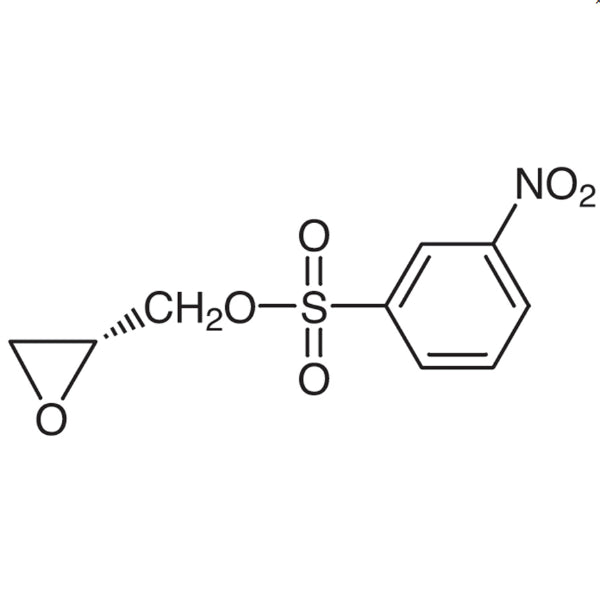
(R)-Glycidyl 3-Nitrobenzenesulfonate, widely known among synthetic chemists as glycidyl nosylate, is the sulfonate ester of glycidol in the (R) configuration. The compound occupies a special position as a chiral building block because it carries two electrophilic centres at once: a strained epoxide ring and a sulfonate group that functions as an excellent leaving group. The presence of both gives researchers the option of directing a nucleophile to either position, so that routes towards chiral target compounds can be designed far more flexibly than with ordinary glycidol.
The property that makes it sought after is the 3-nitrobenzenesulfonyl group, which is strongly electron-withdrawing, so the C–O bond becomes easy to cleave with a nucleophile and substitution reactions can proceed under milder conditions. This matters for preserving the integrity of the stereogenic centre and preventing racemisation from occurring. Unlike many liquid sulfonylating agents, this compound is generally a crystalline solid, so it is easy to weigh accurately, can be purified by recrystallisation, and is more controllable to handle in small- to medium-scale reactions.
In Indonesian laboratories, the compound is typically used in academic and industrial research groups working on asymmetric synthesis, where a reliable source of defined stereochemistry is needed at the start of a synthetic sequence. It is normally ordered in small quantities appropriate to exploratory and optimisation work, handled in a fume hood as part of standard organic synthesis practice, and drawn on where the researcher wants the configuration of the final product to be determined by the starting material rather than by a separate resolution step.
TCI brochures (PDF)
- Chiral Building Blocks 2025-04-14 · p. 12
Related TCI products
- TCI G0287 115314-14-2 (S)-Glycidyl 3-Nitrobenzenesulfonate
- TCI T1612 70987-78-9 (2S)-(+)-Glycidyl p-Toluenesulfonate
- TCI T1611 113826-06-5 (2R)-(-)-Glycidyl p-Toluenesulfonate
- TCI B2239 16495-13-9 Benzyl (S)-(+)-Glycidyl Ether
- TCI B2238 14618-80-5 Benzyl (R)-(-)-Glycidyl Ether
- TCI G0410 71031-03-3 (S)-Glycidyl Phenyl Ether
- Asymmetric synthesis of chiral intermediates — the defined (R) configuration transfers directly into the product, so the stereochemistry of the target is set by the starting material rather than by later resolution.
- Regioselective nucleophilic ring-opening studies — the two distinct electrophilic sites let researchers explore and control whether a nucleophile attacks the epoxide carbon or displaces the sulfonate.
- Preparation of chiral building blocks for multi-step routes — the reagent introduces a three-carbon unit bearing defined stereochemistry that can be elaborated further in subsequent steps.
- Mild-condition alkylation of sensitive nucleophiles — the electron-withdrawing 3-nitrobenzenesulfonyl group allows substitution at lower temperatures, protecting substrates that would not survive harsher conditions.
- Method development in stereoselective organic chemistry — the crystalline form permits accurate weighing and recrystallisation, giving the reproducibility needed when comparing reaction conditions or catalysts.
| Brand | TCI |
|---|---|
| CAS number | 115314-17-5 |
| Molecular formula | — |
| Purity | — |
| Category | Chemistry > Asymmetric Synthesis > Chiral Building Blocks |
| Pack sizes | available in standard research quantities; please confirm the pack size required when ordering |
| Physical form | crystalline solid |
| Storage | keep in a closed original container under the conditions stated on the manufacturer's label |
- Catalogue code: G0286
Store the compound in its original tightly closed container, kept in a cool, dry, well-ventilated place away from heat, ignition sources and incompatible materials, and follow any storage temperature specified on the manufacturer's label and safety data sheet. Amber glass or the supplied container is appropriate; keep the closure tight to limit moisture uptake, since sulfonate esters are susceptible to hydrolysis. Handle in a fume hood using safety goggles, chemical-resistant gloves and a laboratory coat, avoiding contact with skin and eyes and inhalation of dust when weighing the solid. Allow cold containers to warm to room temperature before opening to prevent condensation, return the material promptly to storage after use, and dispose of residues and contaminated consumables through the laboratory's chemical waste route. Consult the manufacturer's safety data sheet before first use.
—
Produk Terkait
-
(S)-Glycidyl3-Nitrobenzenesulfonate TCI G0287
Regular price From Rp 2.094.750,00Regular price -
(2S)-(+)-Glycidylp-Toluenesulfonate TCI T1612
Regular price From Rp 1.220.100,00Regular price -
(2R)-(-)-Glycidylp-Toluenesulfonate TCI T1611
Regular price Rp 1.644.300,00Regular price -
Benzyl(S)-(+)-GlycidylEther TCI B2239
Regular price From Rp 530.250,00Regular price -
Benzyl(R)-(-)-GlycidylEther TCI B2238
Regular price From Rp 530.250,00Regular price -
(S)-GlycidylPhenylEther TCI G0410
Regular price From Rp 1.140.300,00Regular price -
(R)-GlycidylPhenylEther TCI G0409
Regular price Rp 5.194.350,00Regular price -
(S)-GlycidylTritylEther TCI G0285
Regular price From Rp 1.829.100,00Regular price