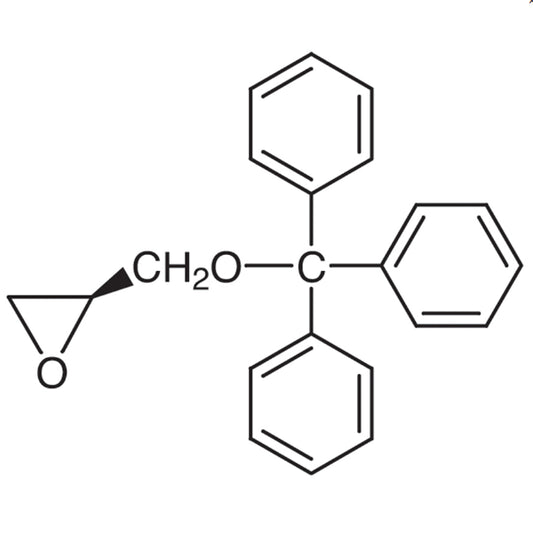
Benzyl (R)-(-)-Glycidyl Ether is a chiral compound widely used in asymmetric synthesis for the creation of bioactive molecules with specific stereochemistry. This material plays a crucial role in organic chemistry laboratories, particularly in the development of pharmaceuticals and complex organic compounds. Its unique optical properties make it an essential tool for researchers aiming to produce enantiomerically pure substances. Due to its stability and reactivity, it is frequently employed in advanced chemical processes requiring precise control over molecular structure.
The compound's optically active nature, characterized by its negative optical activity, makes it a preferred choice in chiral synthesis. This property allows chemists to selectively produce compounds with the desired stereoconfiguration, which is vital in drug development and other specialized chemical applications. Its molecular structure also provides versatility in synthetic pathways, enabling it to serve as a chiral building block in various reaction sequences. These features ensure its reliability and effectiveness in both academic and industrial research settings.
In Indonesian laboratories, Benzyl (R)-(-)-Glycidyl Ether is commonly used in organic chemistry, pharmaceutical, and biochemical research. It supports the development of new therapeutic agents and complex organic molecules. Its availability in the local market ensures accessibility for researchers and industry professionals working on innovative chemical projects. This compound is a valuable resource for advancing scientific knowledge and practical applications in the field of chemistry.
TCI brochures (PDF)
- Epoxide Monomers 2025-09-19 · p. 4
- Chiral Building Blocks 2025-04-14 · p. 12
Related TCI products
- Asymmetric Synthesis: This compound is ideal for asymmetric synthesis due to its chiral structure and optical activity, enabling the production of enantiomerically pure compounds.
- Pharmaceutical Research: It is used in drug development to create bioactive molecules with specific stereochemistry, crucial for therapeutic efficacy and safety.
- Organic Chemistry Studies: Its versatility in synthetic reactions makes it a key component in the study of complex organic molecules and reaction mechanisms.
- Biochemical Applications: It supports the synthesis of compounds used in biochemical research, including enzyme inhibitors and receptor ligands.
- Academic Research: It is widely utilized in universities and research institutions for teaching and experimental studies in chiral chemistry.
| Brand | TCI |
|---|---|
| CAS number | 14618-80-5 |
| Molecular formula | — |
| Purity | — |
| Category | Chemistry > Asymmetric Synthesis > Chiral Building Blocks |
| Pack sizes | Available in various quantities as per supplier specifications |
| Physical form | Solid or liquid, depending on the supplier's formulation |
| Storage | Store in a cool, dry place away from light and moisture |
This compound should be stored in a cool, dry environment, away from direct sunlight and sources of heat. It is recommended to use airtight containers to prevent exposure to moisture and air, which can affect its stability. Proper labeling of containers is essential for safe handling and identification. Laboratory personnel should wear appropriate personal protective equipment, such as gloves and safety goggles, when handling this material. It is important to ensure good ventilation in the workspace to minimize inhalation risks. Regular monitoring of storage conditions ensures the material remains in optimal condition for use in research applications.
—
Produk Terkait
-
Benzyl(S)-(+)-GlycidylEther TCI B2239
Regular price From Rp 530.250,00Regular priceRp 370.650,00Sale price From Rp 530.250,00 -
(S)-GlycidylPhenylEther TCI G0410
Regular price From Rp 1.140.300,00Regular priceRp 796.950,00Sale price From Rp 1.140.300,00 -
(R)-GlycidylPhenylEther TCI G0409
Regular price Rp 5.194.350,00Regular priceRp 3.631.950,00Sale price Rp 5.194.350,00 -
(S)-GlycidylTritylEther TCI G0285
Regular price From Rp 1.829.100,00Regular priceRp 1.278.900,00Sale price From Rp 1.829.100,00 -
(R)-GlycidylTritylEther TCI G0284
Regular price From Rp 1.140.300,00Regular priceRp 796.950,00Sale price From Rp 1.140.300,00 -
(S)-GlycidylMethylEther TCI G0281
Regular price From Rp 2.439.150,00Regular priceRp 1.705.200,00Sale price From Rp 2.439.150,00 -
(R)-GlycidylMethylEther TCI G0280
Regular price From Rp 2.969.400,00Regular priceRp 2.075.850,00Sale price From Rp 2.969.400,00 -
(2S)-(+)-Glycidylp-Toluenesulfonate TCI T1612
Regular price From Rp 1.220.100,00Regular priceRp 852.600,00Sale price From Rp 1.220.100,00