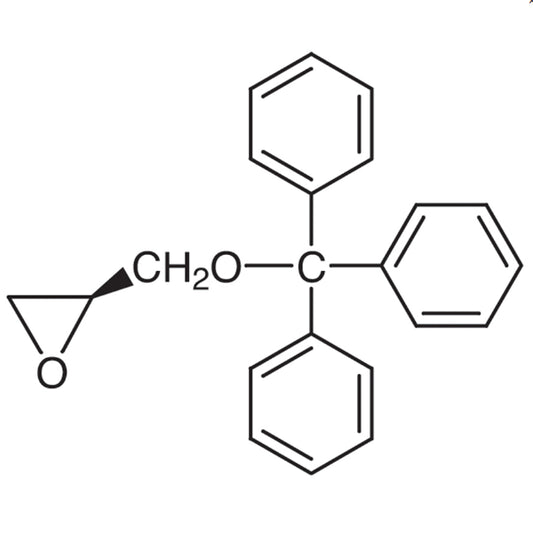
(S)-Glycidyl Phenyl Ether is a chiral compound widely used in asymmetric synthesis to construct molecules with specific biological activities. This material plays a crucial role in organic chemistry laboratories, where precise control over stereochemistry is essential. It serves as a building block for creating complex molecular structures, particularly in pharmaceutical and biochemical research. Its utility extends to the development of compounds with targeted pharmacological effects, making it an indispensable tool for researchers aiming to achieve high selectivity in synthetic processes.
The compound’s key properties include its asymmetric structure and solubility in common organic solvents such as ethyl acetate and acetone. These characteristics make it highly versatile for use in various chemical reactions, especially those requiring controlled stereochemical outcomes. Its solubility profile ensures ease of handling and integration into synthetic protocols, enhancing its appeal for both academic and industrial applications. The ability to produce compounds with defined stereochemistry is a major advantage in the field of asymmetric synthesis.
In Indonesian laboratories, (S)-Glycidyl Phenyl Ether is commonly used in research settings focused on drug development and biochemical studies. It is a preferred choice for scientists and educational institutions conducting applied research and exploring new chemical compounds. Its role in advancing synthetic methodologies and supporting innovation in chemistry and pharmacy makes it a valuable resource for laboratories in Indonesia.
TCI brochures (PDF)
- Epoxide Monomers 2025-09-19 · p. 4
- Chiral Building Blocks 2025-04-14 · p. 12
Related TCI products
- Asymmetric Synthesis: This compound is ideal for asymmetric synthesis due to its chiral structure, enabling the creation of enantiomerically pure compounds.
- Pharmaceutical Research: It is frequently used in drug development to synthesize molecules with specific biological activities and pharmacological properties.
- Organic Chemistry Education: It serves as a key teaching material for students studying stereochemistry and chiral synthesis techniques.
- Biochemical Studies: Its use in biochemical research allows for the development of compounds with targeted biological functions and interactions.
- Industrial Compound Development: It supports the creation of new chemical compounds in industrial settings requiring precise stereochemical control.
| Brand | TCI |
|---|---|
| CAS number | 71031-03-3 |
| Molecular formula | — |
| Purity | — |
| Category | Chemistry > Asymmetric Synthesis > Chiral Building Blocks |
| Pack sizes | Available in various quantities as per standard laboratory supply |
| Physical form | Liquid |
| Storage | Store in a cool, dry place away from light and moisture |
(S)-Glycidyl Phenyl Ether should be stored in a cool, dry environment, away from direct light and moisture to maintain its chemical integrity. It is recommended to use airtight containers made of glass or high-density polyethylene to prevent contamination and evaporation. Due to its chemical nature, it should be handled in a well-ventilated area, and appropriate personal protective equipment such as gloves and safety goggles should be worn. Avoid contact with skin and eyes, and ensure that spillage is promptly cleaned up using suitable absorbent materials. Proper storage and handling practices are essential to ensure the stability and effectiveness of the compound in laboratory applications.
—
Produk Terkait
-
Benzyl(S)-(+)-GlycidylEther TCI B2239
Regular price From Rp 530.250,00Regular priceRp 370.650,00Sale price From Rp 530.250,00 -
Benzyl(R)-(-)-GlycidylEther TCI B2238
Regular price From Rp 530.250,00Regular priceRp 370.650,00Sale price From Rp 530.250,00 -
(R)-GlycidylPhenylEther TCI G0409
Regular price Rp 5.194.350,00Regular priceRp 3.631.950,00Sale price Rp 5.194.350,00 -
(S)-GlycidylTritylEther TCI G0285
Regular price From Rp 1.829.100,00Regular priceRp 1.278.900,00Sale price From Rp 1.829.100,00 -
(R)-GlycidylTritylEther TCI G0284
Regular price From Rp 1.140.300,00Regular priceRp 796.950,00Sale price From Rp 1.140.300,00 -
(S)-GlycidylMethylEther TCI G0281
Regular price From Rp 2.439.150,00Regular priceRp 1.705.200,00Sale price From Rp 2.439.150,00 -
(R)-GlycidylMethylEther TCI G0280
Regular price From Rp 2.969.400,00Regular priceRp 2.075.850,00Sale price From Rp 2.969.400,00 -
(2S)-(+)-Glycidylp-Toluenesulfonate TCI T1612
Regular price From Rp 1.220.100,00Regular priceRp 852.600,00Sale price From Rp 1.220.100,00