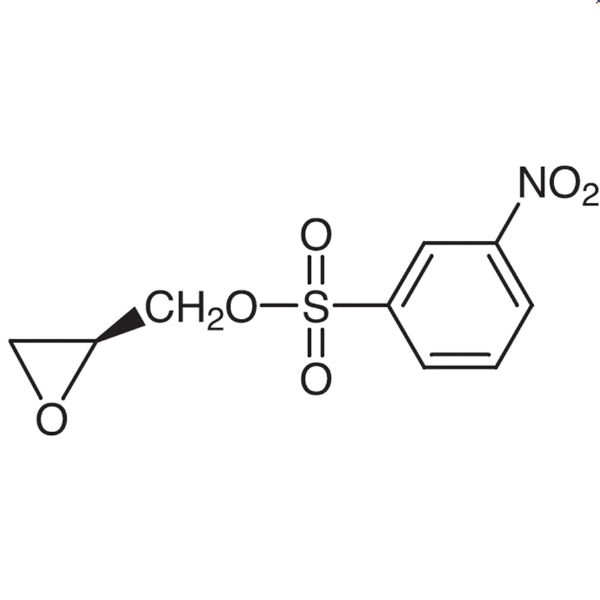
(S)-Glycidyl 3-Nitrobenzenesulfonate is the enantiomer of the (R) form and is commonly known as (S)-glycidyl nosylate, the sulfonate ester of glycidol in the (S) configuration. It is a highly versatile chiral starting material because it presents a strained epoxide ring alongside an activated sulfonate group within a single three-carbon framework. These two electrophilic centres give researchers the freedom to direct a nucleophile to the position they intend, so that synthetic routes toward a target molecule can be designed with a high degree of stereochemical control.
Its principal characteristic derives from the 3-nitrobenzenesulfonyl group, which is strongly electron-withdrawing and therefore functions as an excellent leaving group. As a result, substitution reactions can proceed at lower temperatures and over shorter reaction times, which in turn suppresses the risk of racemisation as well as unwanted side reactions. The compound is generally supplied as a crystalline solid, so it is easier to weigh out accurately, can be purified by recrystallisation, and is more manageable in handling than liquid sulfonyl reagents, which are volatile and tend to be more difficult to store over the long term.
In Indonesia, this compound is used mainly in university and institutional research laboratories working on asymmetric synthesis, and in pharmaceutical and fine-chemical development groups that need to construct enantiomerically defined intermediates. Its solid form suits laboratories that weigh out small quantities for exploratory reactions, and the reliability of the nosylate leaving group makes it a practical choice where reaction conditions must remain mild and stereochemical integrity must be preserved throughout a multi-step sequence.
TCI brochures (PDF)
- Chiral Building Blocks 2025-04-14 · p. 12
Related TCI products
- TCI G0286 115314-17-5 (R)-Glycidyl 3-Nitrobenzenesulfonate
- TCI T1612 70987-78-9 (2S)-(+)-Glycidyl p-Toluenesulfonate
- TCI T1611 113826-06-5 (2R)-(-)-Glycidyl p-Toluenesulfonate
- TCI B2239 16495-13-9 Benzyl (S)-(+)-Glycidyl Ether
- TCI B2238 14618-80-5 Benzyl (R)-(-)-Glycidyl Ether
- TCI G0410 71031-03-3 (S)-Glycidyl Phenyl Ether
- Asymmetric synthesis of chiral intermediates, where the defined (S) configuration allows target molecules to be assembled with predictable stereochemistry rather than relying on later resolution steps.
- Chiral building block chemistry, because the three-carbon framework carries two distinct electrophilic centres that can be addressed selectively to extend a carbon skeleton in a controlled direction.
- Regioselective nucleophilic substitution studies, since the strongly activated nosylate group and the strained epoxide respond differently to nucleophiles and allow reaction site preferences to be examined.
- Preparation of enantiomerically enriched pharmaceutical intermediates, where the mild conditions permitted by the excellent leaving group help suppress racemisation during sensitive coupling and ring-opening steps.
- Methodology development in stereoselective organic chemistry, as the crystalline solid form supports accurate weighing, recrystallisation, and reproducible small-scale reaction screening across repeated experimental runs.
| Brand | TCI |
|---|---|
| CAS number | 115314-14-2 |
| Molecular formula | — |
| Purity | — |
| Category | Chemistry > Asymmetric Synthesis > Chiral Building Blocks |
| Pack sizes | available in standard TCI catalogue pack sizes; please confirm the currently available options with AMI Scientific |
| Physical form | crystalline solid |
| Storage | — |
- Catalogue code: TCI G0287
Store the material in a cool, dry place away from direct sunlight, heat sources, and moisture, and keep it in its original tightly closed container or in a clean, well-sealed glass vessel that protects the solid from humidity. Follow the storage conditions stated on the product label and safety data sheet supplied with the pack. Handle the compound in a fume hood using gloves, safety glasses, and a laboratory coat, and avoid skin contact, inhalation of dust, and contact with strong nucleophiles or bases. Return the container promptly after weighing, label any transferred portions clearly, and dispose of residues and contaminated materials in accordance with the laboratory's chemical waste procedures.
—
Produk Terkait
-
(R)-Glycidyl3-Nitrobenzenesulfonate TCI G0286
Regular price From Rp 3.180.450,00Regular price -
(2S)-(+)-Glycidylp-Toluenesulfonate TCI T1612
Regular price From Rp 1.220.100,00Regular price -
(2R)-(-)-Glycidylp-Toluenesulfonate TCI T1611
Regular price Rp 1.644.300,00Regular price -
Benzyl(S)-(+)-GlycidylEther TCI B2239
Regular price From Rp 530.250,00Regular price -
Benzyl(R)-(-)-GlycidylEther TCI B2238
Regular price From Rp 530.250,00Regular price -
(S)-GlycidylPhenylEther TCI G0410
Regular price From Rp 1.140.300,00Regular price -
(R)-GlycidylPhenylEther TCI G0409
Regular price Rp 5.194.350,00Regular price -
(S)-GlycidylTritylEther TCI G0285
Regular price From Rp 1.829.100,00Regular price