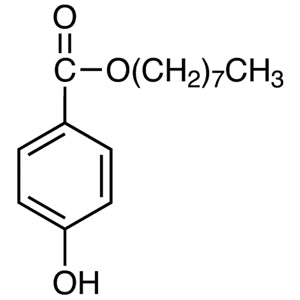
Nonyl 4-Hydroxybenzoate is the nonyl ester of 4-hydroxybenzoic acid, the longest-chain member among the paraben products offered in this listing. In the laboratory it serves as a test compound in structure–activity relationship research, as a model amphiphilic molecule for interfacial and membrane studies, and as a non-heterocyclic building block for the synthesis of functional materials. Its nine-carbon chain makes this compound a valuable end point when researchers want to observe what happens to physical properties and biological activity as lipophilicity is pushed to the highest limit within a single homologous series.
The property that makes it the preferred choice is the strong dominance of the nonpolar portion of the molecule over the polar portion. The long alkyl chain renders the compound very poorly soluble in water, strongly favouring nonpolar solvents and phases, and inclined to accumulate at the interface between two phases. Such character is highly useful for studying partition phenomena, surface adsorption, and the formation of ordered layers. The phenolic hydroxyl group at the polar end retains its hydrogen-bonding capability and provides a reactive site for etherification and further derivatisation.
In Indonesian laboratories this compound is typically drawn upon in university and institutional research settings where homologous ester series are compared side by side, in formulation and materials groups examining interfacial behaviour, and in synthetic chemistry work that requires a defined non-heterocyclic starting fragment. It is generally handled in small research quantities, weighed out as needed for a given experiment, and kept alongside the shorter-chain paraben esters so that comparative studies across the series can be carried out under consistent conditions.
Related TCI products
- TCI A3639 63435-16-5 Methyl 4-Amino-3-hydroxybenzoate
- TCI O0443 1219-38-1 n-Octyl 4-Hydroxybenzoate
- TCI M3513 3964-57-6 Methyl 3-Chloro-4-hydroxybenzoate
- TCI M3498 536-25-4 Methyl 3-Amino-4-hydroxybenzoate
- TCI M2796 1882-72-0 Methyl 2-Amino-5-hydroxybenzoate
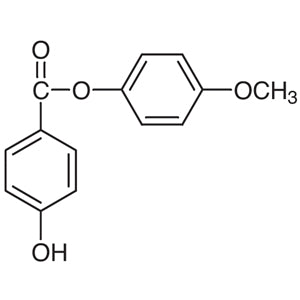
- TCI H0825 50687-62-2 4-Methoxyphenyl 4-Hydroxybenzoate
- Structure–activity relationship studies: as the longest-chain member of the paraben series, it anchors the high-lipophilicity end of the homologous series and lets researchers map how activity changes with chain length.
- Interfacial and membrane research: the strongly amphiphilic character, with a large nonpolar chain against a small polar head, makes it a suitable model molecule for examining behaviour at phase boundaries.
- Partition coefficient and solubility investigations: its very low water solubility and strong preference for nonpolar phases make it an informative extreme point in partitioning experiments between immiscible phases.
- Surface adsorption and ordered layer formation: the tendency of the molecule to accumulate at interfaces supports studies of adsorption behaviour and the assembly of organised molecular layers on surfaces.
- Non-heterocyclic building block for functional material synthesis: the free phenolic hydroxyl provides a reactive site for etherification and further derivatisation into more elaborate target structures.
| Brand | TCI |
|---|---|
| CAS number | 38713-56-3 |
| Molecular formula | — |
| Purity | — |
| Category | Chemistry > Building Blocks > Non-Heterocyclic Building Blocks |
| Pack sizes | available in the research-scale pack sizes listed for this catalogue item |
| Physical form | — |
| Storage | store according to the conditions stated on the manufacturer's product label |
- Product code: H0217
- Chemical name: Nonyl 4-Hydroxybenzoate
Store the container tightly closed in a cool, dry, well-ventilated area away from direct sunlight, heat sources, and strong oxidising agents, following the storage conditions indicated on the manufacturer's label. Keep the material in its original container or in a chemically compatible, clearly labelled vessel, and close it promptly after each use to limit moisture uptake and contamination. Handle in a fume hood or a well-ventilated workspace while wearing a laboratory coat, safety glasses, and suitable chemical-resistant gloves. Avoid raising dust, avoid contact with skin and eyes, and wash hands thoroughly after handling. Consult the Safety Data Sheet supplied with the product before use, and dispose of residues and contaminated materials in accordance with applicable laboratory waste procedures.
—
Produk Terkait
-
Methyl4-Amino-3-hydroxybenzoate TCI A3639
Regular price From Rp 2.041.200,00Regular price -
n-Octyl4-Hydroxybenzoate TCI O0443
Regular price Rp 1.724.100,00Regular price -
Methyl3-Chloro-4-hydroxybenzoate TCI M3513
Regular price From Rp 1.458.450,00Regular price -
Methyl3-Amino-4-hydroxybenzoate TCI M3498
Regular price From Rp 1.378.650,00Regular price -
Methyl2-Amino-5-hydroxybenzoate TCI M2796
Regular price From Rp 717.150,00Regular price -
4-Methoxyphenyl4-Hydroxybenzoate TCI H0825
Regular price From Rp 4.531.800,00Regular price -
2-Hydroxyethyl4-Hydroxybenzoate TCI H0698
Regular price Rp 1.829.100,00Regular price -
2-Ethylhexyl4-Hydroxybenzoate TCI H0506
Regular price From Rp 823.200,00Regular price