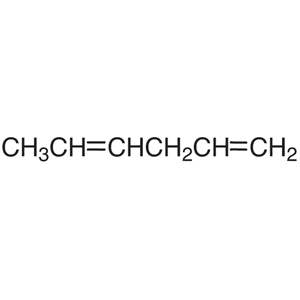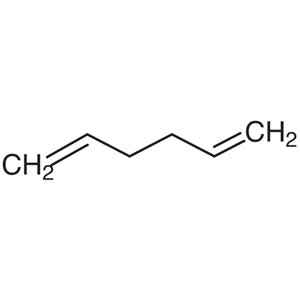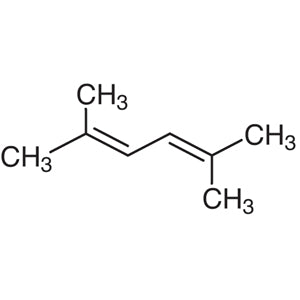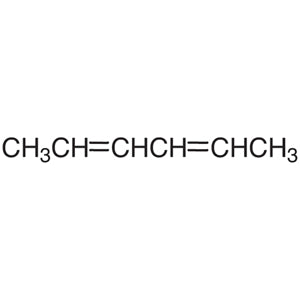
2,4-Hexadiene (mixture of isomers) is a chemical compound widely used as a foundational building block in the synthesis of complex organic compounds. This versatile reagent plays a crucial role in various chemical reactions, including polymerization, substitution, and addition reactions. Its ability to participate in multiple chemical transformations makes it an essential component in both academic and industrial laboratory settings. In Indonesia, it is commonly utilized in organic chemistry research, supporting the development of new materials and pharmaceuticals.
The reactivity and structural flexibility of 2,4-Hexadiene make it a preferred choice for chemists. Its ability to form stable intermediates and react with a wide range of functional groups enables the synthesis of diverse molecular structures. The compound’s aliphatic nature allows for easy modification through various chemical processes, enhancing its utility in both research and production environments. This adaptability ensures that 2,4-Hexadiene remains a key ingredient in the toolkit of organic chemists.
In Indonesian laboratories, 2,4-Hexadiene is extensively used in organic chemistry research, particularly in educational institutions and research organizations. Its availability and cost-effectiveness make it a go-to material for experimental work and product development. The compound supports a wide range of applications, from basic chemical studies to advanced synthetic processes, making it an indispensable resource in the laboratory setting.
Related TCI products
- TCI H0333 592-45-0 1,4-Hexadiene (cis- and trans- mixture)
- TCI U0062 16356-11-9 1,3,5-Undecatriene (mixture of isomers)
- TCI T4428 13929-58-3 1,4,4a,5,8,8a-Hexahydro-1,4:5,8-dimethanonaphthalene (mixture of isomers) (stabilized with BHT)
- TCI T0899 2855-27-8 1,2,4-Trivinylcyclohexane (mixture of isomers)
- TCI I0147 25167-70-8 Diisobutylene (mixture of isomers) (stabilized with BHT)
- TCI H0927 7319-00-8 trans-1,4-Hexadiene
- Organic synthesis applications benefit from 2,4-Hexadiene's ability to form stable intermediates and participate in multiple reaction pathways.
- Polymerization reactions often utilize this compound due to its reactivity and capacity to form long-chain structures.
- Substitution reactions in laboratory settings rely on 2,4-Hexadiene for its compatibility with various functional groups and reagents.
- Addition reactions are enhanced by the compound’s structural flexibility, allowing for precise molecular modifications.
- Research and development projects use 2,4-Hexadiene to explore new chemical structures and synthetic methodologies.
| Brand | TCI |
|---|---|
| CAS number | 592-46-1 |
| Molecular formula | — |
| Purity | — |
| Category | Chemistry > Building Blocks > Non-Heterocyclic Building Blocks |
| Pack sizes | — |
| Physical form | Liquid |
| Storage | Store in a cool, dry place away from light and incompatible materials |
2,4-Hexadiene should be stored in a cool, dry place, away from direct sunlight and incompatible substances. It is recommended to use airtight containers made of materials such as glass or stainless steel to prevent contamination and evaporation. Due to its reactivity, it should be kept separate from strong oxidizers and acids. In laboratory settings, proper ventilation is essential to minimize exposure. Always handle the compound with appropriate personal protective equipment, including gloves and safety goggles, to ensure safety during use and storage.
—
Produk Terkait
-
1,4-Hexadiene(cis-andtrans-mixture) TCI H0333
Regular price Rp 2.227.050,00Regular price -
1,3,5-Undecatriene(mixtureofisomers) TCI U0062
Regular price From Rp 3.155.250,00Regular price -
1,4,4a,5,8,8a-Hexahydro-1,4:5,8-dimethanonaphthalene(mixtureofisomers)(stabilizedwithBHT) TCI T4428
Regular price From Rp 4.056.150,00Regular price -
1,2,4-Trivinylcyclohexane(mixtureofisomers) TCI T0899
Regular price From Rp 689.850,00Regular price -
Diisobutylene(mixtureofisomers)(stabilizedwithBHT) TCI I0147
Regular price From Rp 477.750,00Regular price -
trans-1,4-Hexadiene TCI H0927
Regular price Rp 2.809.800,00Regular price -
1,5-Hexadiene TCI H0084
Regular price From Rp 848.400,00Regular price -
2,5-Dimethyl-2,4-hexadiene(stabilizedwithBHT) TCI D0735
Regular price From Rp 903.000,00Regular price