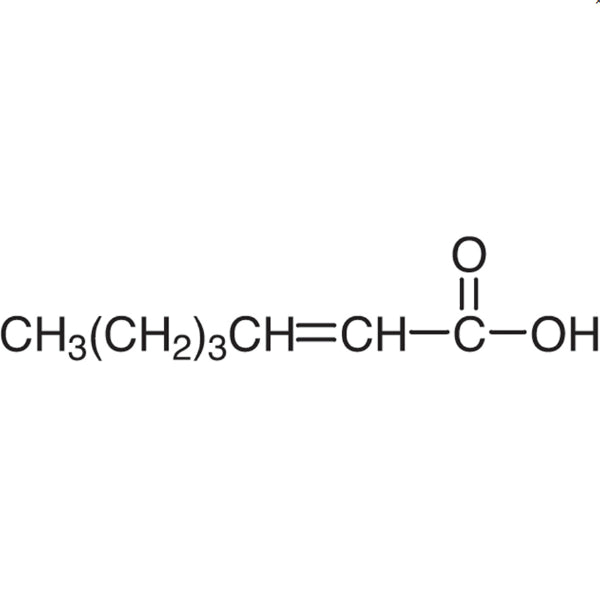
2-Heptenoic Acid (contains 3-Heptenoic Acid), with CAS number 18999-28-5, is an organic compound widely used in scientific research, particularly in the field of materials science. This compound plays a crucial role in the synthesis of colloidal quantum dots, which are essential for optoelectronic and sensing applications. In laboratory settings, it serves as a foundational reagent for creating materials with unique optical and electronic properties. Its versatility makes it a valuable component in advanced material development and nanotechnology research.
The compound is preferred for its stable chemical properties and controlled reactivity, making it suitable for high-precision chemical reactions. It exhibits good solubility in organic solvents, which enhances its utility in various synthetic processes. The presence of 3-Heptenoic Acid within the product adds structural diversity, supporting a broader range of material research applications. These characteristics make it a reliable choice for researchers aiming to achieve consistent and reproducible results.
In Indonesian laboratories, 2-Heptenoic Acid is highly relevant for research in electronics and materials science. It is commonly used by research institutions and universities to develop new technologies, especially in the areas of optoelectronics and sensor development. The availability of this compound supports local innovation and scientific advancement in the region.
- Colloidal Quantum Dot (QD) Synthesis: This compound is ideal for the preparation of colloidal quantum dots due to its chemical stability and solubility, enabling precise control over nanoparticle formation.
- Optoelectronic Device Development: Its optical properties make it suitable for use in the fabrication of optoelectronic components, such as light-emitting diodes and photodetectors.
- Sensor Material Research: The compound contributes to the development of advanced sensor materials by providing a base for creating sensitive and responsive chemical detection systems.
- Organic Semiconductor Fabrication: It is used in the synthesis of organic semiconductors, which are essential for flexible electronics and energy-efficient devices.
- Nanomaterial Characterization Studies: Its molecular structure supports research into the properties of nanomaterials, aiding in the understanding of their behavior in different environments.
| Brand | TCI |
|---|---|
| CAS number | 18999-28-5 |
| Molecular formula | — |
| Purity | — |
| Category | Materials Science > Electronic Materials > Colloidal Quantum Dot (QD) Research Reagents |
| Pack sizes | Available in standard laboratory quantities as per supplier specifications |
| Physical form | Liquid |
| Storage | Store in a cool, dry place away from direct sunlight and incompatible materials |
This compound should be stored in a cool, dry environment, away from direct sunlight and sources of heat. It is recommended to use sealed containers made of glass or high-density polyethylene to prevent contamination and evaporation. Due to its organic nature, it should be kept away from incompatible substances such as strong oxidizing agents. Always ensure proper ventilation when handling the compound to minimize inhalation risks. Laboratory personnel should wear appropriate personal protective equipment, including gloves and safety goggles, to ensure safe handling. The compound is not classified as hazardous under standard laboratory conditions but should be treated with care to maintain its integrity and effectiveness in research applications.
—
Produk Terkait
-
CrotonicAcid TCI C0416
Regular price From Rp 856.800,00Regular price -
ButylCrotonate TCI C0417
Regular price From Rp 592.200,00Regular price -
EthylCrotonate TCI C0418
Regular price From Rp 709.800,00Regular price -
MethylCrotonate TCI C0419
Regular price From Rp 886.200,00Regular price -
CrotonicAnhydride TCI C0420
Regular price Rp 1.329.300,00Regular price -
CrotonoylChloride(cis-andtrans-mixture) TCI C0424
Regular price From Rp 886.200,00Regular price -
p-TolylCrotonate TCI C0866
Regular price From Rp 1.240.050,00Regular price -
VinylCrotonate(stabilizedwithMEHQ) TCI C0897
Regular price From Rp 1.093.050,00Regular price