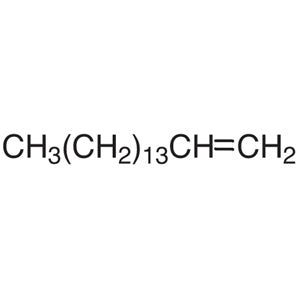
TCI H0610 1-Hexadecene is a straight-chain alpha-olefin containing sixteen carbon atoms with a terminal double bond at the end of the chain. In the laboratory it fills two equally important roles. First, it serves as a high-boiling, weakly coordinating solvent that is widely used in nanocrystal synthesis and other high-temperature reactions. Second, it acts as a pure hydrocarbon building block that supplies a reactive terminal double bond for a broad range of transformations, from hydroformylation and epoxidation through to olefin metathesis and hydrosilylation. Reagent-grade purity matters here, because isomeric olefin impurities can interfere with experimental outcomes.
The properties that make this material a preferred choice are the combination of a long, strongly hydrophobic alkyl chain with a terminal double bond that is considerably more reactive than an internal double bond. Its high boiling point allows reactions to be run at elevated temperatures in open systems without rapid loss of solvent, while its nonpolar character means it does not interfere with many organometallic catalysts. In quantum dot and nanoparticle synthesis, this same set of properties makes it an extremely common reaction medium, since it tolerates the thermal conditions those preparations demand while remaining chemically unobtrusive.
In Indonesian laboratories, 1-Hexadecene is typically encountered in university and institutional research groups working on nanomaterials, in synthetic organic chemistry laboratories preparing functionalised long-chain intermediates, and in catalysis groups that need a well-defined alpha-olefin substrate. It is generally ordered as a reagent-grade item for bench-scale work, where a consistent, isomerically clean starting material is more important than volume, and where the same bottle may serve both as a solvent and as a substrate.
- Nanocrystal and quantum dot synthesis: its high boiling point and weakly coordinating, nonpolar nature let hot-injection and heat-up preparations run at elevated temperature without rapid solvent loss or catalyst interference.
- Hydroformylation studies: the reactive terminal double bond provides a clean, well-defined alpha-olefin substrate for investigating catalyst activity and regioselectivity in long-chain aldehyde formation.
- Epoxidation chemistry: the terminal alkene is readily converted to the corresponding epoxide, giving a long-chain hydrophobic intermediate for further ring-opening and functionalisation work.
- Olefin metathesis: as a straight-chain alpha-olefin, it serves as a standard partner or substrate for cross-metathesis, where terminal unsaturation reacts far more readily than internal double bonds.
- Hydrosilylation reactions: the terminal double bond allows controlled addition of silicon–hydrogen bonds, producing long-chain alkylsilanes used in surface modification and silicone-related research.
| Brand | TCI |
|---|---|
| CAS number | 629-73-2 |
| Molecular formula | — |
| Purity | — |
| Category | Chemistry > Building Blocks > Non-Heterocyclic Building Blocks |
| Pack sizes | available in standard TCI reagent pack sizes; please confirm the size required when ordering. |
| Physical form | — |
| Storage | store in a cool, dark place in a tightly closed container. |
- Product code: H0610
Store 1-Hexadecene in a cool, dark, well-ventilated place, keeping the container tightly closed to limit exposure to air and moisture. The original manufacturer bottle or a compatible tightly sealed glass container is suitable; keep it away from heat, ignition sources and strong oxidising agents. Handle in a fume hood using standard personal protective equipment, including safety glasses, gloves and a laboratory coat, and avoid contact with skin and eyes. Because the terminal double bond is the reactive site, prolonged exposure to air, light or elevated temperature should be avoided so that the material remains isomerically clean for use. Always consult the manufacturer's safety data sheet before handling, and follow local institutional waste disposal procedures.
—
Produk Terkait
-
1-Hexadecene TCI H0323
Regular price From Rp 477.750,00Regular price -
1-Hexadecene[StandardMaterialforGC] TCI S0346
Regular price Rp 2.094.750,00Regular price -
cis-11-Hexadecenal TCI H0679
Regular price From Rp 1.590.750,00Regular price -
HexadecenylsuccinicAnhydride TCI H0073
Regular price Rp 2.386.650,00Regular price -
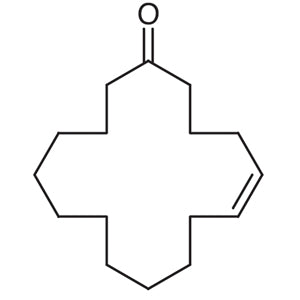
5-Cyclohexadecen-1-one TCI C0874
Regular price From Rp 1.008.000,00Regular price -
Methylcis-9-Hexadecenoate TCI P1958
Regular price From Rp 955.500,00Regular price -
Ethylcis-9-Hexadecenoate TCI H0501
Regular price Rp 2.545.200,00Regular price -
2-HexadecenoicAcid TCI H0428
Regular price From Rp 4.347.000,00Regular price
![629-73-2 1-Hexadecene [Standard Material for GC] - AMI Scientific](http://amiscientific.com/cdn/shop/files/TCI2510S0346.jpg?v=1769143462&width=533)