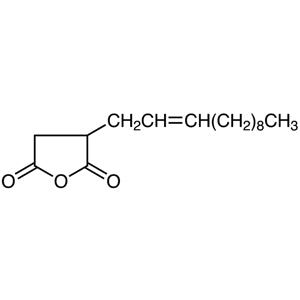
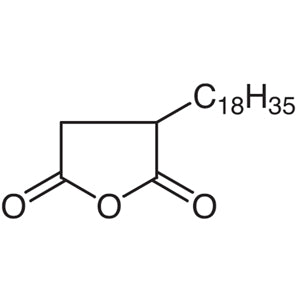
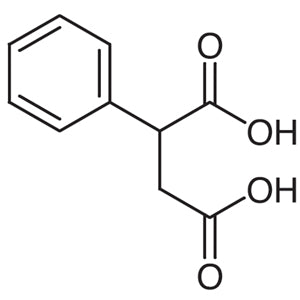
TCI H0073 Hexadecenylsuccinic Anhydride is a succinic anhydride substituted with a hexadecenyl group, a sixteen-carbon hydrocarbon chain that still carries a double bond. Belonging to the alkenyl succinic anhydride family, this compound is widely used in the laboratory as a surface modification reagent and a polymer property modifier. Its reactive anhydride ring allows the molecule to graft long hydrophobic chains onto a variety of substrates bearing hydroxyl or amine groups, letting researchers convert materials that originally absorb water into materials that repel it through a relatively short reaction sequence.
The principal advantage of this compound lies in the duality of its structure. On one side, the anhydride ring is electrophilic and readily opened by nucleophiles, forming strong ester or amide linkages while leaving behind a free carboxyl group that can be used for further functionalisation. On the other side, the long alkenyl chain contributes pronounced hydrophobic character and keeps the compound in a viscous liquid state that is easy to pour and to disperse. The double bond along the chain also opens the door to follow-up chemistry such as addition, epoxidation, or cross-linking reactions.
In Indonesian laboratories, TCI H0073 is typically handled as a building block for materials research groups working on modified starch, cellulose, natural fibre composites, coating formulations, and specialty surfactants. University and institutional research laboratories generally use it at bench scale, where a small quantity is sufficient for repeated modification and characterisation experiments. Because the anhydride ring is moisture sensitive, laboratories usually schedule their reactions carefully and keep the container closed between weighings.
Related TCI products
- TCI B1613 7538-42-3 2-Buten-1-ylsuccinic Anhydride
- TCI H0616 10500-34-2 2-Hexen-1-ylsuccinic Anhydride (cis- and trans- mixture)
- TCI D0976 19780-11-1 2-Dodecen-1-ylsuccinic Anhydride (cis- and trans- mixture)
- TCI D0030 25447-83-0 Decenylsuccinic Anhydride
- TCI O0013 28777-98-2 Octadecenylsuccinic Anhydride (mixture of isomers)
- TCI I0237 58239-72-8 Isooctadecenylsuccinic Anhydride (mixture of branched chain isomers)
- Surface hydrophobisation of hydroxyl-rich substrates, where the anhydride ring opens against surface hydroxyl groups and anchors the long hexadecenyl chain to create a water-repellent layer.
- Modification of polysaccharides such as starch and cellulose, since esterification with the anhydride changes the water affinity of the polymer while preserving the underlying carbohydrate backbone structure.
- Polymer property modification in compounding studies, where the long alkenyl chain acts as an internal plasticising and compatibilising segment between polar and non-polar phases of a blend.
- Synthesis of amphiphilic and surfactant-type intermediates, because ring opening leaves a free carboxyl group at one end while the hydrocarbon chain provides the hydrophobic tail.
- Precursor chemistry exploiting the chain double bond, allowing researchers to perform addition, epoxidation, or cross-linking steps that build more elaborate functional materials from a single starting reagent.
| Brand | TCI |
|---|---|
| CAS number | 32072-96-1 |
| Molecular formula | — |
| Purity | — |
| Category | Chemistry > Building Blocks > Non-Heterocyclic Building Blocks |
| Pack sizes | available in standard TCI laboratory research pack sizes; please confirm the size required when ordering |
| Physical form | viscous liquid |
| Storage | keep tightly closed in a dry place, protected from moisture |
Store the container tightly closed in a cool, dry, well-ventilated area away from moisture, since the anhydride ring hydrolyses on contact with water and humid air. Original manufacturer packaging is the most suitable container; if transfer is necessary, use clean, dry glassware with a tight closure and avoid leaving the material open on the bench. Handle inside a fume hood using safety glasses, chemical-resistant gloves, and a laboratory coat, as anhydrides are irritating to skin, eyes, and the respiratory tract. Keep the reagent away from strong bases, alcohols, amines, and other nucleophiles that may react with it, and consult the manufacturer safety data sheet before use.
—
Produk Terkait
-
2-Buten-1-ylsuccinicAnhydride TCI B1613
Regular price From Rp 2.439.150,00Regular price -
2-Hexen-1-ylsuccinicAnhydride(cis-andtrans-mixture) TCI H0616
Regular price Rp 4.213.650,00Regular price -
2-Dodecen-1-ylsuccinicAnhydride(cis-andtrans-mixture) TCI D0976
Regular price From Rp 610.050,00Regular price -
DecenylsuccinicAnhydride TCI D0030
Regular price From Rp 1.590.750,00Regular price -
OctadecenylsuccinicAnhydride(mixtureofisomers) TCI O0013
Regular price From Rp 1.087.800,00Regular price -
IsooctadecenylsuccinicAnhydride(mixtureofbranchedchainisomers) TCI I0237
Regular price From Rp 1.378.650,00Regular price -
PhenylsuccinicAnhydride TCI P2257
Regular price From Rp 3.605.700,00Regular price -
PhenylsuccinicAcid TCI P0155
Regular price From Rp 557.550,00Regular price