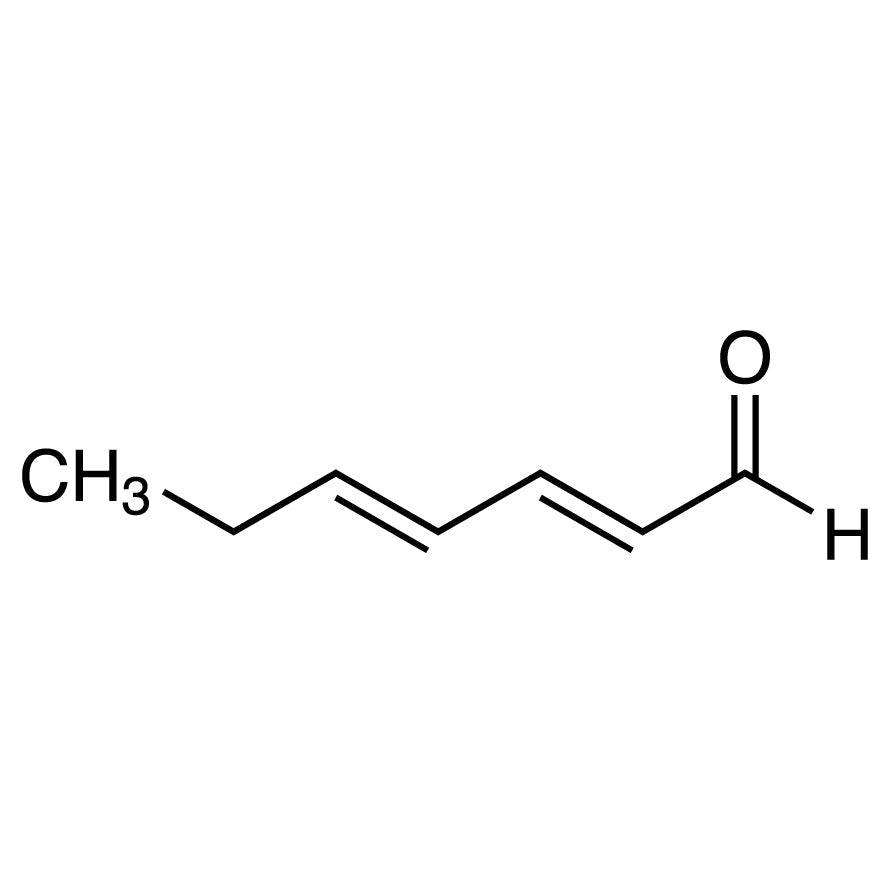
Trans,trans-2,4-Heptadienal is a chemical compound widely used in laboratory settings for its versatility in organic synthesis. As a non-heterocyclic building block, it serves as a key intermediate in the creation of more complex molecular structures. Its alkenic structure enables it to participate in various chemical reactions, such as addition and oxidation, making it an essential component in the development of aromatic and heterocyclic compounds. This compound is commonly found in research and industrial laboratories, where it is used as a starting material for the synthesis of pharmaceuticals, cosmetics, and other chemical products.
The compound's chemical properties make it a preferred choice for chemists due to its stability under controlled conditions and its reactivity in specific environments. While it is relatively stable, it is highly sensitive to oxidation and light, which necessitates careful handling and storage. Its distinctive aroma also makes it valuable for use in olfactory analysis and as a standard in sensory testing. These characteristics ensure that it remains a reliable and widely used reagent in both academic and industrial applications.
In Indonesian laboratories, trans,trans-2,4-Heptadienal is a staple in organic chemistry research, particularly in the synthesis of complex molecules. It is also commonly used in university-level teaching to demonstrate fundamental chemical reactions and molecular synthesis techniques. Its availability in the local market ensures that researchers and educators have consistent access to this essential compound for their experiments and studies.
- Organic synthesis applications benefit from trans,trans-2,4-Heptadienal due to its reactivity and ability to form complex molecular structures through addition and oxidation reactions.
- Pharmaceutical research utilizes this compound as a building block for the development of new drugs and chemical compounds.
- Cosmetic formulation processes often incorporate this material as a precursor for creating fragrance compounds and other specialty ingredients.
- Industrial chemical production relies on trans,trans-2,4-Heptadienal for the synthesis of various chemical intermediates used in manufacturing.
- Sensory analysis and olfactory testing use this compound as a reference standard due to its distinct aroma and chemical stability.
| Brand | TCI |
|---|---|
| CAS number | 4313-03-5 |
| Molecular formula | — |
| Purity | — |
| Category | Chemistry > Building Blocks > Non-Heterocyclic Building Blocks |
| Pack sizes | Available in various quantities as per standard laboratory supply |
| Physical form | Liquid |
| Storage | Store in a cool, dark place away from light and oxidizing agents |
Trans,trans-2,4-Heptadienal should be stored in a cool, dark environment to prevent degradation due to light exposure. It is recommended to use amber-colored glass containers to minimize photodegradation. The compound is sensitive to oxidation, so it should be kept away from strong oxidizing agents. It is important to ensure proper ventilation when handling this material to avoid inhalation of vapors. In laboratory settings, it should be stored in a secure location, away from heat sources and incompatible materials. Regular monitoring of storage conditions is advised to maintain the compound's integrity and effectiveness for use in experiments.
—
Produk Terkait
-
(-)-Citronellal TCI C1454
Regular price From Rp 1.115.100,00Regular price -
(+/-)-Citronellal TCI C3648
Regular price Rp 1.696.800,00Regular price -
Decanal TCI D0032
Regular price Rp 477.750,00Regular price -
Citral(cis-andtrans-mixture) TCI D0762
Regular price Rp 637.350,00Regular price -
Dodecanal(stabilizedwithDL-alpha-Tocopherol) TCI D0979
Regular price From Rp 769.650,00Regular price -
2,6-Dimethyl-5-heptenal TCI D1413
Regular price Rp 1.565.550,00Regular price -
trans-2-Decenal TCI D1642
Regular price From Rp 1.298.850,00Regular price -
trans,trans-2,4-Decadienal TCI D1934
Regular price From Rp 1.670.550,00Regular price