

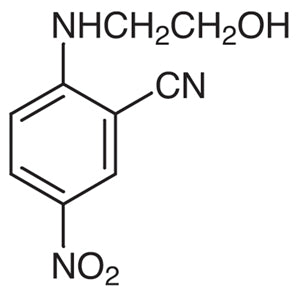
N-(2-Hydroxyethyl)-2-cyano-4-nitroaniline is a chemical compound widely used as a building block in the synthesis of complex organic molecules. It plays a crucial role in laboratory settings where researchers aim to create new compounds or modify existing ones. This compound is particularly valuable due to its versatility in undergoing various chemical reactions, including substitution, reduction, and electrophilic reactions. Its ability to participate in multiple reaction pathways makes it a key component in synthetic chemistry workflows.
The compound’s stable chemical properties and controlled reactivity make it a preferred choice for chemists. Its molecular structure allows for predictable interactions with different reagents, minimizing the formation of unwanted byproducts. This reliability is essential in both academic and industrial research environments. Additionally, its availability in solid form simplifies handling and storage, making it suitable for use in laboratories of varying scales. The compound’s chemical stability ensures consistent results across multiple experiments.
In Indonesian laboratories, N-(2-Hydroxyethyl)-2-cyano-4-nitroaniline is commonly used in organic chemistry research. It supports the development of new compounds and the modification of existing ones, contributing to advancements in pharmaceuticals, materials science, and analytical chemistry. It is also utilized in educational settings to train students in synthesis techniques and compound characterization. Its presence in Indonesian research facilities highlights its importance in both practical and academic applications.
- Organic synthesis applications benefit from this compound’s ability to participate in multiple reaction pathways, enabling the creation of complex molecules with high precision.
- Pharmaceutical research utilizes this compound as a starting material for the development of new drug candidates due to its reactivity and structural versatility.
- Material science studies employ this compound in the synthesis of functional materials, leveraging its chemical properties for tailored applications.
- Analytical chemistry laboratories use it as a reference standard for qualitative and quantitative analysis due to its stability and well-defined chemical properties.
- Educational institutions incorporate it into laboratory courses to teach students about synthetic techniques and the importance of controlled reactivity in chemical processes.
| Brand | TCI |
|---|---|
| CAS number | 63989-40-2 |
| Molecular formula | — |
| Purity | — |
| Category | Chemistry > Building Blocks > Non-Heterocyclic Building Blocks |
| Pack sizes | Available in various quantities as per supplier specifications |
| Physical form | Solid |
| Storage | Store in a cool, dry place away from light and incompatible materials |
This compound should be stored in a cool, dry environment, away from direct sunlight and sources of heat. It is recommended to keep it in a sealed container to prevent moisture absorption and contamination. Due to its chemical nature, it should be stored separately from strong oxidizers and reducing agents to avoid potential reactions. In laboratory settings, it is advisable to handle it with appropriate personal protective equipment, such as gloves and safety goggles, to ensure safety during use. Proper ventilation should be maintained when working with this compound to minimize exposure to vapors. Regular inspection of storage conditions is essential to maintain its integrity and ensure safe handling throughout its lifecycle.
—
Produk Terkait
-
(+/-)-4-(1-Hydroxyethyl)benzonitrile TCI H1955
Regular price From Rp 2.306.850,00Regular price -
2-Iodo-4-nitroaniline TCI I0878
Regular price From Rp 1.246.350,00Regular price -
4-Bromo-3-nitroaniline TCI B4876
Regular price From Rp 637.350,00Regular price -
2-Bromo-4-nitroaniline TCI B4873
Regular price From Rp 1.220.100,00Regular price -
4-Bromo-2-methyl-6-nitroaniline TCI B3730
Regular price From Rp 717.150,00Regular price -
4-Bromo-2-nitroaniline TCI B3033
Regular price From Rp 689.850,00Regular price -
2-Bromo-6-chloro-4-nitroaniline TCI B1771
Regular price Rp 477.750,00Regular price -
2-Bromo-4,6-dinitroaniline TCI B0814
Regular price From Rp 717.150,00Regular price


