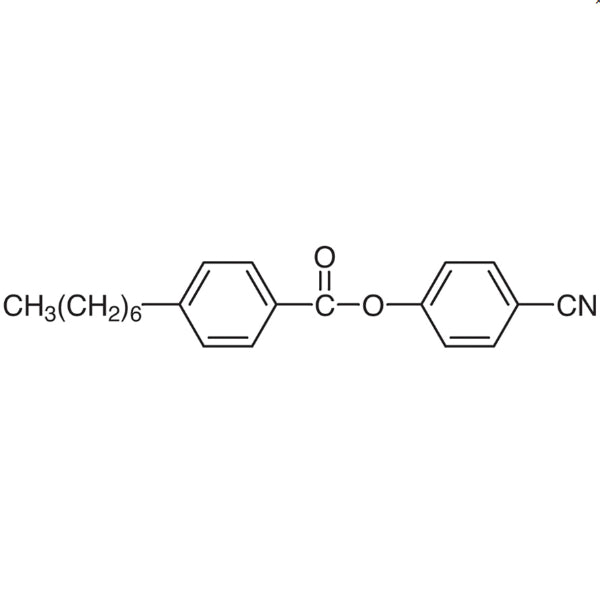
4-Cyanophenyl 4-Heptylbenzoate (CAS 38690-76-5) from TCI is a liquid crystal compound belonging to the benzoate ester family, built around a biphenyl-ester core carrying a cyano group at one end and a heptyl alkyl chain at the other. This elongated, rigid molecular architecture is the classic design template for mesogenic materials: the molecules tend to arrange themselves in parallel alignment and give rise to a mesomorphic phase that sits between the crystalline solid state and the isotropic liquid. Within the electronic materials category, the compound is used both as a single-component material and as a building block in liquid crystal mixtures for display and optics research.
The properties that make this material a preferred choice are the combination of a strongly polar cyano group with a flexible alkyl chain. The cyano group confers large dielectric anisotropy, so the molecules respond readily to an applied electric field — the operating principle behind virtually every liquid crystal display device. The heptyl chain, meanwhile, governs the balance between the rigidity of the aromatic core and overall molecular mobility, which in turn determines the temperature range of the mesomorphic phase. The ester bridge linking the two aromatic rings gives electronic behaviour and thermal stability that differ from those of the directly linked biphenyl analogues, making the compound a distinct option in formulation work.
In Indonesian laboratories, this material is typically encountered in university and institutional research groups working on materials science, applied physics, and electronic materials. It is generally handled in small quantities on the bench for phase behaviour studies, thin-film alignment experiments, and the preparation of laboratory-scale liquid crystal mixtures. Such work is usually carried out alongside polarising microscopy and thermal analysis, so the compound is ordered in modest research-scale packs rather than bulk production volumes.
TCI brochures (PDF)
- Liquid Crystal Materials 2026-04-01 · p. 8
Related TCI products
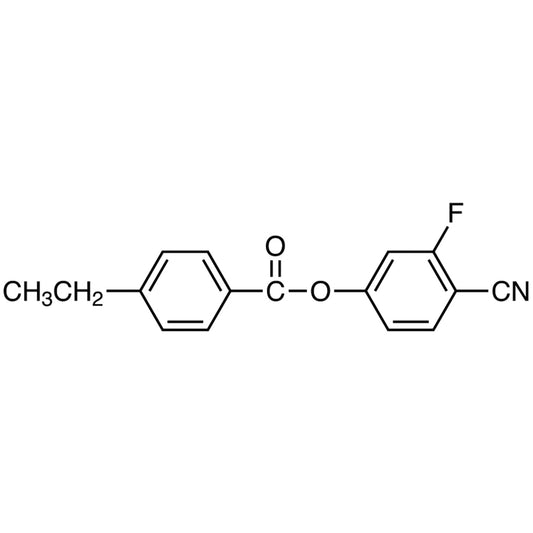
- TCI C3540 86776-50-3 4-Cyano-3-fluorophenyl 4-Ethylbenzoate
- TCI B1586 114482-57-4 4-Cyanophenyl 4-(3-Butenyloxy)benzoate
- TCI C3794 38690-77-6 4-Cyanophenyl 4-Butylbenzoate
- TCI B1091 38454-28-3 4-(Hexyloxy)phenyl 4-Butylbenzoate
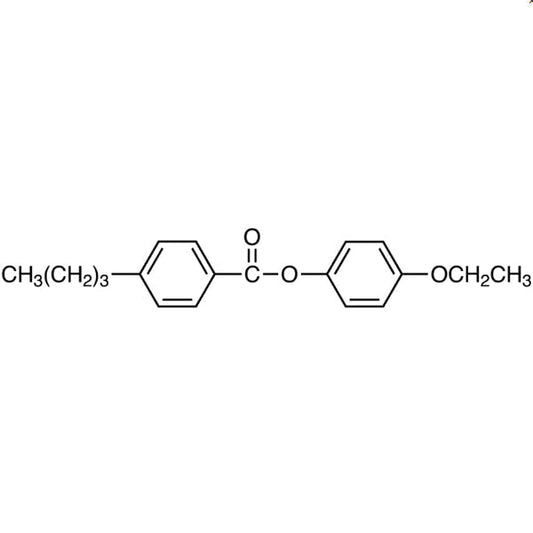
- TCI B0375 62716-65-8 4-Ethoxyphenyl 4-Butylbenzoate
- TCI C3341 86776-52-5 4-Cyano-3-fluorophenyl 4-Butylbenzoate
- Liquid crystal mixture formulation — serves as a polar component whose cyano group raises the dielectric anisotropy of a blend, allowing researchers to tune field response without redesigning the entire mixture.
- Display and electro-optic device research — the strong response to applied electric fields makes it a suitable model material for studying switching behaviour in laboratory-scale liquid crystal cells.
- Mesophase and phase-transition studies — the well-defined mesomorphic behaviour between crystalline and isotropic states makes it a convenient subject for polarising microscopy and thermal characterisation work.
- Structure–property relationship investigations — the ester bridge distinguishes it from direct biphenyl analogues, so it is useful when comparing how linking groups affect thermal stability and electronic character.
- Alignment and optics experiments — the elongated rigid core promotes parallel molecular ordering, which suits thin-film alignment studies and optical anisotropy measurements in research settings.
| Brand | TCI (Tokyo Chemical Industry) |
|---|---|
| CAS number | 38690-76-5 |
| Molecular formula | — |
| Purity | — |
| Category | Materials Science > Electronic Materials > Liquid Crystal (LC) Materials |
| Pack sizes | available in research-scale quantities; please confirm the current pack options when ordering |
| Physical form | — |
| Storage | keep in a cool, dry place in the original tightly closed container |
- Catalogue Number: H0810
Store the container tightly closed in a cool, dry, well-ventilated area, away from direct sunlight, heat sources, and incompatible materials. The original supplier packaging is the preferred container; if the material is transferred, use clean, chemically compatible glassware with a secure closure and label it clearly. Because thermal history can affect the phase behaviour of mesogenic materials, avoid unnecessary heating cycles and repeated exposure to ambient moisture. Handle the compound in a fume hood or a well-ventilated laboratory area, wearing safety glasses, gloves, and a laboratory coat. Consult the manufacturer's safety data sheet before first use and follow institutional procedures for chemical waste disposal.
—
Produk Terkait
-
4-Cyano-3-fluorophenyl4-Ethylbenzoate TCI C3540
Regular price From Rp 1.220.100,00Regular price -
4-Cyanophenyl4-(3-Butenyloxy)benzoate TCI B1586
Regular price Rp 2.704.800,00Regular price -
4-Cyanophenyl4-Butylbenzoate TCI C3794
Regular price From Rp 848.400,00Regular price -
4-(Hexyloxy)phenyl4-Butylbenzoate TCI B1091
Regular price Rp 3.127.950,00Regular price -
4-Ethoxyphenyl4-Butylbenzoate TCI B0375
Regular price Rp 6.015.450,00Regular price -
4-Cyano-3-fluorophenyl4-Butylbenzoate TCI C3341
Regular price Rp 1.140.300,00Regular price -
4-Cyano-3,5-difluorophenyl4-Pentylbenzoate TCI C3512
Regular price From Rp 1.458.450,00Regular price -
Bis(4-cyanophenyl)Ether TCI B2790
Regular price From Rp 3.419.850,00Regular price