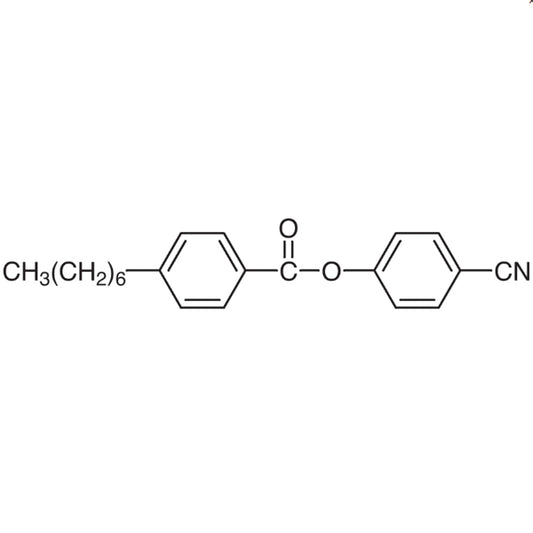
4-Cyanophenyl 4-(3-Butenyloxy)benzoate is a specialized chemical compound used in electronic materials research, particularly in the development of liquid crystal (LC) materials. This compound plays a crucial role in laboratories where scientists investigate the optical and electronic properties of liquid crystals. Its molecular structure allows for specific interactions with liquid media, making it an essential component in the study of phase behavior and material response to external stimuli. As a key ingredient in LC-based technologies, it supports advancements in display technologies and optoelectronic devices.
The compound is known for its polar nature and ability to form ordered structures in liquid media. These properties make it a preferred choice for researchers working on phase transitions and thermal behavior of liquid crystals. Its stability and reactivity also allow for precise control in experimental conditions, which is vital for reproducible results. The compound’s unique characteristics enable it to be used in a variety of applications, from sensor development to advanced material synthesis, making it a versatile tool in modern materials science.
In Indonesian laboratories, 4-Cyanophenyl 4-(3-Butenyloxy)benzoate is commonly used in research related to electronic materials, especially in institutions focused on display technology and optoelectronic devices. It is a key component in the development of active materials for liquid crystal-based applications, contributing to the advancement of scientific knowledge in the field.
TCI brochures (PDF)
- Liquid Crystal Materials 2026-04-01 · p. 8
Related TCI products
- TCI M2106 76487-56-4 4-Methoxyphenyl 4-(3-Butenyloxy)benzoate
- TCI H0810 38690-76-5 4-Cyanophenyl 4-Heptylbenzoate
- TCI C3794 38690-77-6 4-Cyanophenyl 4-Butylbenzoate
- TCI P2150 154102-21-3 (R)-1-Phenyl-1,2-ethanediyl Bis[4-(trans-4-pentylcyclohexyl)benzoate]
- TCI O0461 87321-20-8 (S)-2-Octyl 4-[4-(Hexyloxy)benzoyloxy]benzoate
- TCI O0460 133676-09-2 (R)-2-Octyl 4-[4-(Hexyloxy)benzoyloxy]benzoate
- Liquid Crystal Display (LCD) Development: This compound is ideal for creating active materials used in LCDs due to its ability to form ordered structures in liquid media.
- Optical Sensor Fabrication: Its polar nature and interaction with liquid media make it suitable for developing sensitive optical sensors.
- Electronic Material Research: It supports studies on the optical and electronic properties of liquid crystals, aiding in the design of new materials.
- Phase Transition Studies: The compound’s ability to undergo controlled phase changes makes it useful for investigating thermal and electrical responses in liquid crystals.
- Material Synthesis for Advanced Technologies: Its chemical stability and reactivity make it a valuable component in synthesizing new electronic materials for next-generation devices.
| Brand | TCI |
|---|---|
| CAS number | 114482-57-4 |
| Molecular formula | — |
| Purity | — |
| Category | Materials Science > Electronic Materials > Liquid Crystal (LC) Materials |
| Pack sizes | Available in various sizes as per supplier specifications |
| Physical form | Solid (as per standard chemical properties) |
| Storage | Store in a cool, dry place away from direct sunlight |
This compound should be stored in a cool, dry environment, away from direct sunlight and sources of heat. It is recommended to use airtight containers to prevent moisture absorption and contamination. Due to its chemical nature, it should be handled with appropriate personal protective equipment, including gloves and safety goggles. Storage should be in a well-ventilated area to minimize exposure to vapors. Always ensure that the container is properly sealed when not in use to maintain the integrity of the compound. Regular inspection of storage conditions is advised to ensure optimal preservation of the material.
—
Produk Terkait
-
4-Methoxyphenyl4-(3-Butenyloxy)benzoate TCI M2106
Regular price From Rp 3.922.800,00Regular priceRp 2.758.350,00Sale price From Rp 3.922.800,00 -
4-Cyanophenyl4-Heptylbenzoate TCI H0810
Regular price From Rp 875.700,00Regular priceRp 627.900,00Sale price From Rp 875.700,00 -
4-Cyanophenyl4-Butylbenzoate TCI C3794
Regular price From Rp 900.900,00Regular priceRp 645.750,00Sale price From Rp 900.900,00 -
(R)-1-Phenyl-1,2-ethanediylBis[4-(trans-4-pentylcyclohexyl)benzoate] TCI P2150
Regular price From Rp 2.571.450,00Regular priceRp 1.813.350,00Sale price From Rp 2.571.450,00 -
(S)-2-Octyl4-[4-(Hexyloxy)benzoyloxy]benzoate TCI O0461
Regular price From Rp 1.801.800,00Regular priceRp 1.275.750,00Sale price From Rp 1.801.800,00 -
(R)-2-Octyl4-[4-(Hexyloxy)benzoyloxy]benzoate TCI O0460
Regular price Rp 5.300.400,00Regular priceRp 3.722.250,00Sale price Rp 5.300.400,00 -
2-Methyl-1,4-phenyleneBis[4-[[6-(acryloyloxy)hexyl]oxy]benzoate] TCI M3585
Regular price Rp 2.439.150,00Regular priceRp 1.720.950,00Sale price Rp 2.439.150,00 -
1-(3-Butenyloxy)-2,3,3,4,4,5,5-heptafluorocyclopentene TCI B4881
Regular price From Rp 6.148.800,00Regular priceRp 4.299.750,00Sale price From Rp 6.148.800,00