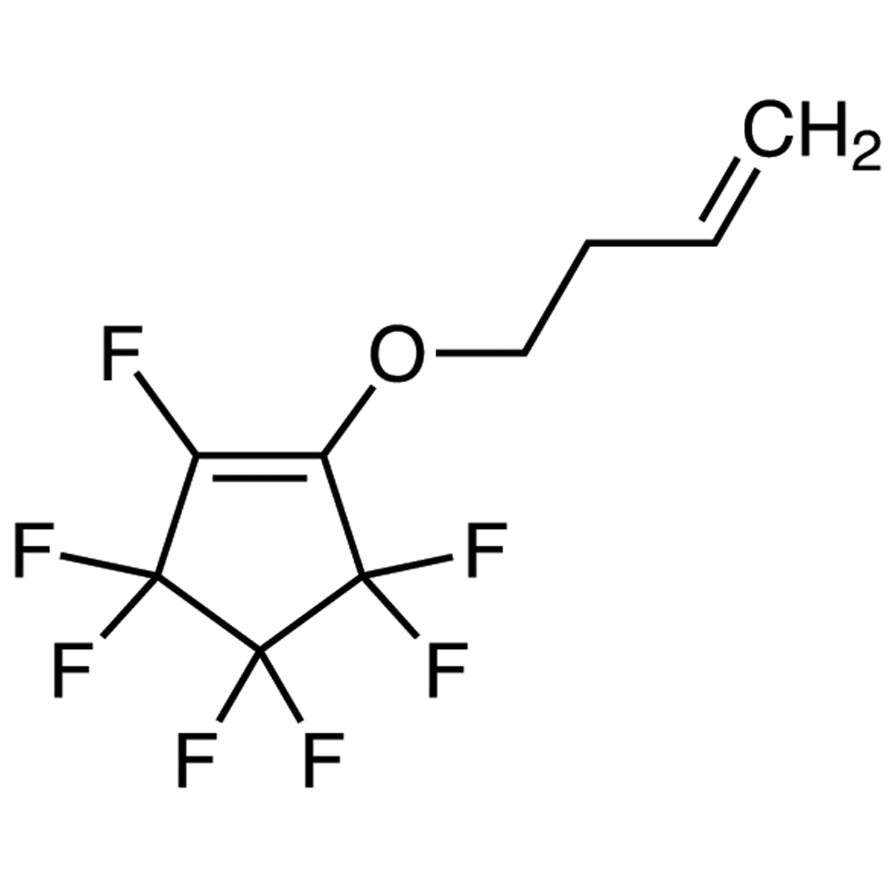
1-(3-Butenyloxy)-2,3,3,4,4,5,5-heptafluorocyclopentene is a specialized chemical compound used in material science and polymer chemistry research. As a monomer, it serves as a fundamental building block for the synthesis of fluorinated polymers and complex compounds. Its unique molecular structure, characterized by multiple fluorine atoms, makes it a key component in the development of advanced materials with enhanced thermal and chemical stability. This compound is widely utilized in laboratories for its ability to contribute to the creation of high-performance materials with specific functional properties.
The compound’s fluorinated structure provides it with exceptional chemical inertness and thermal stability, making it a preferred choice for applications requiring long-term durability and resistance to environmental factors. Its non-polar nature and low polarity further enhance its suitability for use in environments where chemical stability and resistance to degradation are critical. These properties make it an essential reagent for researchers working on advanced material development and polymer synthesis.
In Indonesian laboratories, this compound is commonly used in research focused on the development of fluorinated polymers. Its application spans across various fields, including electronics, medical devices, and environmental technologies. The compound’s unique properties make it a valuable tool for scientists aiming to create materials with superior performance characteristics. Its role in Indonesian research underscores its importance in the advancement of material science and chemical innovation.
Advantages (TCI brochure)
- The spiro- and bicyclo-structured homopolymer can be synthesized by bulk radical polymerization.
- BHFC homopolymer dissolves in organic solvents and shows high light transmissibility, low refractive index and high glass-transition temperature.
TCI brochures (PDF)
- Cyclic Olefin Monomer for Transparent Fluorinated Polymers 2024-12-10 · p. 1
- Fluorinated Monomers 2025-10-03 · p. 1
- Monomers 2025-05-28 · p. 40
Related TCI products
- TCI C1617 142-29-0 Cyclopentene
- TCI C0511 142-29-0 Cyclopentene
- TCI B1586 114482-57-4 4-Cyanophenyl 4-(3-Butenyloxy)benzoate
- TCI B1585 115595-27-2 4-(3-Butenyloxy)benzoic Acid
- TCI M2106 76487-56-4 4-Methoxyphenyl 4-(3-Butenyloxy)benzoate
- TCI H1674 13695-31-3 2,2,3,3,4,4,4-Heptafluorobutyl Methacrylate (stabilized with MEHQ)
- Fluorinated Polymer Synthesis: This compound is ideal for creating fluorinated polymers due to its stable fluorine structure, which enhances thermal and chemical resistance.
- Surface Coating Development: Its non-polar nature makes it suitable for surface modification and coating applications where chemical inertness is required.
- Medical Device Material Research: The compound is used in the development of durable, biocompatible materials for medical applications due to its stability and inertness.
- Environmental Protection Material Testing: Its resistance to degradation makes it useful in studying materials for environmental protection and pollution control.
- Advanced Material Characterization: Researchers use it to study the reactivity and properties of fluorinated compounds in various experimental conditions.
From the TCI brochure
- Cyclic olefin monomer for transparent fluorinated polymers
| Brand | TCI |
|---|---|
| CAS number | 958032-89-8 |
| Molecular formula | — |
| Purity | — |
| Category | Materials Science > Polymer/Macromolecule Reagents > Monomers |
| Pack sizes | Available in standard laboratory quantities |
| Physical form | Liquid |
| Storage | Store in a cool, dry place away from light |
Data from the TCI brochure
| Refractive index nd (BHFC homopolymer) | 1.385 |
|---|---|
| Abbe's number Vd (BHFC homopolymer) | 64 |
| Transmittance %T (BHFC homopolymer) | >90% (250 - 900 nm) |
| Tg (BHFC homopolymer) | 191 ºC |
| Temperature (polymerization) | 80 ºC (initiator: BPO or AIBN) |
Source: TCI brochure FF048 (2024-12-10)
This compound should be stored in a cool, dry environment, away from direct sunlight and sources of heat. It is recommended to use airtight containers made of materials that are chemically inert, such as glass or high-density polyethylene, to prevent contamination and degradation. Due to its fluorinated nature, it is important to handle the compound with care to avoid exposure, as it may have potential health risks. Always ensure proper ventilation in the laboratory when working with this material. Regular monitoring of storage conditions is advised to maintain the integrity and effectiveness of the compound. Laboratories should follow standard safety protocols when handling and storing such specialized reagents.
—
Product Categories
Produk Terkait
-
Cyclopentene TCI C1617
Regular price From Rp 477.750,00Regular priceRp 333.900,00Sale price From Rp 477.750,00 -
Cyclopentene TCI C0511
Regular price From Rp 875.700,00Regular priceRp 612.150,00Sale price From Rp 875.700,00 -
4-Cyanophenyl4-(3-Butenyloxy)benzoate TCI B1586
Regular price Rp 2.757.300,00Regular priceRp 1.943.550,00Sale price Rp 2.757.300,00 -
4-(3-Butenyloxy)benzoicAcid TCI B1585
Regular price Rp 5.750.850,00Regular priceRp 4.037.250,00Sale price Rp 5.750.850,00 -
4-Methoxyphenyl4-(3-Butenyloxy)benzoate TCI M2106
Regular price From Rp 3.922.800,00Regular priceRp 2.758.350,00Sale price From Rp 3.922.800,00 -
2,2,3,3,4,4,4-HeptafluorobutylMethacrylate(stabilizedwithMEHQ) TCI H1674
Regular price From Rp 2.969.400,00Regular priceRp 2.075.850,00Sale price From Rp 2.969.400,00 -
1,2-Bis(2,4-dimethyl-5-phenyl-3-thienyl)-3,3,4,4,5,5-hexafluoro-1-cyclopentene TCI B2629
Regular price From Rp 2.411.850,00Regular priceRp 1.702.050,00Sale price From Rp 2.411.850,00 -
1,2-Bis[2-methylbenzo[b]thiophen-3-yl]-3,3,4,4,5,5-hexafluoro-1-cyclopentene TCI B2287
Regular price From Rp 2.121.000,00Regular priceRp 1.498.350,00Sale price From Rp 2.121.000,00