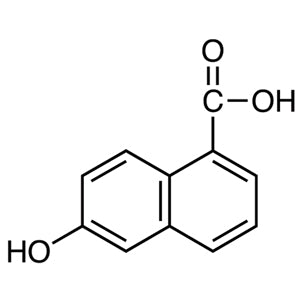
6-Hydroxy-1-naphthoic Acid, CAS 2437-17-4, is a naphthalene-based carboxylic acid carrying a hydroxyl group at the six position. As a non-heterocyclic building block, this compound supplies a rigid bicyclic aromatic core together with two functional groups placed far apart along the molecular axis. That arrangement is highly valued in synthesis laboratories because it yields a linear framework extendable in two directions, whether the goal is to construct complex organic molecules or to assemble repeating structures in materials research.
The property that makes it attractive is the rigidity of the naphthalene skeleton combined with two complementary functional groups. The carboxylic acid group can be esterified or amidated, while the phenolic hydroxyl group can be acylated, alkylated, or act as a hydrogen bond donor. The pairing of a phenol and a carboxylate on a single rigid skeleton is a classic motif in the formation of aromatic polyesters and metal-organic frameworks, since the two can react alternately to form chains. The extended aromatic system also imparts absorption and fluorescence characteristics of interest to photophysical studies.
In Indonesia, this building block is typically used in university and institutional research laboratories working on organic synthesis, polymer chemistry, and functional materials. It is commonly ordered as a reference building block for method development, for preparing intermediates on a laboratory scale, and for teaching advanced synthesis practicals where a difunctional aromatic substrate is required to demonstrate selective transformations at two distinct reactive sites.
Related TCI products
- TCI B3229 2208-15-3 4-Bromo-3-hydroxy-2-naphthoic Acid
- TCI B3180 1779-11-9 7-Bromo-3-hydroxy-2-naphthoic Acid
- TCI H0783 6704-40-1 3-Hydroxy-2-naphthoic Acid 2-Chloroanilide
- TCI H0707 143355-56-0 3-Hydroxy-7-methoxy-2-naphthoic Acid
- TCI H0612 16712-64-4 6-Hydroxy-2-naphthoic Acid
- TCI H0282 5341-58-2 3-Hydroxy-2-naphthoic Acid Hydrazide
- Organic synthesis intermediate preparation: the two spatially separated functional groups allow stepwise, selective transformation of the carboxyl and phenolic sites within multi-step synthetic routes.
- Aromatic polyester research: the combined phenol and carboxylate on one rigid backbone lets the monomer react alternately to build linear, thermally robust polymer chains.
- Metal-organic framework construction: the carboxylate serves as a coordinating site while the rigid naphthalene axis provides predictable linker geometry for extended porous network assembly.
- Photophysical characterization studies: the extended bicyclic aromatic system gives useful absorption and fluorescence behaviour for probing electronic transitions and emission properties of derivatives.
- Derivatization and protecting-group methodology: esterification, amidation, acylation, and alkylation can each be explored on one substrate bearing two chemically distinct reactive centres.
| Brand | TCI |
|---|---|
| CAS number | 2437-17-4 |
| Molecular formula | — |
| Purity | — |
| Category | Chemistry > Building Blocks > Non-Heterocyclic Building Blocks |
| Pack sizes | available in standard laboratory research pack sizes; please confirm the currently listed options when ordering |
| Physical form | — |
| Storage | store in a tightly closed container in a cool, dry place away from direct light |
- Product code: H0886
Store the material in a tightly closed original container in a cool, dry, well-ventilated area, protected from direct sunlight and moisture, and kept away from strong oxidising agents and strong bases. Amber glass or the manufacturer's supplied container is suitable for maintaining product integrity, and containers should be resealed promptly after each use to limit moisture uptake. Handle the solid in a fume hood using gloves, safety goggles, and a laboratory coat, and avoid generating or inhaling dust. Weigh and transfer with clean, dry spatulas to prevent cross-contamination, and always consult the manufacturer's safety data sheet before use and before disposal of residues.
—
Produk Terkait
-
4-Bromo-3-hydroxy-2-naphthoicAcid TCI B3229
Regular price From Rp 2.174.550,00Regular price -
7-Bromo-3-hydroxy-2-naphthoicAcid TCI B3180
Regular price From Rp 769.650,00Regular price -
3-Hydroxy-2-naphthoicAcid2-Chloroanilide TCI H0783
Regular price Rp 3.100.650,00Regular price -
3-Hydroxy-7-methoxy-2-naphthoicAcid TCI H0707
Regular price Rp 1.881.600,00Regular price -
6-Hydroxy-2-naphthoicAcid TCI H0612
Regular price From Rp 477.750,00Regular price -
3-Hydroxy-2-naphthoicAcidHydrazide TCI H0282
Regular price Rp 1.405.950,00Regular price -
3-Hydroxy-2-naphthoicAcid TCI H0281
Regular price From Rp 717.150,00Regular price -
2-Hydroxy-1-naphthoicAcid TCI H0280
Regular price From Rp 557.550,00Regular price