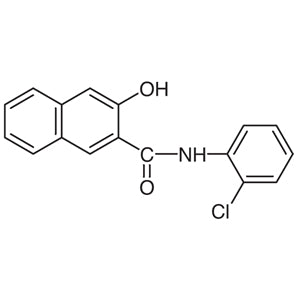
3-Hydroxy-2-naphthoic Acid 2-Chloroanilide is a chemical compound widely used as a building block in organic synthesis. It serves as a versatile intermediate in the development of complex molecules, particularly in the creation of heterocyclic compounds and bioactive substances. Its unique molecular structure combines a hydroxylated naphthoic acid group with a chloroanilide moiety, making it a valuable tool for chemists seeking to modify molecular frameworks. This compound is commonly employed in laboratory settings to explore new synthetic pathways and to generate compounds with potential applications in pharmaceutical and material sciences.
The compound's chemical properties make it a preferred choice for researchers. It exhibits high reactivity due to its functional groups, which enable participation in various reaction types such as substitution, esterification, and nucleophilic reactions. Its ability to interact with a wide range of reagents allows for the synthesis of diverse compounds with tailored properties. However, it is sensitive to moisture and air exposure, requiring careful handling and storage to maintain its integrity. These characteristics make it a reliable and effective reagent in synthetic chemistry.
In Indonesian laboratories, this compound is frequently used in organic chemistry research and the synthesis of new compounds. It is a key component in the development of pharmaceuticals, materials, and other chemical products. Researchers in Indonesia rely on this compound for its reactivity and versatility, making it an essential part of their synthetic toolkit. Its application is widespread across academic and industrial research settings.
Related TCI products
- TCI B3229 2208-15-3 4-Bromo-3-hydroxy-2-naphthoic Acid
- TCI B3180 1779-11-9 7-Bromo-3-hydroxy-2-naphthoic Acid
- TCI H0886 2437-17-4 6-Hydroxy-1-naphthoic Acid
- TCI H0707 143355-56-0 3-Hydroxy-7-methoxy-2-naphthoic Acid
- TCI H0612 16712-64-4 6-Hydroxy-2-naphthoic Acid
- TCI H0282 5341-58-2 3-Hydroxy-2-naphthoic Acid Hydrazide
- Organic synthesis of heterocyclic compounds due to its reactive functional groups and structural versatility.
- Development of bioactive molecules for pharmaceutical research as a key intermediate in complex molecule construction.
- Preparation of functional materials in material science through its ability to participate in esterification and substitution reactions.
- Investigation of chemical reactivity in academic research settings for exploring new synthetic methodologies.
- Support for medicinal chemistry projects where the compound is used to create derivatives with potential therapeutic applications.
| Brand | TCI |
|---|---|
| CAS number | 6704-40-1 |
| Molecular formula | — |
| Purity | — |
| Category | Chemistry > Building Blocks > Non-Heterocyclic Building Blocks |
| Pack sizes | Available in standard laboratory quantities |
| Physical form | Solid |
| Storage | Requires protection from moisture and air exposure |
This compound should be stored in a cool, dry place away from moisture and air exposure to maintain its chemical integrity. It is recommended to use airtight containers made of glass or high-density polyethylene to prevent degradation. Due to its reactivity, it should be handled in a well-ventilated laboratory environment with appropriate personal protective equipment. Avoid prolonged exposure to light and ensure that storage conditions are consistent to prevent unwanted chemical changes. Regular monitoring of storage conditions is advised to ensure the compound remains suitable for use in laboratory applications.
—
Produk Terkait
-
4-Bromo-3-hydroxy-2-naphthoicAcid TCI B3229
Regular price From Rp 2.174.550,00Regular price -
7-Bromo-3-hydroxy-2-naphthoicAcid TCI B3180
Regular price From Rp 769.650,00Regular price -
6-Hydroxy-1-naphthoicAcid TCI H0886
Regular price From Rp 5.750.850,00Regular price -
3-Hydroxy-7-methoxy-2-naphthoicAcid TCI H0707
Regular price Rp 1.881.600,00Regular price -
6-Hydroxy-2-naphthoicAcid TCI H0612
Regular price From Rp 477.750,00Regular price -
3-Hydroxy-2-naphthoicAcidHydrazide TCI H0282
Regular price Rp 1.405.950,00Regular price -
3-Hydroxy-2-naphthoicAcid TCI H0281
Regular price From Rp 717.150,00Regular price -
2-Hydroxy-1-naphthoicAcid TCI H0280
Regular price From Rp 557.550,00Regular price