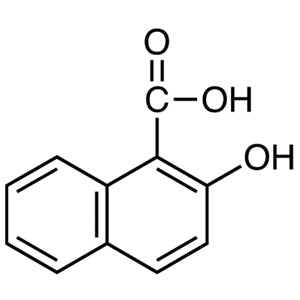
3-Hydroxy-2-naphthoic Acid is a chemical compound widely used as a building block in various chemical reactions, particularly in the synthesis of complex molecules. Its role in laboratory settings is crucial for researchers and chemists aiming to develop new compounds or modify existing molecular structures. This compound is commonly found in laboratory applications, supporting both research and product development in the chemical industry. As a key component in both heterocyclic and non-heterocyclic compounds, it plays a significant role in the formation of complex chemical structures.
The compound is known for its stable molecular structure and moderate reactivity, making it a preferred choice for a variety of chemical reactions such as esterification, amidation, and substitution reactions. Its relatively low reactivity ensures that it can be easily handled under various laboratory conditions without undergoing unwanted side reactions. Additionally, its high purity and consistent quality make it a reliable material for scientific research. These properties contribute to its popularity among chemists and researchers working in different fields.
In Indonesian laboratories, 3-Hydroxy-2-naphthoic Acid is frequently used in chemical, pharmaceutical, and industrial research settings. Local researchers and industries rely on this compound for the development of new chemical substances, molecular modifications, and the testing of chemical reaction feasibility. Its availability and quality make it a relevant and essential material in the context of scientific and industrial innovation.
Related TCI products
- TCI B3229 2208-15-3 4-Bromo-3-hydroxy-2-naphthoic Acid
- TCI B3180 1779-11-9 7-Bromo-3-hydroxy-2-naphthoic Acid
- TCI H0886 2437-17-4 6-Hydroxy-1-naphthoic Acid
- TCI H0783 6704-40-1 3-Hydroxy-2-naphthoic Acid 2-Chloroanilide
- TCI H0707 143355-56-0 3-Hydroxy-7-methoxy-2-naphthoic Acid
- TCI H0612 16712-64-4 6-Hydroxy-2-naphthoic Acid
- Used in organic synthesis for creating complex molecular structures due to its versatile reactivity and stability.
- Applied in pharmaceutical research to develop new drug compounds and modify existing molecular frameworks.
- Utilized in chemical analysis for standardization and as a reference material in various analytical procedures.
- Employed in industrial chemistry for the production of specialty chemicals and functional materials.
- Integrated into academic research for teaching and experimental purposes in undergraduate and graduate chemistry programs.
| Brand | TCI |
|---|---|
| CAS number | 92-70-6 |
| Molecular formula | — |
| Purity | — |
| Category | Chemistry > Building Blocks > Non-Heterocyclic Building Blocks |
| Pack sizes | Available in various quantities as per standard laboratory supply options |
| Physical form | Solid, crystalline appearance |
| Storage | Store in a cool, dry place away from direct sunlight and moisture |
3-Hydroxy-2-naphthoic Acid should be stored in a cool, dry place, away from direct sunlight and moisture to maintain its stability and purity. It is recommended to use airtight containers to prevent exposure to air and humidity, which could affect its quality over time. As a solid compound, it is typically handled using standard laboratory equipment, and care should be taken to avoid contamination. While it is not highly reactive, it is advisable to work in a well-ventilated area to ensure safe handling. Proper labeling and storage conditions are essential to maintain its integrity and ensure safe use in laboratory environments.
—
Produk Terkait
-
4-Bromo-3-hydroxy-2-naphthoicAcid TCI B3229
Regular price From Rp 2.174.550,00Regular price -
7-Bromo-3-hydroxy-2-naphthoicAcid TCI B3180
Regular price From Rp 769.650,00Regular price -
6-Hydroxy-1-naphthoicAcid TCI H0886
Regular price From Rp 5.750.850,00Regular price -
3-Hydroxy-2-naphthoicAcid2-Chloroanilide TCI H0783
Regular price Rp 3.100.650,00Regular price -
3-Hydroxy-7-methoxy-2-naphthoicAcid TCI H0707
Regular price Rp 1.881.600,00Regular price -
6-Hydroxy-2-naphthoicAcid TCI H0612
Regular price From Rp 477.750,00Regular price -
3-Hydroxy-2-naphthoicAcidHydrazide TCI H0282
Regular price Rp 1.405.950,00Regular price -
2-Hydroxy-1-naphthoicAcid TCI H0280
Regular price From Rp 557.550,00Regular price