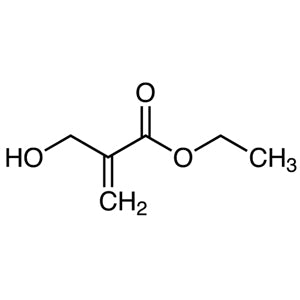
TCI H0916 Ethyl 2-(Hydroxymethyl)acrylate is a functionalized acrylate ester that carries a hydroxymethyl group at the position alpha to the carbon–carbon double bond, and it is supplied in a stabilized state with hydroquinone acting as a polymerization inhibitor. The compound is a characteristic product of the Morita–Baylis–Hillman reaction and is a highly valued starting material because it combines three structural elements in a single molecule: a conjugated alkene, an ester group, and an allylic alcohol. In the laboratory, this material serves both as a functional monomer and as a versatile building block in organic synthesis.
The property that makes this compound a preferred choice is its dual, mutually complementary reactivity within a small molecular framework. The double bond conjugated with the ester functions as a Michael acceptor and therefore readily accepts nucleophilic attack, while the allylic alcohol group can be esterified, etherified, activated into a leaving group, or oxidized. The combination of these two reactive handles enables allylic substitution reactions, cyclizations toward lactones and other functional rings, and the formation of polymers bearing free hydroxyl groups. The presence of hydroquinone as a stabilizer keeps the material in its monomeric form throughout storage.
In Indonesian laboratories, this building block is typically used in university and institutional research groups working on organic synthesis, medicinal chemistry, and polymer and materials chemistry. It is normally handled at the bench scale for exploratory routes, method development, and the preparation of intermediates that are later carried forward into larger sequences. Because it belongs to the non-heterocyclic building block category, it is commonly kept as part of a general synthetic reagent inventory rather than being purchased for a single reaction.
Related TCI products
- TCI T3297 5395-50-6 1,3,4,6-Tetrakis(hydroxymethyl)tetrahydroimidazo[4,5-d]imidazole-2,5(1H,3H)-dione
- TCI B1492 20605-01-0 Diethyl 2,2-Bis(hydroxymethyl)malonate
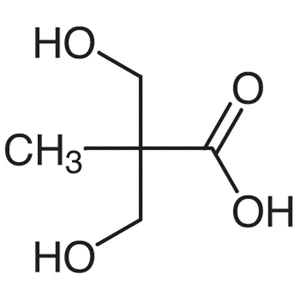
- TCI B1192 4767-03-7 2,2-Bis(hydroxymethyl)propionic Acid
- TCI H1823 6282-02-6 N-(Hydroxymethyl)benzamide
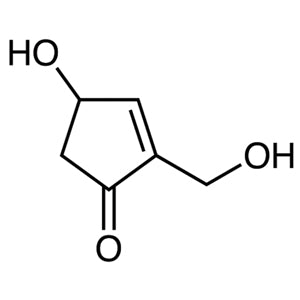
- TCI H1723 76374-26-0 4-Hydroxy-2-(hydroxymethyl)-2-cyclopenten-1-one
- TCI H1605 16375-88-5 N-[4-(Hydroxymethyl)phenyl]acetamide
- Michael addition chemistry — the alkene conjugated to the ester acts as an electron-poor Michael acceptor, allowing nucleophiles such as amines, thiols, and stabilized carbanions to add cleanly across the double bond.
- Morita–Baylis–Hillman adduct chemistry — since the compound is itself a representative MBH product, it lets researchers begin directly at the adduct stage and study downstream transformations without first performing the coupling.
- Allylic substitution reactions — the allylic alcohol can be converted into a leaving group and then displaced by nucleophiles, giving access to a wide range of substituted acrylate derivatives from one common precursor.
- Lactone and functional ring synthesis — the simultaneous presence of an ester, a hydroxyl group, and an alkene allows intramolecular cyclization strategies that build lactones and other functionalized ring systems efficiently.
- Functional monomer for polymer chemistry — the compound can be polymerized to give materials carrying free hydroxyl groups along the chain, providing polymers with sites available for subsequent grafting or crosslinking.
| Brand | TCI (Tokyo Chemical Industry) |
|---|---|
| CAS number | 10029-04-6 |
| Molecular formula | — |
| Purity | — |
| Category | Chemistry > Building Blocks > Non-Heterocyclic Building Blocks |
| Pack sizes | available in standard TCI research-scale packaging; please refer to the current catalog listing for the sizes offered |
| Physical form | — |
| Storage | supplied stabilized with hydroquinone (HQ) as a polymerization inhibitor; store under conditions that preserve the monomeric form |
- Catalog number: H0916
Store this reagent in a cool, dark place in its original tightly closed container, keeping it away from heat, direct sunlight, and sources of ignition, since acrylate esters are prone to polymerization when the inhibitor is depleted or when the material is exposed to elevated temperature. Do not remove or neutralize the hydroquinone stabilizer unless the experimental procedure specifically requires it. Handle the material inside a fume hood while wearing gloves, safety goggles, and a laboratory coat, and avoid contact with skin, eyes, and inhalation of vapors. Use clean, dry glassware and transfer tools to prevent contamination, close the container promptly after use, and consult the manufacturer's safety data sheet before working with the compound.
—
Produk Terkait
-
1,3,4,6-Tetrakis(hydroxymethyl)tetrahydroimidazo[4,5-d]imidazole-2,5(1H,3H)-dione TCI T3297
Regular price From Rp 1.035.300,00Regular price -
Diethyl2,2-Bis(hydroxymethyl)malonate TCI B1492
Regular price From Rp 3.021.900,00Regular price -
2,2-Bis(hydroxymethyl)propionicAcid TCI B1192
Regular price From Rp 530.250,00Regular price -
N-(Hydroxymethyl)benzamide TCI H1823
Regular price From Rp 2.068.500,00Regular price -
4-Hydroxy-2-(hydroxymethyl)-2-cyclopenten-1-one TCI H1723
Regular price Rp 1.936.200,00Regular price -
N-[4-(Hydroxymethyl)phenyl]acetamide TCI H1605
Regular price From Rp 1.538.250,00Regular price -
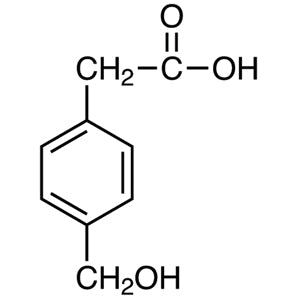
4-(Hydroxymethyl)phenylaceticAcid TCI H1473
Regular price From Rp 955.500,00Regular price -
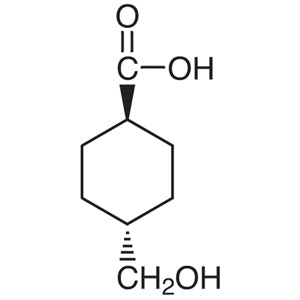
trans-4-(Hydroxymethyl)cyclohexanecarboxylicAcid TCI H1243
Regular price From Rp 3.207.750,00Regular price
![5395-50-6 1,3,4,6-Tetrakis(hydroxymethyl)tetrahydroimidazo[4,5-d]imidazole-2,5(1H,3H)-dione - AMI Scientific](http://amiscientific.com/cdn/shop/files/TCI2510T3297.jpg?v=1769181342&width=533)


![16375-88-5 N-[4-(Hydroxymethyl)phenyl]acetamide - AMI Scientific](http://amiscientific.com/cdn/shop/files/TCI2510H1605.jpg?v=1767118290&width=533)