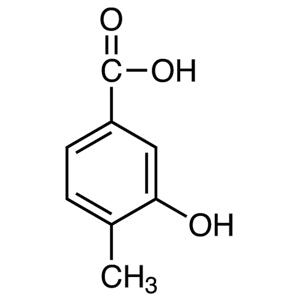
3-Hydroxy-4-methylbenzoic Acid is a substituted benzoic acid that carries a phenolic hydroxyl group and a methyl group at adjacent positions on the aromatic ring. This arrangement of three functional groups makes it a practical building block for synthetic chemists: the carboxylic acid can be esterified or converted to an amide, the phenolic hydroxyl can be etherified or acylated, and the methyl group contributes electronic and steric effects that direct subsequent reactions on the ring. In the laboratory, the compound is commonly used as a starting scaffold in the preparation of ligands, pharmaceutical intermediates, and target molecules for structure-activity relationship research.
The property that most often drives its selection is the presence of two functional groups of differing acidity within a single molecule. The carboxylic acid group is considerably more acidic than the phenolic group, so the two can be deprotonated in a stepwise manner and functionalised selectively simply by adjusting the base and the reaction conditions. The proximity of the hydroxyl and carboxyl groups also allows the formation of bidentate chelates with metal ions, which is useful both in coordination chemistry and in the design of porous materials. The compound is supplied as a crystalline solid.
In Indonesian laboratories, this building block is typically used in university and institutional synthetic chemistry groups, in pharmaceutical research units preparing intermediates, and in materials research teams working on metal-organic frameworks and coordination complexes. It is normally weighed out in small portions for multi-step syntheses, method development, and derivatisation studies, where a well-defined starting scaffold with orthogonally addressable functional groups shortens the route to the desired target molecule.
Related TCI products
- Synthesis of pharmaceutical intermediates, where the carboxylic acid is converted to esters or amides to build the core framework of candidate molecules under investigation.
- Preparation of organic ligands, since the neighbouring hydroxyl and carboxyl groups form bidentate chelates with metal ions for coordination complexes and catalyst development work.
- Structure-activity relationship studies, because the methyl group and the two acidic sites allow systematic variation of substituents around a consistent aromatic scaffold.
- Construction of porous and framework materials, where the carboxylate serves as a linker to metal nodes while the phenolic group provides an additional coordination or modification site.
- Selective functionalisation method development, taking advantage of the clear acidity difference between the carboxylic and phenolic groups to test stepwise deprotonation and protection strategies.
| Brand | TCI |
|---|---|
| CAS number | 586-30-1 |
| Molecular formula | — |
| Purity | — |
| Category | Chemistry > Building Blocks > Non-Heterocyclic Building Blocks |
| Pack sizes | available in the standard research-scale pack sizes listed for this catalogue item |
| Physical form | crystalline solid |
| Storage | keep in a tightly closed original container in a cool, dry place away from light |
- Product code: H0929
Store the material in its original tightly closed container in a cool, dry, well-ventilated area, protected from light, moisture, and incompatible substances such as strong bases and strong oxidising agents. Amber glass or the supplier's original packaging is suitable for long-term storage; reseal promptly after each use to limit moisture uptake and contamination. Handle the solid in a fume hood or a well-ventilated workspace, and wear a laboratory coat, chemical-resistant gloves, and safety goggles. Avoid generating dust during weighing and transfer, wash hands thoroughly after handling, and consult the manufacturer's safety data sheet before use and for disposal guidance in accordance with local regulations.
—
Produk Terkait
-
2-Hydroxy-6-methylbenzoicAcid TCI M3737
Regular price From Rp 2.332.050,00Regular price -
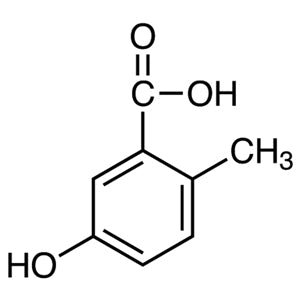
5-Hydroxy-2-methylbenzoicAcid TCI H1586
Regular price From Rp 903.000,00Regular price -
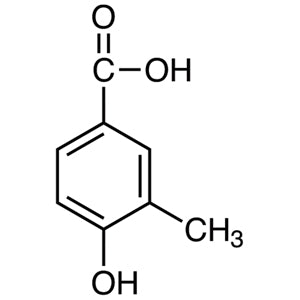
4-Hydroxy-3-methylbenzoicAcid TCI H1319
Regular price From Rp 1.378.650,00Regular price -
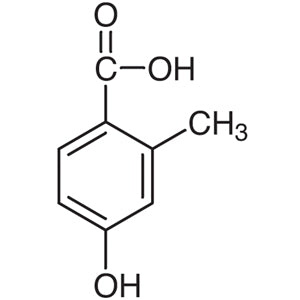
4-Hydroxy-2-methylbenzoicAcid TCI H1311
Regular price From Rp 2.359.350,00Regular price -
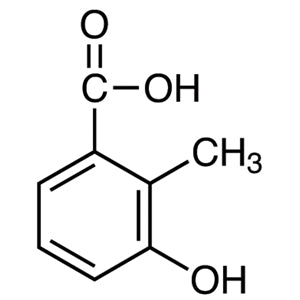
3-Hydroxy-2-methylbenzoicAcid TCI H0885
Regular price From Rp 477.750,00Regular price -
2-Bromo-5-methylbenzoicAcid TCI B4145
Regular price From Rp 1.510.950,00Regular price -
2-Bromo-6-methylbenzoicAcid TCI B4097
Regular price From Rp 1.431.150,00Regular price -
2-Bromo-4-methylbenzoicAcid TCI B3879
Regular price From Rp 795.900,00Regular price