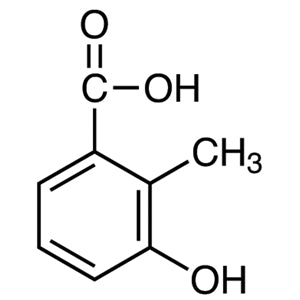
3-Hydroxy-2-methylbenzoic Acid, CAS number 603-80-5, is a substituted benzoic acid that carries a hydroxyl group at the three position and a methyl group at the two position of its aromatic ring. This arrangement of three neighbouring functional groups makes it a valuable building block for researchers who require an aromatic scaffold with a specific substitution pattern. In the laboratory, the compound is commonly used as a starting point for the synthesis of pharmaceutical intermediates, ligands, and molecules that demand precise placement of functional groups on a benzene ring.
The principal characteristic of this material is the presence of three working points that can be exploited in sequence. The carboxylic acid group can be esterified, amidated, or activated for coupling reactions; the phenolic hydroxyl group can be alkylated, acylated, or converted into a triflate for cross-coupling chemistry; and the methyl group at the ortho position provides a steric influence that can direct reaction selectivity and affect the conformation of the product. The proximity of the hydroxyl group to the carboxylate also allows intramolecular hydrogen bonding to form, together with the ability to bind metal ions as a bidentate ligand.
In Indonesian laboratories, this building block is typically handled in university research groups, pharmaceutical development units, and institutional synthesis facilities where multi-step organic routes are assembled. It is normally ordered in small research quantities for method development and route scouting rather than for production work. Researchers value the predictable substitution pattern because it reduces the number of protection and deprotection steps required when constructing more elaborate target molecules.
Related TCI products
- TCI M3737 567-61-3 2-Hydroxy-6-methylbenzoic Acid
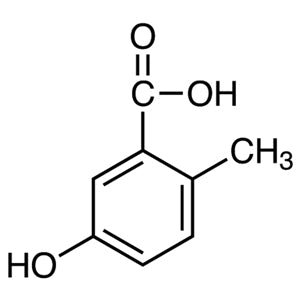
- TCI H1586 578-22-3 5-Hydroxy-2-methylbenzoic Acid
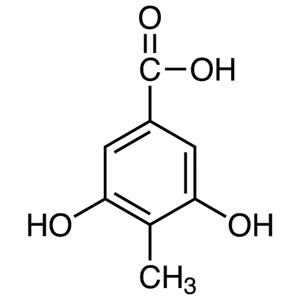
- TCI D4712 28026-96-2 3,5-Dihydroxy-4-methylbenzoic Acid
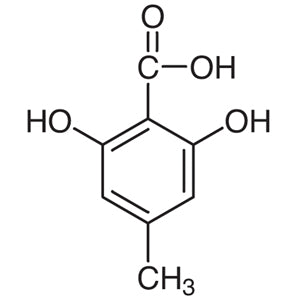
- TCI D2770 480-67-1 2,6-Dihydroxy-4-methylbenzoic Acid
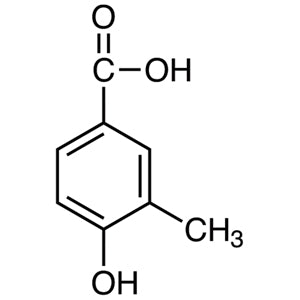
- TCI H1319 499-76-3 4-Hydroxy-3-methylbenzoic Acid
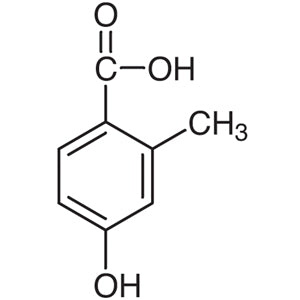
- TCI H1311 578-39-2 4-Hydroxy-2-methylbenzoic Acid
- Pharmaceutical intermediate synthesis: the three distinct reactive handles allow chemists to build complex drug candidate scaffolds through sequential, selectively controlled transformations on a single aromatic core.
- Ligand preparation for coordination chemistry: the adjacent hydroxyl and carboxylate groups can act together as a bidentate binding site for metal ions in complex formation studies.
- Cross-coupling route development: the phenolic hydroxyl can be converted into a triflate leaving group, opening the ring system to palladium-catalysed carbon–carbon bond forming reactions.
- Ester and amide derivative libraries: the carboxylic acid is readily esterified or amidated, making the compound a convenient anchor for preparing families of related analogues.
- Steric and conformational studies: the ortho methyl group exerts a defined steric influence that researchers use to probe reaction selectivity and the preferred conformation of products.
| Brand | TCI |
|---|---|
| CAS number | 603-80-5 |
| Molecular formula | — |
| Purity | — |
| Category | Chemistry > Building Blocks > Non-Heterocyclic Building Blocks |
| Pack sizes | available in standard research-scale packaging; please refer to the current catalogue listing for the sizes offered |
| Physical form | — |
| Storage | store in a cool, dry place in the tightly closed original container |
- Product code: H0885
Store the container in a cool, dry, well ventilated area away from direct sunlight, moisture, and incompatible materials such as strong oxidising agents and strong bases. Keep the material in its tightly closed original container, or in a clean amber glass or chemically compatible bottle if transfer is necessary, and label any secondary container clearly. Handle the solid in a fume hood while wearing safety glasses, gloves, and a laboratory coat, and avoid generating or inhaling dust. Weigh the material with clean, dry spatulas to prevent contamination, close the container promptly after use, and consult the manufacturer's safety data sheet before first handling and for disposal guidance.
—
Produk Terkait
-
2-Hydroxy-6-methylbenzoicAcid TCI M3737
Regular price From Rp 2.332.050,00Regular price -
5-Hydroxy-2-methylbenzoicAcid TCI H1586
Regular price From Rp 903.000,00Regular price -
3,5-Dihydroxy-4-methylbenzoicAcid TCI D4712
Regular price From Rp 1.431.150,00Regular price -
2,6-Dihydroxy-4-methylbenzoicAcid TCI D2770
Regular price Rp 7.234.500,00Regular price -
4-Hydroxy-3-methylbenzoicAcid TCI H1319
Regular price From Rp 1.378.650,00Regular price -
4-Hydroxy-2-methylbenzoicAcid TCI H1311
Regular price From Rp 2.359.350,00Regular price -
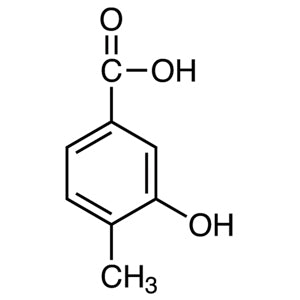
3-Hydroxy-4-methylbenzoicAcid TCI H0929
Regular price From Rp 769.650,00Regular price -
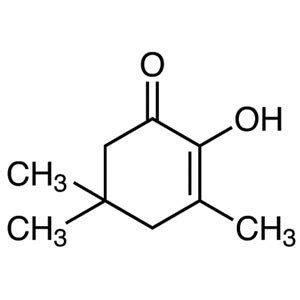
2-Hydroxy-3,5,5-trimethyl-2-cyclohexen-1-one TCI T2723
Regular price Rp 1.273.650,00Regular price