

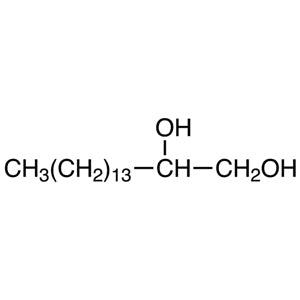
1,2-Hexadecanediol is a chemical compound classified under the category of building blocks in chemistry. It is a diol, meaning it contains two hydroxyl (-OH) groups at the terminal positions of a 16-carbon chain. This structural feature makes it a versatile molecule in synthetic chemistry, particularly in reactions that require the formation of esters, amides, or polymers. In the laboratory, it serves as a fundamental component for the synthesis of more complex organic compounds. Its reactivity and functional group availability make it a valuable tool for chemists working on a wide range of applications.
The compound’s two hydroxyl groups render it highly reactive in various chemical reactions, including esterification, amidation, and polymerization. These properties make it an ideal choice for the development of surfactants, solvents, and polymer-based materials. Its stability under normal laboratory conditions further enhances its utility, allowing it to be used in both research and industrial settings. The compound’s ability to participate in multiple reaction pathways makes it a preferred material for synthetic chemists seeking to create functional molecules with specific properties.
In Indonesian laboratories, 1,2-Hexadecanediol is widely used in organic chemistry research and pharmaceutical development. It is commonly found in projects aimed at creating new compounds with applications in cosmetics, medicine, and industrial products. Its availability in the local market ensures that researchers can easily access this essential building block for their experiments and innovations.
- Organic synthesis is a primary application for 1,2-Hexadecanediol due to its ability to participate in esterification and amidation reactions, making it ideal for creating complex organic molecules.
- Pharmaceutical research benefits from this compound as it is used in the development of new drugs and active pharmaceutical ingredients, particularly in formulations requiring hydrophilic properties.
- Polymer science utilizes 1,2-Hexadecanediol as a building block for creating biodegradable or specialty polymers, offering versatility in material design and application.
- Cosmetic formulation relies on this compound for its surfactant properties, enabling the creation of stable emulsions and improved product textures in skincare and personal care products.
- Industrial chemical production uses 1,2-Hexadecanediol as a versatile intermediate in the synthesis of solvents and specialty chemicals, supporting various manufacturing processes.
| Brand | TCI |
|---|---|
| CAS number | 6920-24-7 |
| Molecular formula | — |
| Purity | — |
| Category | Chemistry > Building Blocks > Non-Heterocyclic Building Blocks |
| Pack sizes | Available in various quantities as per supplier specifications |
| Physical form | Liquid |
| Storage | Store in a cool, dry place away from direct sunlight |
1,2-Hexadecanediol should be stored in a cool, dry environment to maintain its chemical stability and prevent degradation. It is recommended to keep the compound in a tightly sealed container to minimize exposure to air and moisture, which could affect its reactivity. Suitable storage containers include glass or high-density polyethylene (HDPE) bottles that are resistant to chemical interactions. In laboratory settings, it is important to handle the compound with appropriate personal protective equipment (PPE) such as gloves and safety goggles to ensure safe handling. Avoid contact with incompatible materials, and ensure proper ventilation when working with this substance. Regular monitoring of storage conditions will help maintain the integrity of the compound for extended use in research and industrial applications.
—
Produk Terkait
-
1,16-Hexadecanediol TCI H0552
Regular price From Rp 3.817.800,00Regular price -
1,2-Decanediol TCI D2720
Regular price From Rp 1.167.600,00Regular price -
1,10-Decanediol TCI D0014
Regular price From Rp 610.050,00Regular price -
erythro-5,6-Dodecanediol TCI D2719
Regular price From Rp 2.704.800,00Regular price -
threo-5,6-Dodecanediol TCI D2678
Regular price Rp 8.585.850,00Regular price -
1,2-Dodecanediol TCI D1861
Regular price From Rp 1.298.850,00Regular price -
1,12-Dodecanediol TCI D0969
Regular price From Rp 769.650,00Regular price -
1,2-Tetradecanediol TCI T1353
Regular price Rp 2.809.800,00Regular price


