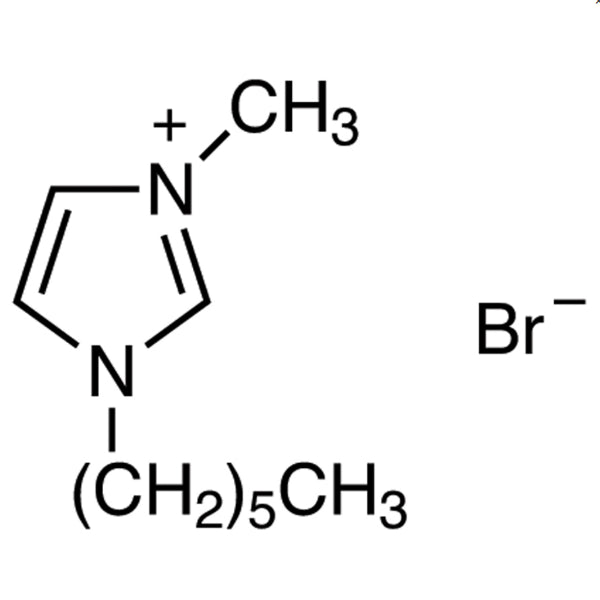
1-Hexyl-3-methylimidazolium Bromide is an imidazolium salt belonging to the class of materials known as ionic liquids — substances composed entirely of ions that nevertheless remain liquid at relatively low temperatures. In this compound, an imidazolium cation bearing a hexyl chain is paired with a bromide anion, producing a material with very low vapour pressure that does not readily evaporate and is capable of dissolving a wide range of organic and inorganic compounds. In the laboratory, it serves as an alternative solvent in place of volatile organic solvents, and equally as an intermediate for preparing other ionic liquids through anion exchange.
The property that makes this material a frequent choice is the balance it strikes between ionic character and the hydrophobic character contributed by the hexyl chain. An alkyl chain of this length gives the compound surfactant-like behaviour, so that it can stabilise interfaces, assist in the formation of nanoparticles, and modify the solubility of organic substrates. The bromide anion is relatively easy to displace, which makes the compound a practical precursor for synthesising ionic liquids based on other anions by way of metathesis reactions. Its negligible vapour pressure means the material does not escape into laboratory air — a genuine advantage from the standpoint of occupational health and of green chemistry principles.
In Indonesian laboratories, this ionic liquid is typically encountered in university and institutional research settings working on alternative solvent systems, materials synthesis, and separation chemistry. It is commonly used at small scale in synthetic and physical chemistry groups, either directly as a reaction medium or as the starting salt from which a series of task-specific ionic liquids is prepared. Because it is handled in modest quantities, it is usually kept as a bench-scale research chemical rather than a bulk process solvent.
- Alternative reaction solvent — replaces volatile organic solvents as a reaction medium, since its negligible vapour pressure keeps solvent vapour out of the laboratory atmosphere while still dissolving many organic and inorganic species.
- Ionic liquid synthesis via anion metathesis — the bromide anion is comparatively easy to displace, so this salt acts as a practical starting material for preparing ionic liquids built around other anions.
- Nanoparticle preparation — the surfactant-like behaviour imparted by the hexyl chain helps stabilise interfaces during particle formation, supporting controlled growth and dispersion of nanostructured materials in solution.
- Interface and surface stabilisation studies — the combination of ionic head group and hydrophobic alkyl chain allows this compound to accumulate at interfaces, making it useful for work on emulsions and phase boundaries.
- Solubility and extraction work — the amphiphilic structure modifies the solubility of organic substrates, so the material is applied where partitioning behaviour or dissolution of otherwise poorly soluble compounds must be adjusted.
| Brand | TCI |
|---|---|
| CAS number | 85100-78-3 |
| Molecular formula | — |
| Purity | — |
| Category | Chemistry > Specialty Synthesis > Ionic Liquids [Specialty Synthesis] |
| Pack sizes | research-scale packaging as listed on the product page |
| Physical form | — |
| Storage | store in a tightly closed container; refer to the manufacturer's label and safety data sheet for the specified storage conditions |
- Product code: H1227
Keep the material in its original tightly closed container, protected from moisture, and store it according to the conditions stated on the manufacturer's label and safety data sheet. Imidazolium bromide salts are generally hygroscopic, so containers should be closed promptly after use and, where practical, handled in a dry environment to limit water uptake. Transfer with clean, dry glass or compatible plastic implements and avoid contamination between batches. Handle in a well-ventilated area or fume hood, wearing gloves, safety glasses, and a laboratory coat, and avoid contact with skin and eyes. Although the negligible vapour pressure means there is little inhalation risk from vapour, spills should still be contained and cleaned up promptly. Consult the current safety data sheet before first use and dispose of residues through the laboratory's chemical waste stream.
—
Produk Terkait
-
TCI B5774 5,10-Bis(4,4,5,5-tetramethyl-1,3,2-dioxaborolan-2-yl)naphtho[1,2-c:5,6-c']bis([1,2,5]oxadiazole)
Regular price Rp 10.255.350,00Regular price -
Dihydroiodide TCI B6569
Regular price From Rp 1.936.200,00Regular price -
Trifluoromethanesulfonate TCI B7003
Regular price From Rp 1.936.200,00Regular price
![5,10-Bis(4,4,5,5-tetramethyl-1,3,2-dioxaborolan-2-yl)naphtho[1,2-c:5,6-c']bis([1,2,5]oxadiazole) - TCI B5774 - AMI Scientific](http://amiscientific.com/cdn/shop/files/TCI2510B5774.jpg?v=1769180228&width=533)