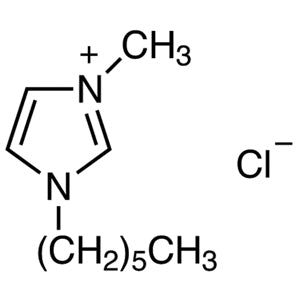
1-Hexyl-3-methylimidazolium Chloride is an ionic liquid that plays a crucial role in modern laboratory settings, particularly in chemical synthesis and electrochemical research. As a non-volatile and high-boiling-point compound, it serves as an effective medium for various chemical reactions, offering stability under extreme conditions. Its unique properties make it ideal for use as a solvent, catalyst, or reaction medium in a wide range of experimental applications. This compound is widely utilized in both academic and industrial research due to its versatility and reliability in maintaining reaction efficiency and product purity.
The key properties that make 1-Hexyl-3-methylimidazolium Chloride a preferred choice include its high ionic conductivity, non-volatility, and thermal stability. These characteristics allow it to function efficiently in applications requiring ion transfer or prolonged reaction times. Additionally, its low vapor pressure minimizes evaporation during experiments, ensuring consistent results. The compound’s ability to dissolve a wide range of substances also enhances its utility in complex chemical processes, making it a valuable tool in both basic and applied research.
In Indonesian laboratories, 1-Hexyl-3-methylimidazolium Chloride is commonly used in organic synthesis, electrochemical studies, and separation processes. Its stability and conductivity make it particularly relevant for research in chemical purity and advanced analytical techniques. Many institutions in Indonesia rely on this compound for experiments that require a reliable and stable reaction environment. Its application is especially prominent in universities and research centers focusing on chemical sciences and related fields.
TCI brochures (PDF)
- Ionic Liquids 2026-06-08 · p. 8
Related TCI products
- TCI H1633 178631-05-5 1-Hexyl-3-methylimidazolium Iodide
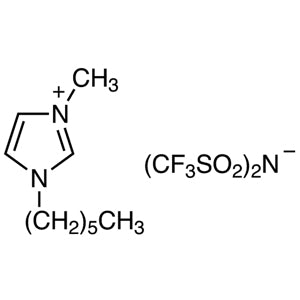
- TCI H1423 382150-50-7 1-Hexyl-3-methylimidazolium Bis(trifluoromethanesulfonyl)imide
- TCI H1227 85100-78-3 1-Hexyl-3-methylimidazolium Bromide
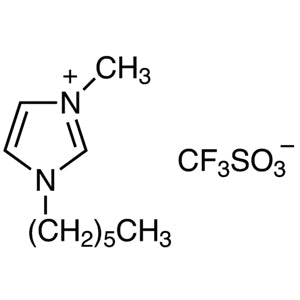
- TCI H1100 460345-16-8 1-Hexyl-3-methylimidazolium Trifluoromethanesulfonate
- TCI H1099 244193-50-8 1-Hexyl-3-methylimidazolium Tetrafluoroborate
- TCI H1098 304680-35-1 1-Hexyl-3-methylimidazolium Hexafluorophosphate
- Organic synthesis experiments benefit from this ionic liquid due to its ability to dissolve a wide range of organic compounds and facilitate reaction efficiency.
- Electrochemical studies utilize this compound as a non-volatile electrolyte, providing stable ion transport in electrochemical cells.
- Chemical separation processes take advantage of its high boiling point and low vapor pressure, ensuring minimal evaporation during distillation or purification.
- Catalytic reactions often use this ionic liquid as a reaction medium, enhancing reaction rates and selectivity in complex chemical transformations.
- Analytical chemistry applications rely on its stability and conductivity for accurate measurements in ion-exchange and spectroscopic analyses.
| Brand | TCI |
|---|---|
| CAS number | 171058-17-6 |
| Molecular formula | — |
| Purity | — |
| Category | Chemistry > Specialty Synthesis > Ionic Liquids |
| Pack sizes | Available in various quantities as per supplier specifications |
| Physical form | Solid or liquid, depending on the specific product formulation |
| Storage | Store in a cool, dry place away from direct sunlight and moisture |
This ionic liquid should be stored in a cool, dry environment, away from direct sunlight and moisture to maintain its chemical integrity. It is recommended to use sealed containers made of glass or high-density polyethylene to prevent contamination and evaporation. Due to its non-volatile nature, it does not require special refrigeration, but it should be kept in a secure location to avoid accidental exposure. In laboratory settings, proper personal protective equipment, such as gloves and safety goggles, should be worn when handling this compound to ensure safety. Regular monitoring of storage conditions is advised to ensure optimal performance and longevity of the material.
—
Produk Terkait
-
1-Hexyl-3-methylimidazoliumIodide TCI H1633
Regular price From Rp 1.856.400,00Regular price -
1-Hexyl-3-methylimidazoliumBis(trifluoromethanesulfonyl)imide TCI H1423
Regular price From Rp 1.644.300,00Regular price -
1-Hexyl-3-methylimidazoliumBromide TCI H1227
Regular price From Rp 1.298.850,00Regular price -
1-Hexyl-3-methylimidazoliumTrifluoromethanesulfonate TCI H1100
Regular price Rp 2.254.350,00Regular price -
1-Hexyl-3-methylimidazoliumTetrafluoroborate TCI H1099
Regular price From Rp 1.193.850,00Regular price -
1-Hexyl-3-methylimidazoliumHexafluorophosphate TCI H1098
Regular price From Rp 823.200,00Regular price -
1-Butyl-3-methylimidazoliumChloride TCI B2194
Regular price From Rp 875.700,00Regular price -
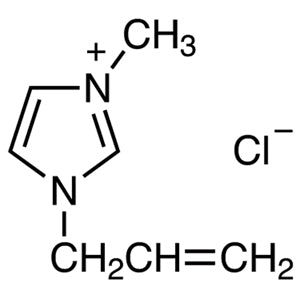
1-Allyl-3-methylimidazoliumChloride TCI A2084
Regular price From Rp 1.298.850,00Regular price