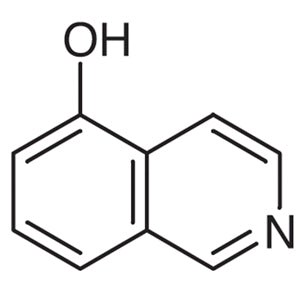
5-Hydroxyisoquinoline with CAS number 2439-04-5 is a heterocyclic building block built on an isoquinoline framework, a fused aromatic ring system containing a single nitrogen atom. The compound carries a hydroxyl group at the fifth position of the benzene ring, which combines the weakly basic character of the heterocyclic nitrogen with the weakly acidic character of the phenolic group within one molecule. This dual character makes the material a genuinely useful starting point for organic and medicinal chemistry researchers who are constructing compounds in which the isoquinoline skeleton serves as the core of biological activity.
The main reason this compound is selected lies in the presence of two complementary centres for functionalisation. The phenolic hydroxyl group can be alkylated, acylated, or converted into a triflate in preparation for transition-metal-catalysed cross-coupling reactions, while the ring nitrogen can act both as a coordination site and as a point for quaternisation. The isoquinoline framework itself is a motif that appears very frequently in natural alkaloids and across a wide range of drug candidates, which makes this compound an efficient point of departure. Reagent-grade quality from TCI ensures a consistent impurity profile from batch to batch.
In Indonesian laboratories, this building block is typically used in university and institutional research groups working on synthetic organic chemistry, natural product chemistry, and medicinal chemistry programmes. It is handled at the bench scale in multi-step synthesis, in postgraduate research projects, and in method development work where a reliable heterocyclic starting material is required. Its role is usually that of an early-stage intermediate that is elaborated further rather than used directly.
Related TCI products
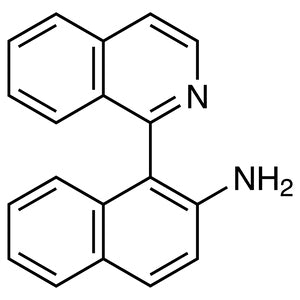
- TCI A2221 664302-70-9 1-(2-Amino-1-naphthyl)isoquinoline
- TCI I1246 6624-49-3 Isoquinoline-3-carboxylic Acid
- TCI I0942 80278-67-7 Isoquinoline-5-carboxaldehyde
- TCI I0671 486-73-7 Isoquinoline-1-carboxylic Acid
- TCI I0540 1532-72-5 Isoquinoline N-Oxide
- TCI I0509 203626-75-9 Isoquinoline-3-carboxylic Acid Monohydrate
- Medicinal chemistry scaffold construction: the isoquinoline core is a recurring motif in drug candidates, so this compound gives researchers a direct entry into biologically relevant chemical space.
- Cross-coupling precursor preparation: the phenolic hydroxyl can be converted into a triflate, providing a handle for transition-metal-catalysed cross-coupling reactions that extend the aromatic framework.
- O-alkylation and O-acylation chemistry: the phenolic group reacts readily under standard alkylation and acylation conditions, allowing systematic variation of substituents during structure-activity studies.
- Natural product and alkaloid synthesis: because the isoquinoline skeleton occurs widely in natural alkaloids, this material serves as an efficient starting point for total synthesis routes.
- Coordination and ligand chemistry: the ring nitrogen can act as a coordination site toward metal centres, making the compound useful in the preparation of nitrogen-donor ligand systems.
| Brand | TCI |
|---|---|
| CAS number | 2439-04-5 |
| Molecular formula | — |
| Purity | — |
| Category | Chemistry > Building Blocks > Heterocyclic Building Blocks |
| Pack sizes | available in standard TCI research pack sizes; please refer to the current catalogue listing |
| Physical form | — |
| Storage | store in a cool, dry place in a tightly closed container |
- Product code: H1259
Store this product in a tightly closed original container in a cool, dry, and well-ventilated area, away from direct sunlight, heat sources, and incompatible materials such as strong oxidising agents. As a phenolic compound, it should be protected from prolonged exposure to air and moisture to preserve its quality over time. Handle in a fume hood using standard personal protective equipment, including safety glasses, gloves, and a laboratory coat, and avoid generating or inhaling dust. Keep containers clearly labelled, close them promptly after use, and consult the manufacturer's safety data sheet before first use.
—
Produk Terkait
-
1-(2-Amino-1-naphthyl)isoquinoline TCI A2221
Regular price Rp 7.446.600,00Regular price -
Isoquinoline-3-carboxylicAcid TCI I1246
Regular price From Rp 2.809.800,00Regular price -
Isoquinoline-5-carboxaldehyde TCI I0942
Regular price From Rp 3.790.500,00Regular price -
Isoquinoline-1-carboxylicAcid TCI I0671
Regular price From Rp 1.590.750,00Regular price -
IsoquinolineN-Oxide TCI I0540
Regular price Rp 2.650.200,00Regular price -
Isoquinoline-3-carboxylicAcidMonohydrate TCI I0509
Regular price From Rp 2.068.500,00Regular price -
Isoquinoline-5-sulfonicAcid TCI I0470
Regular price From Rp 2.094.750,00Regular price -
Isoquinoline TCI I0182
Regular price From Rp 477.750,00Regular price