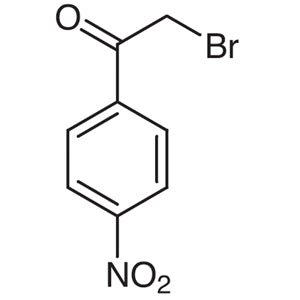
2'-Hydroxy-5'-nitroacetophenone is a substituted acetophenone that carries a hydroxyl group at the position ortho to the acetyl group and a nitro group at the position para to that hydroxyl. This arrangement makes it a highly valuable building block in the organic synthesis laboratory, because the ortho relationship between a phenolic hydroxyl and a ketone group is a classic starting point for constructing a wide range of heterocyclic systems. Many synthetic routes to chromones, flavones, benzofurans, and coumarins begin from a skeleton of exactly this kind, which is why the compound appears repeatedly in synthesis protocols that are already well established in the literature.
The property that makes this material a preferred choice is the intramolecular hydrogen bond between the hydroxyl group and the carbonyl, which influences both the reactivity and the solubility of the molecule. Added to this is the electron-withdrawing nitro group, which activates the aromatic ring toward certain reactions. The nitro group also functions as a convertible handle, since its reduction yields an aromatic amine that opens onward synthetic pathways toward amides, azo compounds, or fused heterocycles. Because the substitution pattern is already established from the outset, the chemist saves synthetic steps and avoids difficult separation problems later in a route.
In Indonesian laboratories, a building block of this type is typically drawn upon by university and institutional research groups working on organic synthesis and medicinal chemistry, where chromone and flavone scaffolds are frequent targets. It suits bench-scale preparative work in which a defined substitution pattern must be carried through several steps, as well as method development and the reproduction of published procedures where starting from a ready-made ortho-hydroxy ketone shortens the route considerably.
Related TCI products
- TCI B4556 70978-54-0 5'-Bromo-2'-hydroxy-3'-nitroacetophenone
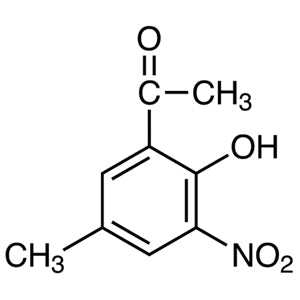
- TCI H1479 66108-30-3 2'-Hydroxy-5'-methyl-3'-nitroacetophenone
- TCI H0968 6322-56-1 4'-Hydroxy-3'-nitroacetophenone
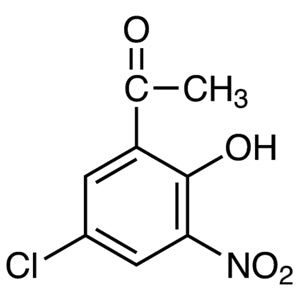
- TCI C2973 84942-40-5 5'-Chloro-2'-hydroxy-3'-nitroacetophenone
- TCI B3528 6851-99-6 2-Bromo-2'-nitroacetophenone
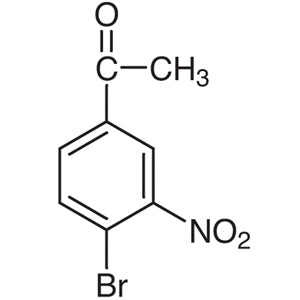
- TCI B3383 18640-58-9 4'-Bromo-3'-nitroacetophenone
- Chromone and flavone synthesis — the ortho-hydroxy ketone motif is the classical entry point to these scaffolds, letting researchers follow established literature routes without first having to install the substitution pattern themselves.
- Benzofuran construction — the phenolic hydroxyl adjacent to the acetyl group provides the oxygen and the carbon framework needed for ring closure, making this compound a direct precursor in well-documented cyclization protocols.
- Coumarin preparation — the same ortho relationship between the phenol and the ketone supports the condensation chemistry that builds the coumarin ring system, a target class widely pursued in academic synthesis work.
- Aromatic amine intermediates — reduction of the nitro group delivers an aniline-type functionality on an already functionalized ring, giving access to amides, azo compounds, and fused heterocyclic products in subsequent steps.
- Multi-step medicinal chemistry routes — because the hydroxyl and nitro substituents are positioned from the start, the compound saves synthetic steps and avoids the troublesome isomer separations that late-stage functionalization often creates.
| Brand | TCI |
|---|---|
| CAS number | 1450-76-6 |
| Molecular formula | — |
| Purity | — |
| Category | Chemistry > Building Blocks > Non-Heterocyclic Building Blocks |
| Pack sizes | available in the catalogue pack sizes offered by TCI for this product code |
| Physical form | — |
| Storage | store according to the conditions stated on the manufacturer's label and safety data sheet |
- Product code: H1378
Store the container tightly closed in a cool, dry, and well-ventilated place, away from heat sources, direct sunlight, and incompatible materials, following the conditions printed on the manufacturer's label and safety data sheet. Keep the material in its original supplier container, or in a clean, chemically compatible, well-sealed glass container that is clearly labelled with the compound name and CAS number. Handle the substance in a fume hood using standard personal protective equipment, including safety glasses, gloves, and a laboratory coat, and avoid generating dust, inhaling vapours, or allowing contact with skin and eyes. As with any nitroaromatic compound, keep it away from strong reducing agents and sources of ignition, and consult the safety data sheet before use and before disposal.
—
Produk Terkait
-
5'-Bromo-2'-hydroxy-3'-nitroacetophenone TCI B4556
Regular price From Rp 743.400,00Regular price -
2'-Hydroxy-5'-methyl-3'-nitroacetophenone TCI H1479
Regular price From Rp 1.087.800,00Regular price -
4'-Hydroxy-3'-nitroacetophenone TCI H0968
Regular price Rp 928.200,00Regular price -
5'-Chloro-2'-hydroxy-3'-nitroacetophenone TCI C2973
Regular price From Rp 717.150,00Regular price -
2-Bromo-2'-nitroacetophenone TCI B3528
Regular price From Rp 2.545.200,00Regular price -
4'-Bromo-3'-nitroacetophenone TCI B3383
Regular price From Rp 664.650,00Regular price -
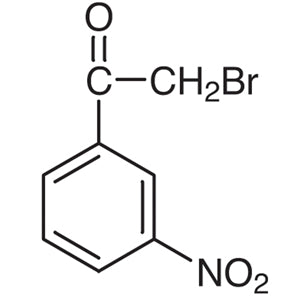
2-Bromo-3'-nitroacetophenone TCI B2855
Regular price From Rp 610.050,00Regular price -
2-Bromo-4'-nitroacetophenone TCI N0473
Regular price From Rp 584.850,00Regular price