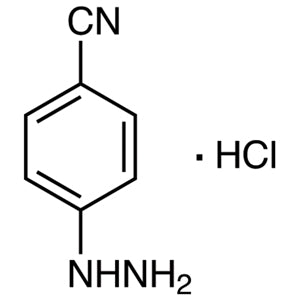
4-Hydrazinobenzonitrile Hydrochloride is the hydrochloride salt of an arylhydrazine that carries a nitrile group at the para position of the benzene ring. The salt form is chosen deliberately: free arylhydrazines are relatively prone to oxidation, whereas the hydrochloride form is considerably more stable, easier to weigh accurately, and safer to store over the long timeframes typical of a research programme. In the organic synthesis laboratory this compound serves as a key building block for constructing nitrogen-containing heterocyclic rings, particularly when the chemist needs the nitrile group to remain intact as a handle for later derivatisation.
The property that drives its widespread use is its structural bifunctionality. The hydrazine group supplies two nucleophilic nitrogen atoms that readily condense with carbonyl compounds, diketones, and ester derivatives, providing a direct entry into pyrazoles, indoles via the Fischer route, triazoles, and a range of other heterocyclic frameworks. The nitrile group, meanwhile, is electron-withdrawing, modulating the reactivity of the ring while remaining available for subsequent conversion into amides, carboxylic acids, amines, or tetrazoles. The combination of these two groups means that a single starting material can lead to many different target scaffolds.
In Indonesian laboratories, this reagent is typically found in university organic synthesis and medicinal chemistry groups, in pharmaceutical research and development units, and in institutional laboratories preparing heterocyclic intermediates. It is generally used at small to moderate scale for method development, route scouting, and the preparation of compound libraries, where a reliably stable and accurately weighable building block matters more than bulk quantity. Its stability in salt form suits the storage conditions and project timelines common in such settings.
- Pyrazole synthesis: the two nucleophilic hydrazine nitrogens condense cleanly with 1,3-diketones and related carbonyl partners to close the five-membered ring in a single, predictable step.
- Fischer indole synthesis: the arylhydrazine functionality is precisely the substrate this classical route requires, and the para-nitrile survives the reaction to give substituted indoles bearing a further derivatisation handle.
- Triazole and fused heterocycle construction: the hydrazine group reacts with esters, orthoesters, and other electrophilic carbon sources to build nitrogen-rich rings for screening collections.
- Medicinal chemistry intermediate preparation: the retained nitrile can later be converted into amides, carboxylic acids, amines, or tetrazoles, letting one scaffold branch into several analogue series.
- Nitrile transformation studies: chemists use this compound to examine hydrolysis, reduction, and cycloaddition chemistry of an aromatic nitrile while a heterocycle-forming group is already present on the ring.
| Brand | TCI |
|---|---|
| CAS number | 2863-98-1 |
| Molecular formula | — |
| Purity | — |
| Category | Chemistry > Building Blocks > Non-Heterocyclic Building Blocks |
| Pack sizes | available in the research-scale pack sizes listed for this catalogue item |
| Physical form | — |
| Storage | store as indicated on the manufacturer's label and accompanying documentation |
- Catalogue Number: H1425
Store the container tightly closed in a cool, dry, well-ventilated area away from light, moisture, oxidising agents, and sources of heat or ignition, following the conditions stated on the manufacturer's label. Keep the material in its original supplier packaging or in a tightly sealed, chemically compatible amber glass container, and reseal promptly after each use to limit exposure to air and humidity. Handle in a fume hood using safety glasses, chemically resistant gloves, and a laboratory coat. Arylhydrazines should be treated as hazardous, so avoid inhalation of dust and any contact with skin or eyes, weigh the solid carefully to minimise dispersion, and consult the Safety Data Sheet before use and before disposal. Label all working solutions clearly and segregate waste for appropriate chemical disposal.
—
Produk Terkait
-
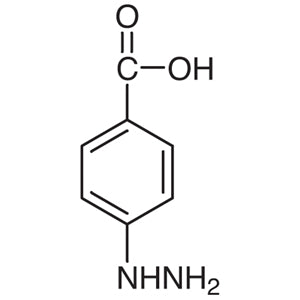
4-HydrazinobenzoicAcid TCI H0800
Regular price Rp 2.094.750,00Regular price -
3-HydrazinobenzoicAcid TCI H0799
Regular price From Rp 1.193.850,00Regular price -
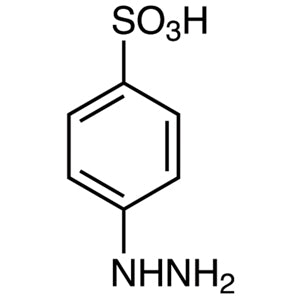
4-HydrazinobenzenesulfonicAcid TCI H1662
Regular price From Rp 1.008.000,00Regular price -
3-Aminobenzonitrile TCI A1203
Regular price From Rp 1.060.500,00Regular price -
2-Aminobenzonitrile TCI A0861
Regular price From Rp 1.060.500,00Regular price -
3-Aminobenzonitrile TCI A0860
Regular price From Rp 1.060.500,00Regular price -
4-Aminobenzonitrile TCI A0695
Regular price From Rp 1.353.450,00Regular price -
3,4-Diaminobenzonitrile TCI D5194
Regular price From Rp 1.060.500,00Regular price