

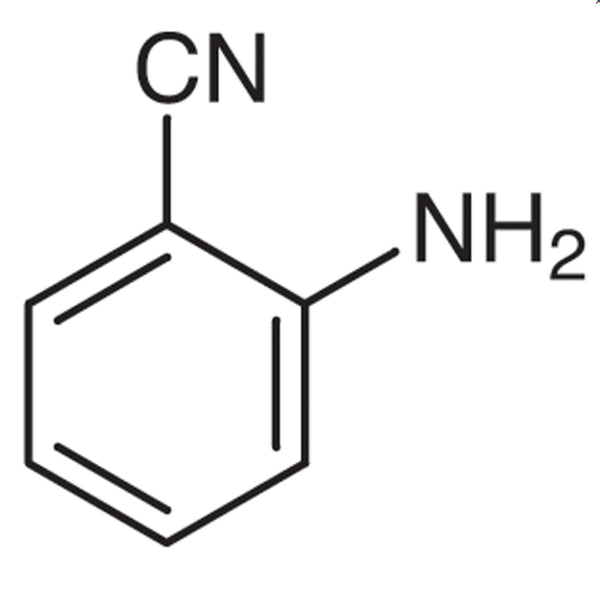
2-Aminobenzonitrile is a chemical compound widely used as a building block in the synthesis of complex organic molecules. It is a versatile reagent that plays a key role in various laboratory processes, particularly in organic chemistry. Its aromatic structure, combined with the presence of an amine group and a nitrile group, makes it highly reactive and suitable for a range of chemical reactions, including nucleophilic substitution, coupling reactions, and functional group transformations. This compound is commonly found in both academic and industrial research settings, where it serves as a foundation for the development of new compounds and materials.
The properties of 2-Aminobenzonitrile make it a preferred choice for laboratory use. It is polar in nature, which facilitates its solubility in polar solvents and enables efficient crystallization and purification processes. Its relatively high melting point allows for stable handling under standard laboratory conditions. Additionally, it is considered non-toxic at low doses, making it a safe option for routine use. These characteristics contribute to its popularity among chemists and researchers who require reliable and consistent reagents for their experiments.
In Indonesian laboratories, 2-Aminobenzonitrile is widely used in the synthesis of pharmaceuticals, industrial chemicals, and functional compounds. Its role in constructing complex molecular structures is particularly important in the development of heterocyclic and aromatic compounds. Due to its stability and reactivity, it is a valuable tool for researchers working in diverse fields, including medicinal chemistry and materials science.
- Organic synthesis is a primary application where 2-Aminobenzonitrile is used to build complex molecular structures, especially in the development of heterocyclic compounds.
- Pharmaceutical research benefits from this compound due to its ability to participate in nucleophilic and coupling reactions, aiding in the synthesis of drug molecules.
- Industrial chemical production utilizes 2-Aminobenzonitrile for the creation of functional compounds and intermediates required in various manufacturing processes.
- Materials science applications rely on this compound for the synthesis of aromatic and heterocyclic compounds used in polymer and composite development.
- Analytical chemistry uses 2-Aminobenzonitrile as a standard reference material for spectroscopic and chromatographic analyses due to its well-defined chemical properties.
| Brand | TCI |
|---|---|
| CAS number | 1885-29-6 |
| Molecular formula | — |
| Purity | — |
| Category | Chemistry > Building Blocks > Non-Heterocyclic Building Blocks |
| Pack sizes | Available in various quantities as per supplier specifications |
| Physical form | Solid |
| Storage | Store in a cool, dry place away from moisture and direct sunlight |
2-Aminobenzonitrile should be stored in a cool, dry environment to maintain its chemical stability. It is recommended to keep it in a sealed container to prevent exposure to moisture and air. While it is considered non-toxic at low doses, standard laboratory safety practices should still be followed, including the use of personal protective equipment when handling. The compound is stable under normal laboratory conditions and does not require special refrigeration. It is important to ensure that it is stored separately from incompatible substances to avoid any potential chemical interactions. Proper labeling and storage practices help ensure the safety and integrity of the compound during handling and use.
—
Produk Terkait
-
3-Aminobenzonitrile TCI A1203
Regular price Rp 1.113.000,00Regular priceRp 793.800,00Sale price Rp 1.113.000,00 -
3-Aminobenzonitrile TCI A0860
Regular price Rp 1.113.000,00Regular priceRp 793.800,00Sale price Rp 1.113.000,00 -
4-Aminobenzonitrile TCI A0695
Regular price Rp 1.405.950,00Regular priceRp 998.550,00Sale price Rp 1.405.950,00 -
3,4-Diaminobenzonitrile TCI D5194
Regular price Rp 1.113.000,00Regular priceRp 793.800,00Sale price Rp 1.113.000,00 -
2-Aminobenzotrifluoride TCI A0433
Regular price Rp 823.200,00Regular priceRp 575.400,00Sale price Rp 823.200,00 -
3,4-Diaminobenzohydrazide TCI D4551
Regular price Rp 848.400,00Regular priceRp 609.000,00Sale price Rp 848.400,00 -
3,4-Diaminobenzophenone TCI D1950
Regular price Rp 2.837.100,00Regular priceRp 1.983.450,00Sale price Rp 2.837.100,00 -
2-AminobenzylCyanide TCI A2997
Regular price Rp 557.550,00Regular priceRp 405.300,00Sale price Rp 557.550,00


