

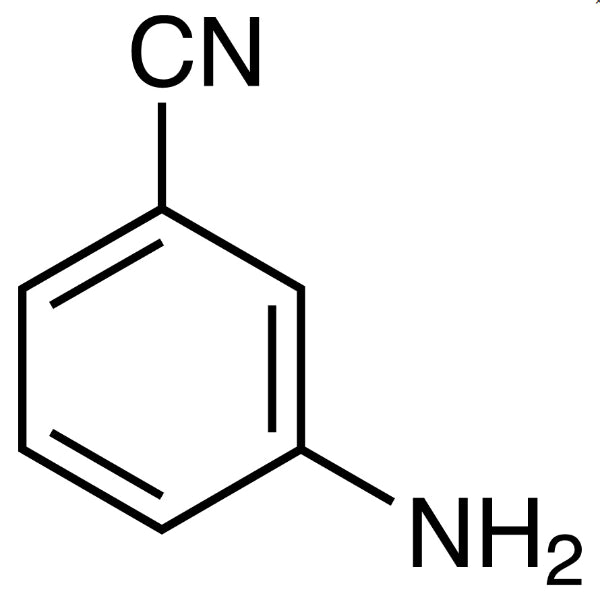
3-Aminobenzonitrile is a chemical compound widely used as a foundational building block in the synthesis of complex organic molecules. It plays a crucial role in laboratory settings by enabling the formation of nitrogen-carbon bonds and facilitating substitution reactions. Its versatility makes it an essential component in various synthetic pathways, allowing chemists to construct compounds with specific structural features. This compound is particularly valuable in organic chemistry due to its ability to participate in multiple reaction types, including nitrilation and functional group transformations.
The chemical properties of 3-Aminobenzonitrile, including its stability and reactivity, make it a preferred choice for researchers. Its molecular structure consists of a benzene ring with an amino group and a nitrile group, which contributes to its reactivity in chemical reactions. This combination of functional groups allows it to interact effectively with other reactive species, making it suitable for a wide range of synthetic applications. The controlled chemical behavior of this compound ensures that it can be manipulated under various laboratory conditions without compromising its integrity.
In Indonesian laboratories, 3-Aminobenzonitrile is commonly used in chemical, pharmaceutical, and materials research. Its availability and reliability make it a go-to material for scientists working on drug development, polymer synthesis, and other advanced chemical processes. The compound’s role in creating complex structures underscores its importance in both academic and industrial research settings.
- Organic synthesis: 3-Aminobenzonitrile is ideal for creating complex organic molecules due to its reactive functional groups.
- Pharmaceutical research: It is used in the development of new drugs as a building block for various medicinal compounds.
- Polymer chemistry: The compound contributes to the formation of polymers through its ability to undergo substitution reactions.
- Functional group modification: Its nitrile and amino groups allow for versatile chemical transformations in synthetic pathways.
- Materials science: It is employed in the synthesis of advanced materials due to its structural adaptability and reactivity.
| Brand | TCI |
|---|---|
| CAS number | 2237-30-1 |
| Molecular formula | — |
| Purity | — |
| Category | Chemistry > Building Blocks > Non-Heterocyclic Building Blocks |
| Pack sizes | Available in various quantities as per standard laboratory supply |
| Physical form | Solid |
| Storage | Store in a cool, dry place away from moisture and direct sunlight |
3-Aminobenzonitrile should be stored in a cool, dry environment to maintain its chemical integrity. It is recommended to keep it in a sealed container to prevent exposure to moisture and air. The compound should be stored away from direct sunlight and sources of heat to avoid degradation. In laboratory settings, it is important to handle the material with appropriate personal protective equipment, such as gloves and safety goggles. Due to its reactivity, it should be kept in a well-ventilated area to minimize any potential hazards. Proper storage ensures that the compound remains stable and suitable for use in various chemical applications.
—
Produk Terkait
-
2-Aminobenzonitrile TCI A0861
Regular price Rp 1.113.000,00Regular priceRp 793.800,00Sale price Rp 1.113.000,00 -
3-Aminobenzonitrile TCI A0860
Regular price Rp 1.113.000,00Regular priceRp 793.800,00Sale price Rp 1.113.000,00 -
4-Aminobenzonitrile TCI A0695
Regular price Rp 1.405.950,00Regular priceRp 998.550,00Sale price Rp 1.405.950,00 -
3,4-Diaminobenzonitrile TCI D5194
Regular price Rp 1.113.000,00Regular priceRp 793.800,00Sale price Rp 1.113.000,00 -
2-Aminobenzotrifluoride TCI A0433
Regular price Rp 823.200,00Regular priceRp 575.400,00Sale price Rp 823.200,00 -
3,4-Diaminobenzohydrazide TCI D4551
Regular price Rp 848.400,00Regular priceRp 609.000,00Sale price Rp 848.400,00 -
3,4-Diaminobenzophenone TCI D1950
Regular price Rp 2.837.100,00Regular priceRp 1.983.450,00Sale price Rp 2.837.100,00 -
2-AminobenzylCyanide TCI A2997
Regular price Rp 557.550,00Regular priceRp 405.300,00Sale price Rp 557.550,00


