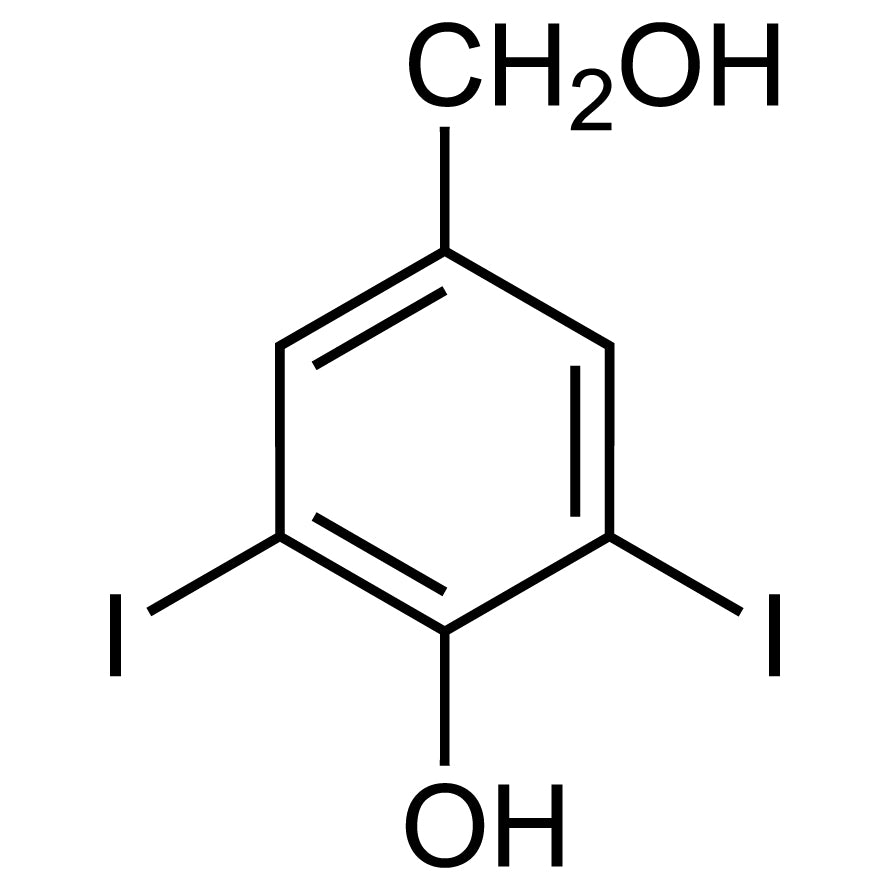
TCI H1958 4-(Hydroxymethyl)-2,6-diiodophenol is a doubly iodinated phenol carrying a hydroxymethyl group at the para position. The diiodophenol framework, in which two iodine atoms flank the phenolic hydroxyl group, is a well-recognised motif in the chemistry of tyrosine derivatives and thyroid hormones, which makes this compound a valuable intermediate for medicinal chemistry laboratories, biochemical research groups, and applied organic synthesis. The presence of a benzylic alcohol adds a further point of functionalisation that is straightforward to elaborate in subsequent steps.
The property that makes this material sought after is the strong influence exerted by the two iodine atoms on the aromatic ring. These bulky, inductively electron-withdrawing substituents raise the acidity of the phenol group appreciably compared with plain phenol, while simultaneously shielding both ortho positions from further electrophilic attack. The carbon-iodine bonds also serve as ready-made handles for palladium- and copper-catalysed cross-coupling reactions, allowing the ring to be developed into more elaborate structures. The hydroxymethyl group, for its part, is readily oxidised to an aldehyde or acid, esterified, or activated as a leaving group for nucleophilic substitution.
In Indonesian laboratories this building block is typically used in research and development settings rather than in routine analysis. University chemistry departments, pharmaceutical research units, and institutional research centres draw on compounds of this type when preparing tyrosine-related analogues, developing iodinated reference materials, or assembling substituted aromatic scaffolds. Because it is an intermediate rather than a finished reagent, it is generally ordered in modest quantities matched to a specific synthetic route and consumed over the course of a defined project.
TCI brochures (PDF)
- Iodinated Phenol/Benzoic Acid/Benzaldehyde Building Blocks 2024-11-15 · p. 1
- Medicinal chemistry intermediate synthesis: the diiodophenol core mirrors motifs found in thyroid hormone chemistry, giving researchers a direct entry point into tyrosine-related analogue preparation without building the halogenation pattern from scratch.
- Palladium-catalysed cross-coupling chemistry: the two carbon-iodine bonds are among the most reactive aryl halide handles available, allowing Suzuki, Sonogashira, or Heck couplings to extend the aromatic ring selectively.
- Copper-mediated coupling and etherification work: iodoarenes respond well to copper catalysis, so this substrate supports Ullmann-type carbon-heteroatom bond formation where less reactive halides would fail.
- Selective oxidation route development: the benzylic hydroxymethyl group can be converted cleanly to the corresponding aldehyde or carboxylic acid, providing a convenient way to access related derivatives from one starting material.
- Protecting group and derivatisation studies: the phenolic hydroxyl, benzylic alcohol, and iodine substituents offer three orthogonal reaction sites for teaching and investigating chemoselective transformations in substituted aromatic systems.
| Brand | TCI (Tokyo Chemical Industry) |
|---|---|
| CAS number | 37987-26-1 |
| Molecular formula | — |
| Purity | — |
| Category | Chemistry > Building Blocks > Non-Heterocyclic Building Blocks |
| Pack sizes | available in standard TCI research-scale packaging; please confirm the current pack size options when ordering |
| Physical form | — |
| Storage | store according to the conditions stated on the manufacturer's label and safety data sheet |
- Product code: H1958
- Chemical name: 4-(Hydroxymethyl)-2,6-diiodophenol
Store the container tightly closed in a cool, dry, well-ventilated area away from direct sunlight, and follow any specific temperature or atmosphere requirements printed on the manufacturer's label and safety data sheet. Iodinated aromatic compounds are generally best protected from prolonged light exposure, so keep the material in its original amber or opaque container wherever possible. Handle the solid in a fume hood using gloves, safety glasses, and a laboratory coat, and avoid generating dust when weighing out portions. Keep the compound separate from strong oxidising agents and strong bases. Allow refrigerated material to reach room temperature before opening to prevent moisture condensation, and dispose of residues and contaminated consumables through the laboratory's chemical waste stream in accordance with local regulations.
—
Produk Terkait
-
4-Iodophenol[forBiochemicalResearch] TCI I0840
Regular price From Rp 848.400,00Regular price -
4-Bromo-2-iodophenol TCI B4957
Regular price From Rp 2.491.650,00Regular price -
3-Iodophenol TCI I0495
Regular price From Rp 1.776.600,00Regular price -
2-Iodophenol TCI I0460
Regular price From Rp 1.378.650,00Regular price -
4-Iodophenol TCI I0311
Regular price From Rp 1.298.850,00Regular price -
4-Chloro-2-iodophenol TCI C3172
Regular price Rp 1.856.400,00Regular price -
2,4,6-Triiodophenol TCI T0452
Regular price From Rp 2.782.500,00Regular price -
2-(Bromomethyl)-2-(hydroxymethyl)-1,3-propanediol TCI B4057
Regular price From Rp 1.644.300,00Regular price
![540-38-5 4-Iodophenol [for Biochemical Research] - AMI Scientific](http://amiscientific.com/cdn/shop/files/TCI2510I0840.jpg?v=1769180954&width=533)