

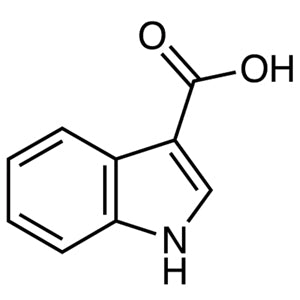
Indole-3-carboxylic acid is a chemical compound widely used in synthetic reactions to produce heterocyclic compounds. It plays a crucial role in laboratory settings where the synthesis of complex organic molecules is required. As a member of the indole family, it offers a versatile structural framework that supports a wide range of chemical modifications. This compound is commonly utilized in research fields such as pharmacology and organic chemistry due to its ability to participate in various reaction mechanisms. Its chemical structure allows for the development of bioactive compounds, making it an essential reagent in synthetic chemistry.
The physical and chemical properties of indole-3-carboxylic acid make it a preferred choice for laboratory applications. It has a high density and is soluble in organic solvents like ethyl acetate and acetone, which facilitates its use in reactions requiring high solubility. Its stability under certain conditions ensures reliable performance in controlled environments. However, it is sensitive to moisture and air exposure, requiring careful handling and storage. These characteristics make it suitable for use in both academic and industrial research settings.
In Indonesian laboratories, indole-3-carboxylic acid is frequently employed in chemical, pharmaceutical, and biochemical research. It is a key component in the development of new compounds with potential medical applications. Many research institutions and universities in Indonesia rely on this compound for advancing their studies in drug discovery and synthetic chemistry. Its availability and chemical versatility ensure its continued use in various scientific investigations.
- Used in pharmaceutical research to develop new drugs with bioactive properties due to its structural versatility and reactivity.
- Applied in organic synthesis to create complex heterocyclic compounds that are essential in medicinal chemistry.
- Utilized in biochemical studies to investigate the effects of indole derivatives on biological systems and cellular processes.
- Employed in academic research to explore the chemical behavior and reactivity of indole-based compounds.
- Integrated into drug discovery programs to design compounds with targeted therapeutic effects and improved pharmacological profiles.
| Brand | TCI |
|---|---|
| CAS number | 771-50-6 |
| Molecular formula | — |
| Purity | — |
| Category | Chemistry > Building Blocks > Heterocyclic Building Blocks |
| Pack sizes | Available in various quantities as per supplier specifications |
| Physical form | Solid |
| Storage | Store in a cool, dry place away from moisture and air exposure |
Indole-3-carboxylic acid should be stored in a cool, dry environment to prevent degradation due to moisture and air exposure. It is recommended to use airtight containers made of glass or high-density polyethylene to maintain its chemical integrity. Laboratory personnel should handle the compound with care, using appropriate personal protective equipment such as gloves and safety goggles. Avoid direct contact with skin and inhalation of vapors. Ensure proper ventilation in the workspace to minimize exposure. Regular monitoring of storage conditions is essential to maintain the compound’s stability and effectiveness in research applications.
—
Produk Terkait
-
5-Nitro-1H-indole-2-carboxylicAcid TCI N1036
Regular price Rp 4.133.850,00Regular price -
Indole-4-carboxylicAcid TCI I0722
Regular price From Rp 955.500,00Regular price -
Indole-6-carboxylicAcid TCI I0663
Regular price From Rp 1.115.100,00Regular price -
Indole-2-carboxylicAcid TCI I0332
Regular price From Rp 823.200,00Regular price -
Indole-5-carboxylicAcid TCI I0029
Regular price From Rp 743.400,00Regular price -
Indole-6-carboxaldehyde TCI I0743
Regular price From Rp 2.359.350,00Regular price -
Indole-2-carboxaldehyde TCI I0852
Regular price From Rp 3.949.050,00Regular price -
AcidMonohydrate TCI T4293
Regular price From Rp 1.696.800,00Regular price


![1,1,2-Trimethyl-1H-benzo[e]indole-7-sulfonic Acid Monohydrate - AMI Scientific](http://amiscientific.com/cdn/shop/files/TCI2510T4293.jpg?v=1767145027&width=533)