

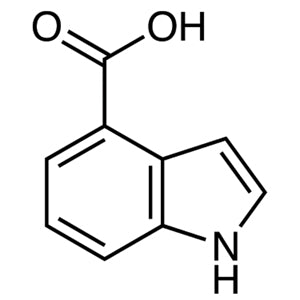
Indole-4-carboxylic acid is a chemical compound belonging to the heterocyclic category, characterized by its indole core with a carboxylic acid group at the 4-position. This compound plays a crucial role in laboratory settings, particularly in organic and pharmaceutical research, where it serves as a fundamental building block for the synthesis of complex molecules. Its unique structure enables it to participate in various chemical reactions, making it an essential tool for chemists seeking to develop new compounds with specific biological activities.
The chemical properties of indole-4-carboxylic acid make it a preferred choice for researchers. It exhibits stability under certain conditions while remaining highly reactive in specific chemical environments. This dual nature allows it to interact effectively with a wide range of functional groups, such as amines, hydroxyls, and halogens. Its ability to form new bonds and undergo substitution reactions enhances its versatility in synthetic chemistry. Additionally, its melting point and solubility characteristics ensure compatibility with a variety of experimental conditions.
In Indonesian laboratories, indole-4-carboxylic acid is widely used in organic chemistry research. It is a key component in the development of bioactive compounds and pharmaceuticals, supporting both academic and industrial research initiatives. Its availability through reliable suppliers like AMI Scientific ensures that researchers have access to high-quality materials for their experiments, contributing to the advancement of scientific knowledge in the region.
- Organic synthesis: Indole-4-carboxylic acid is widely used in the synthesis of complex organic molecules due to its reactivity and structural versatility.
- Pharmaceutical research: It serves as a building block for the development of bioactive compounds and drug candidates in pharmaceutical laboratories.
- Heterocyclic chemistry: Its indole core makes it ideal for studies involving heterocyclic compounds and their derivatives.
- Bioconjugation studies: The compound’s ability to react with functional groups enables its use in bioconjugation and molecular modification experiments.
- Analytical chemistry: It is used as a standard or reagent in analytical procedures requiring precise chemical reactions and compound identification.
| Brand | TCI |
|---|---|
| CAS number | 2124-55-2 |
| Molecular formula | — |
| Purity | — |
| Category | Chemistry > Building Blocks > Heterocyclic Building Blocks |
| Pack sizes | Available in various quantities as per supplier specifications |
| Physical form | Solid |
| Storage | Store in a cool, dry place away from moisture and direct sunlight |
Indole-4-carboxylic acid should be stored in a cool, dry environment to maintain its chemical stability. It is recommended to keep it in a tightly sealed container to prevent exposure to moisture and air. Due to its reactivity, it should be handled in a well-ventilated area, ideally within a fume hood, to minimize inhalation risks. Avoid contact with incompatible substances such as strong acids or bases. Proper personal protective equipment, including gloves and safety goggles, should be worn during handling. The compound is generally stable under standard laboratory conditions but should be stored away from heat sources to ensure long-term integrity.
—
Produk Terkait
-
5-Nitro-1H-indole-2-carboxylicAcid TCI N1036
Regular price Rp 4.186.350,00Regular priceRp 2.943.150,00Sale price Rp 4.186.350,00 -
Indole-6-carboxylicAcid TCI I0663
Regular price Rp 1.167.600,00Regular priceRp 831.600,00Sale price Rp 1.167.600,00 -
Indole-2-carboxylicAcid TCI I0332
Regular price Rp 875.700,00Regular priceRp 627.900,00Sale price Rp 875.700,00 -
Indole-5-carboxylicAcid TCI I0029
Regular price Rp 795.900,00Regular priceRp 572.250,00Sale price Rp 795.900,00 -
Indole-3-carboxylicAcid TCI I0028
Regular price Rp 875.700,00Regular priceRp 627.900,00Sale price Rp 875.700,00 -
Indole-6-carboxaldehyde TCI I0743
Regular price Rp 2.411.850,00Regular priceRp 1.702.050,00Sale price Rp 2.411.850,00 -
Indole-2-carboxaldehyde TCI I0852
Regular price Rp 4.001.550,00Regular priceRp 2.814.000,00Sale price Rp 4.001.550,00 -
AcidMonohydrate TCI T4293
Regular price Rp 1.749.300,00Regular priceRp 1.239.000,00Sale price Rp 1.749.300,00


![1,1,2-Trimethyl-1H-benzo[e]indole-7-sulfonic Acid Monohydrate - AMI Scientific](http://amiscientific.com/cdn/shop/files/TCI2510T4293.jpg?v=1767145027&width=533)