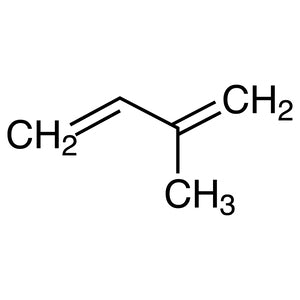
Isoprene, with CAS number 78-79-5, is a widely used chemical compound in laboratory settings. It serves as a fundamental building block in the synthesis of complex organic compounds. Its simple molecular structure plays a crucial role in the formation of polymers and their derivatives. In the laboratory, isoprene is commonly used as a raw material for the synthesis of rubber, polymers, and aromatic compounds. Its chemical properties make it versatile for various reactions, though it requires stabilization to maintain its integrity in different conditions.
This compound is known for its chemical stability, but it can react with acids, bases, and oxidizing agents. To enhance its resistance to oxidation and degradation, it has been stabilized with tert-butylcatechol (TBC). This stabilization ensures that the compound remains effective and safe for use in laboratory environments. The addition of TBC makes it particularly suitable for applications that require long-term stability and consistent performance.
In Indonesian laboratories, isoprene is a key component in chemical research, especially in the fields of organic synthesis, polymer development, and studies involving aliphatic compounds. Its availability and quality make it a preferred choice for researchers and chemists. Its role in various chemical processes highlights its importance in both academic and industrial research settings.
TCI brochures (PDF)
- Sodium Dispersion Handleable Safely in Organic Synthesis 2025-01-09 · p. 1
- 1,3-Butadiene Derivatives 2025-08-07 · p. 1
- Terpenes 2025-09-22 · p. 3
- Biomaterials Research Reagents 2025-02-19 · p. 14
- Monomers 2025-05-28 · p. 12
Related TCI products
- TCI A0045 108-05-4 Vinyl Acetate Monomer (stabilized with HQ)
- TCI V0076 22408-41-9 2-Vinyloxytetrahydropyran
- TCI U0057 5299-57-0 Vinyl 10-Undecenoate (stabilized with MEHQ)
- TCI B0765 123-20-6 Vinyl Butyrate (stabilized with MEHQ)
- TCI E0404 94-04-2 Vinyl 2-Ethylhexanoate (stabilized with MEHQ)
- TCI C0898 3050-69-9 Vinyl Hexanoate (stabilized with MEHQ)
- Organic synthesis applications benefit from isoprene's role as a foundational building block for creating complex molecules.
- Polymer development relies on isoprene as a precursor for producing synthetic rubbers and other polymer-based materials.
- Aromatic compound research utilizes isoprene in reactions that form aromatic structures and functional groups.
- Aliphatic compound studies use isoprene to explore reactions and properties of non-heterocyclic compounds.
- Chemical reaction testing involves isoprene to evaluate reactivity with various reagents and conditions.
From the TCI brochure
- Reagent in the NaTMP synthesis scheme
| Brand | TCI |
|---|---|
| CAS number | 78-79-5 |
| Molecular formula | — |
| Purity | — |
| Category | Chemistry > Building Blocks > Non-Heterocyclic Building Blocks |
| Pack sizes | Available in standard laboratory quantities |
| Physical form | Liquid |
| Storage | Store in a cool, dark place away from heat and direct sunlight |
Isoprene should be stored in a cool, dark location, away from heat and direct sunlight to maintain its stability. It is recommended to use sealed containers made of materials that are chemically inert to prevent contamination and degradation. Proper ventilation is essential when handling this compound to minimize exposure to vapors. Laboratory personnel should wear appropriate personal protective equipment, including gloves and safety goggles, when working with isoprene. The compound should be kept in a well-ventilated area, and storage should be away from incompatible materials such as strong oxidizers. Regular monitoring of storage conditions ensures the compound remains safe and effective for use in research settings.
References cited in the TCI brochure
- Sobi Asako. Lithium‐Free Synthesis of Sodium 2,2,6,6‐Tetramethylpiperidide and Its Synthetic Applications Advanced Synthesis & Catalysis, 2019. doi:10.1002/adsc.201900215
Product Categories
Produk Terkait
-
VinylAcetateMonomer(stabilizedwithHQ) TCI A0045
Regular price Rp 477.750,00Regular priceRp 333.900,00Sale price Rp 477.750,00 -
2-Vinyloxytetrahydropyran TCI V0076
Regular price Rp 7.446.600,00Regular priceRp 5.222.700,00Sale price Rp 7.446.600,00 -
Vinyl10-Undecenoate(stabilizedwithMEHQ) TCI U0057
Regular price Rp 2.041.200,00Regular priceRp 1.442.700,00Sale price Rp 2.041.200,00 -
VinylButyrate(stabilizedwithMEHQ) TCI B0765
Regular price From Rp 505.050,00Regular priceRp 352.800,00Sale price From Rp 505.050,00 -
Vinyl2-Ethylhexanoate(stabilizedwithMEHQ) TCI E0404
Regular price Rp 1.220.100,00Regular priceRp 868.350,00Sale price Rp 1.220.100,00 -
VinylHexanoate(stabilizedwithMEHQ) TCI C0898
Regular price From Rp 1.272.600,00Regular priceRp 905.100,00Sale price From Rp 1.272.600,00 -
VinylCrotonate(stabilizedwithMEHQ) TCI C0897
Regular price From Rp 1.033.200,00Regular priceRp 738.150,00Sale price From Rp 1.033.200,00 -
VinylsulfonicAcid TCI V0134
Regular price From Rp 2.016.000,00Regular priceRp 1.409.100,00Sale price From Rp 2.016.000,00